
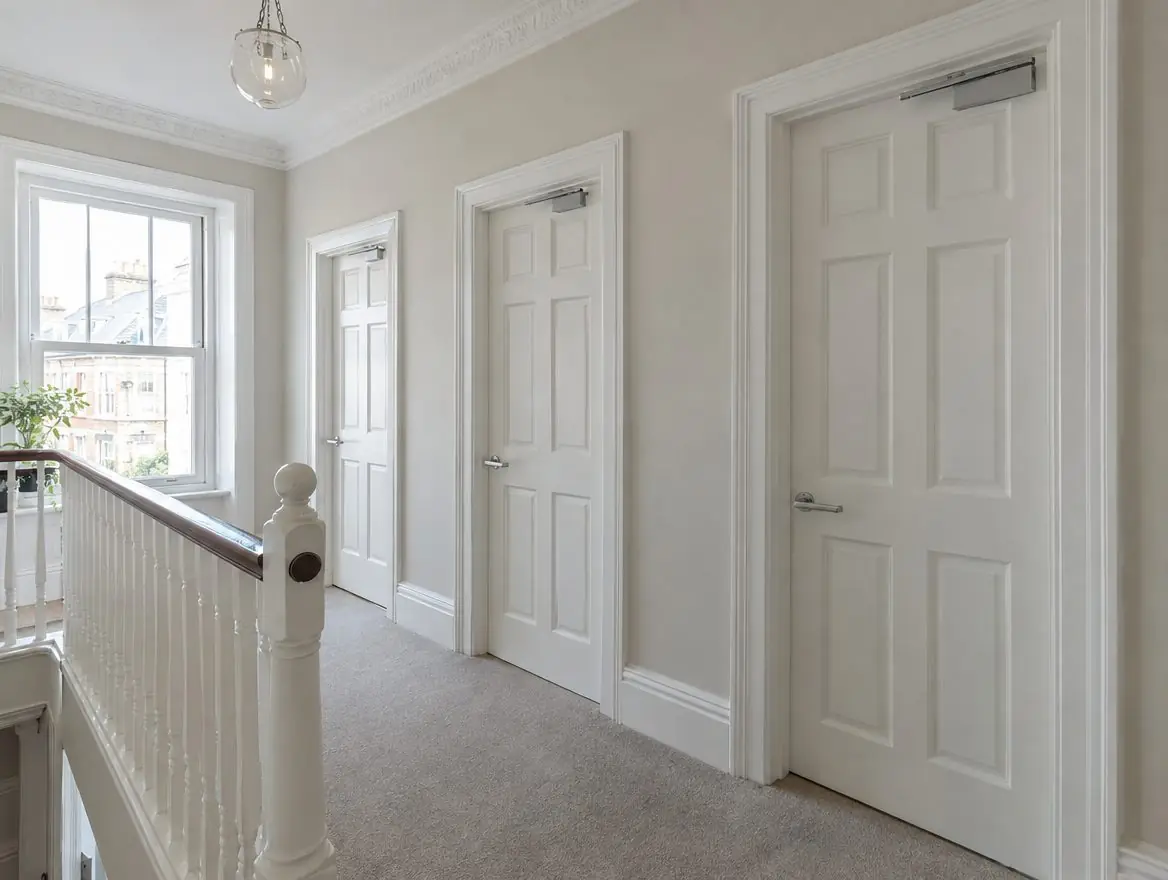
Fire doors for HMO landlords are the fire-resisting, self-closing doors that protect the shared escape route in a house in multiple occupation, typically to each letting room and the kitchen. Councils commonly assess them against LACORS fire safety guidance, so the standard required depends on the number of storeys, the occupants and the layout.
Which doors in an HMO normally need to be fire doors?
In a typical shared house, the escape route is the hall, stair and landing every tenant uses to get out. Doors opening onto that route are where fire protection is concentrated: each letting room, the shared kitchen, and any cupboard housing the meter or boiler. In larger or three-storey HMOs, councils commonly expect FD30 fire doors with smoke seals and self-closers on these openings. In smaller two-storey houses with a lower risk profile, the guidance may allow existing solid doors that are sound and close-fitting.
The HMO fire door requirements guide works through common layouts, including bedsits with cooking facilities inside the room, which raise the standard expected.
What does the council expect, and does it differ by nation?
The landlord or managing agent is the person responsible for fire safety in an HMO, and licence conditions often name fire doors specifically. Councils in England and Wales commonly assess HMOs against the LACORS guidance, Housing – Fire Safety, alongside the housing health and safety rating system. The common parts also fall under the Fire Safety Order 2005, so a written fire risk assessment is expected. Many councils also run additional licensing schemes that bring smaller shared houses into licensing, so a property outside mandatory licensing may still have conditions.
Scotland and Northern Ireland run their own HMO licensing regimes, and councils there apply their own conditions. Wherever the property is, agree the door schedule with the licensing or housing officer before ordering, because fitting doors twice is the expensive outcome.
How do we fit doors without disrupting tenants?
The easiest window is between tenancies or during the summer gap in student lets, when rooms are empty. In occupied houses, work room by room: each bedroom door is swapped and secured within a few hours, with the tenant's lock transferred or rekeyed so nobody is left with an unlockable room overnight. Give tenants written notice of access, fit the kitchen door when the kitchen is least used, and keep the hall clear of materials so the escape route stays usable while work is under way.
Before ordering, measure every opening: frames in converted houses are rarely a standard size, and a door delivered at the wrong size leaves a tenant waiting. If the council has set a deadline in a licence condition or notice, share the programme with the officer so they can see the work is in hand.
Which components cause the most problems in HMOs?
- Self-closers: tenants disconnect closers or wedge doors when the closer is too strong. Properly adjusted fire door closers reduce tampering.
- Locks: letting room doors need a lock that opens from inside without a key, so a tenant can always get out.
- Seals: smoke seals get painted over or torn off; intumescent strips and smoke seals are inexpensive to renew.
- Damage: forced doors and split frames after lock-outs are common, which is why many landlords choose HMO fire doors supplied as complete doorsets.
What paperwork satisfies a licensing inspection?
Keep a simple pack for each property: a floor plan marking every fire door, the product evidence for each one, photographs of the installation, and confirmation that each closer shuts and latches its door from any angle. Check the doors at every change of tenancy and record the result, noting any damage and when it was put right. If a council visit has already flagged problems, our failed inspection guide sets out how to prioritise fixes, and the prices page gives typical costs to budget against.
Doorset or door leaf: which is better for an HMO?
A door leaf is just the door. A doorset is the leaf, frame, hinges and seals, often with the closer and lock, supplied as a tested unit. In HMOs, where frames are often original, out of square or split from earlier break-ins, a complete fire doorset usually gives a more predictable result and a cleaner evidence trail. Hanging a new leaf in an old frame can work where the frame is sound and suitable, but the leaf may need trimming, and there are strict limits on how much a fire door can be cut down. Our guides to certified fire doorsets and trimming fire doors explain the trade-offs, and fire door installation cost compares the two.
Questions we're asked
Do all HMO bedroom doors need to be fire doors?
Not always. Councils commonly use LACORS guidance, which sets a higher standard for larger and taller HMOs, usually FD30 self-closing doors to bedrooms and the kitchen. Some smaller two-storey shared houses may be acceptable with sound, close-fitting solid doors. The licensing officer's requirements decide it.
Can I upgrade existing HMO doors instead of replacing them?
Occasionally, where the council accepts that approach for a lower-risk property, but upgrading rarely produces a door with certification and the results vary. Hollow, damaged or poorly fitting doors and frames are usually better replaced with a complete fire doorset that comes with its own evidence.
Do HMO fire doors need self-closers?
Where the council requires fire doors to letting rooms and kitchens, self-closers are normally part of that requirement, because an open fire door gives no protection. The closer should be adjusted so tenants can open the door comfortably while it still closes and latches reliably.