
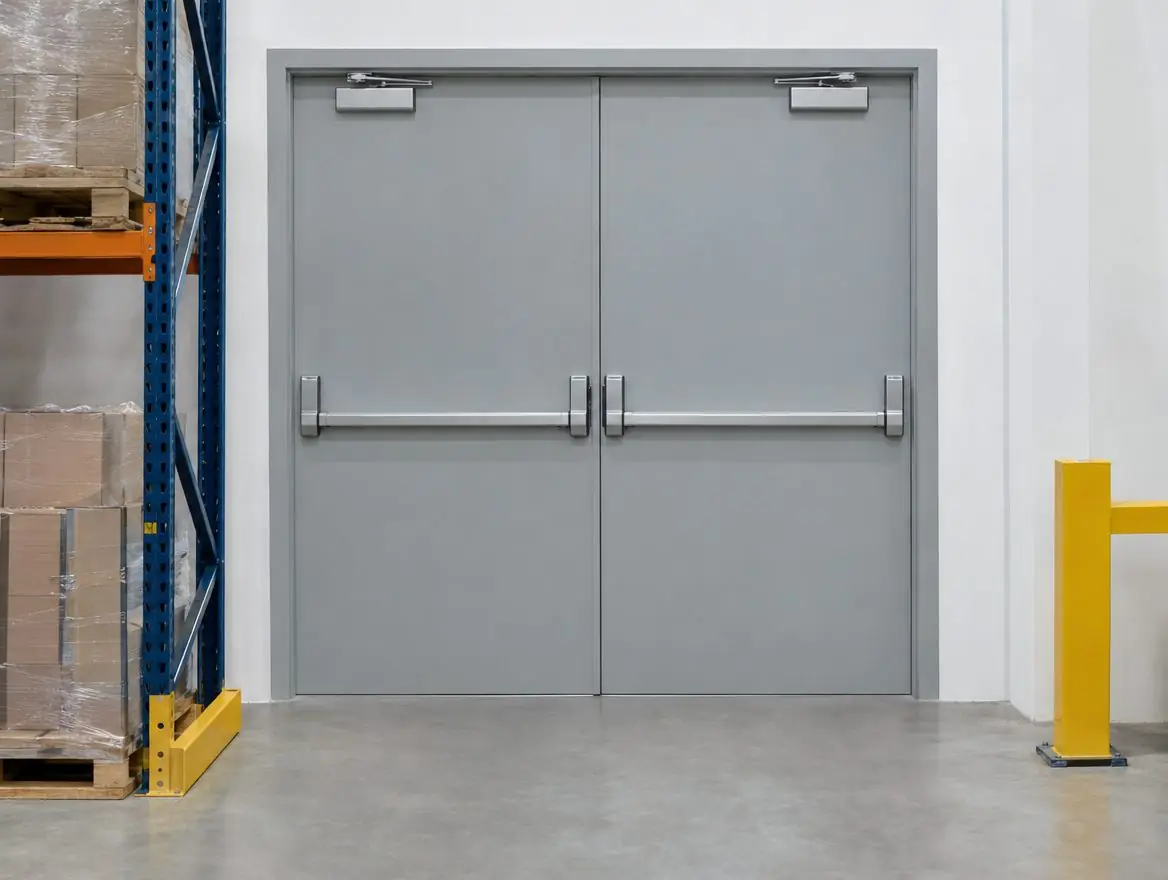
A fire exit door is a door on an escape route, usually the final exit to outside, fitted with hardware that lets people open it quickly without a key. Panic hardware (BS EN 1125) is used where the public may be present; emergency exit hardware (BS EN 179) where users are trained staff.
Is every fire exit door a fire door?
Not necessarily. A final exit door leading straight outside often does not need fire resistance, but it must open easily in the direction of escape and be secure the rest of the time. If the exit door also sits in a wall that the fire strategy requires to resist fire, it needs to be a certified fire doorset as well. We check which applies before quoting, so you do not pay for fire resistance you do not need, or miss it where you do.
Panic bars or emergency hardware?
Panic hardware to BS EN 1125, such as push bars, is designed for places where members of the public may be present and may not know the building. Emergency exit hardware to BS EN 179, such as push pads or levers, is for areas used by trained staff who know how the exit works. The right choice depends on who will be using the door in an emergency.
Security without blocking escape
Exit doors need to keep intruders out while letting people out in seconds. We can fit outside access devices, alarmed hardware and access control interfaces that do not stop the door being opened from inside. Any of these on a fire-rated exit door must be covered by its evidence.
Specification at a glance
- Hardware (public)
- Panic hardware, BS EN 1125
- Hardware (staff)
- Emergency exit hardware, BS EN 179
- Doors
- Steel or timber, single or double
- Fire rating
- Where the strategy requires it
- Security
- Outside access and alarm options
- Typical uses
- Shops, offices, schools, warehouses
What's included
- Assessment of whether fire resistance is required
- Single and double exit doors in steel or timber
- BS EN 1125 panic hardware or BS EN 179 emergency hardware
- Outside access devices and alarmed options
- Weather and threshold detailing
- Commissioning and handover
How the installation runs
- Check the fire strategy and who uses the exit
- Select door type, rating and exit hardware
- Order doorset and hardware set
- Remove the existing door and prepare the opening
- Install, seal and weather the doorset
- Test exit operation, closers and security features
How much does it cost?
£1,100 – £2,600 ex VAT
£1,100–£2,600 per exit doorset with hardware, supplied and fitted, ex VAT. These are guide figures; your price is fixed after a free survey. See all guide prices or try the guide-price tool.
Questions about fire exit doors
Do fire exit doors have to open outwards?
Exit doors generally open in the direction of escape, especially where many people use them. Your fire strategy or risk assessment sets the requirement for each door.
Can a fire exit door be locked?
It can be secured against entry from outside, but it must open from inside without a key whenever the building is occupied. Panic and emergency exit hardware are designed for exactly this.
Which is better, a push bar or a push pad?
Push bars (panic hardware) suit public areas; push pads and levers (emergency exit hardware) suit areas used by trained staff. The choice depends on who will use the door in an emergency.
Do fire exit doors need closers?
Final exit doors often have closers for security and weather reasons. If the exit door is also a fire door, a closer is normally required to keep it shut.