
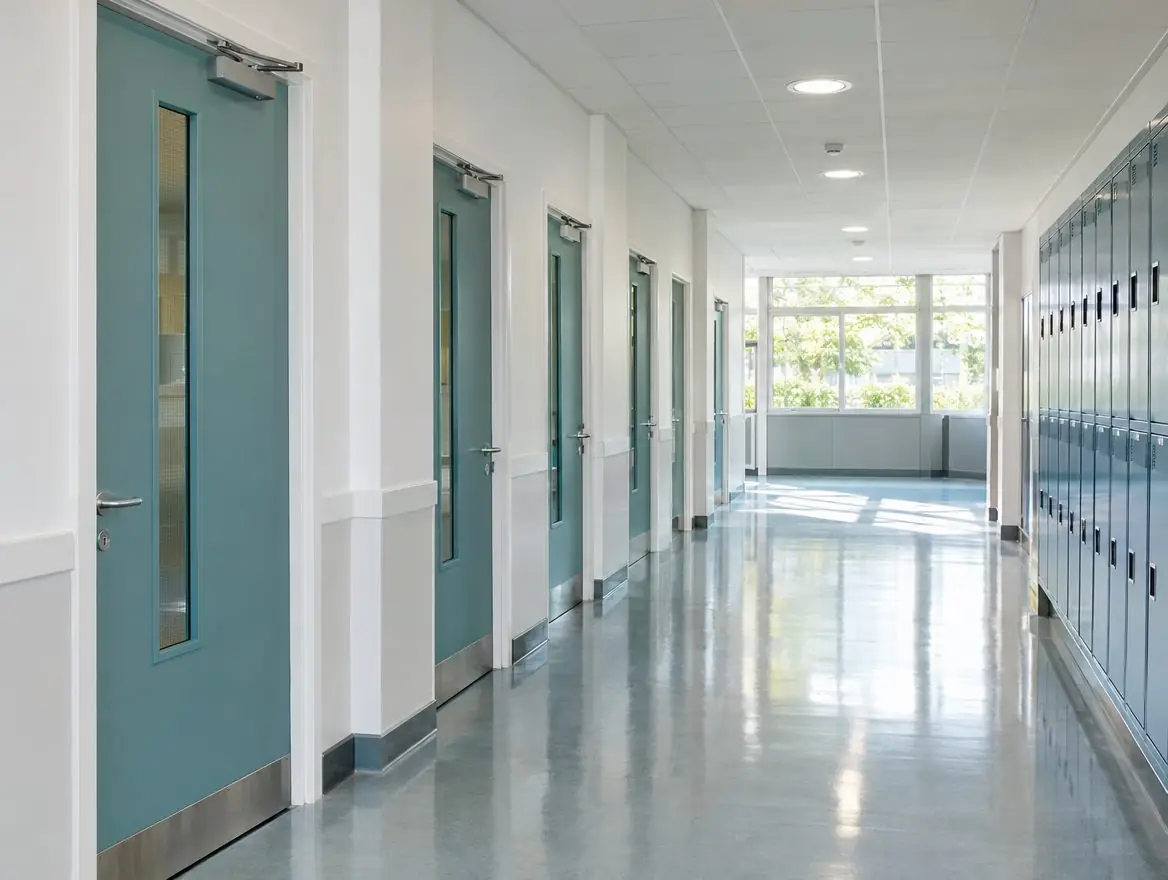
Fire door installation for schools covers the corridor, stair, classroom, kitchen and plant room doors that keep fire and smoke away from escape routes in an education building. Because pupils give the doors heavy daily use, the specification focuses on robust doorsets and alarm-linked hold-open devices, with most work programmed into the school holidays.
What kind of fire doors does a school estate contain?
School buildings are rarely one era. A single site may combine a Victorian main block, a system-built extension from the 1960s or 1970s, a modular classroom unit and a recent new-build wing. Fire doors range from heavy double doors on corridors and stairwells to single classroom doors, kitchen and server room doors, and store cupboards full of paper and PE kit. Many corridor doors have vision panels so pupils can see who is coming the other way.
The common failure pattern is wear: hinges dropping under constant use, closers leaking or disconnected, edges chewed by trolleys and bags, and doors wedged open between lessons because they are heavy for younger children.
Who is the duty-holder in a school?
Under the Fire Safety Order 2005 in England and Wales, the responsible person is generally the employer. That means the local authority for community and voluntary controlled schools, the academy trust for academies and free schools, and the governing body for most foundation and voluntary aided schools. Independent schools answer through their proprietor or trustees. Headteachers, business managers and site staff usually carry out the day-to-day duties on the employer's behalf.
In Scotland, duties under the Fire (Scotland) Act 2005 normally rest with the education authority or the independent school's proprietor. In Northern Ireland they sit with the employer or body controlling the premises under the Fire and Rescue Services (NI) Order 2006. In England, Building Bulletin 100 has long been the reference design guide for fire safety in schools.
When can fire door works be done in a school?
The summer holiday is the main window for large programmes, with half-terms and Easter suited to smaller packages. Where urgent remedial work cannot wait, it can run after the school day or at weekends, one corridor at a time, so escape routes stay complete while the building is in use. Every operative needs to follow the school's safeguarding procedures, sign in at reception and work in areas segregated from pupils.
Plan the order carefully: stair doors and cross-corridor doors on main escape routes first, then classroom and store doors. Agree with the site team which doors carry access control or alarm interfaces, so those trades can be booked alongside rather than after.
What specification stands up to pupils?
- Heavy-duty double fire doors on corridors, with door coordinators, robust pull handles and kick plates.
- Hold-open devices linked to the fire alarm on doors that would otherwise be propped, so they release automatically when the alarm sounds.
- Glazed fire doors with vision panels positioned for both adults and children, using fire-rated glass and beads.
- Closers to BS EN 1154 with backcheck to stop doors slamming into walls, and finger guards on hinge edges where they are compatible with the door's evidence.
Doorsets with third-party certification simplify the paperwork at every future inspection.
What should the estates team receive at the end?
Ask for a door schedule cross-referenced to the school's fire plan drawings, product certificates, photographs of fire stopping, and commissioning records for every closer and hold-open device. Trusts running several schools benefit from a common referencing format, so records can be compared across the estate and capital bids can be supported with consistent condition data. A quote can be prepared from a site survey or from an existing fire door inspection report.
Should a school repair its fire doors or replace them?
Repair makes sense where the leaf and frame are sound and the faults are hardware or seals: a closer that no longer latches, a dropped hinge, missing smoke seals or a damaged glazing bead. Fire door repairs like these can often be completed in a single holiday visit across a whole site. Replacement is usually the better choice when leaves are delaminating, frames are loose or split, edges have been repeatedly patched, or there is no way to establish what the door was originally tested to. Doors in older blocks often fall into that last group.
A condition survey that scores each door helps the business manager split the work into a repair package and a replacement programme spread over several funding years, with the highest-risk escape routes first. Our guide to how long fire doors last explains the signs that a door has reached the end of its useful life.
Questions we're asked
Can fire doors in schools be held open?
Yes, if they are held by a device to BS EN 1155 that is linked to the fire alarm and releases the door automatically when the alarm sounds or the power fails. Wedges, hooks and furniture must never be used, because the door will not close in a fire.
Who pays for fire doors in an academy?
The academy trust is normally responsible for maintaining its buildings, including fire doors, and funds the work from its own budgets or capital funding it secures. For community schools the local authority usually holds that responsibility. Check the funding agreement or lease for the specific site.
How long does it take to replace fire doors in a school?
It depends on the number of doors and how much frame and wall repair is needed. With doorsets made to measure, an empty building allows steady progress, so most single-school programmes fit within a summer holiday. Term-time work is slower because areas must be segregated from pupils.