
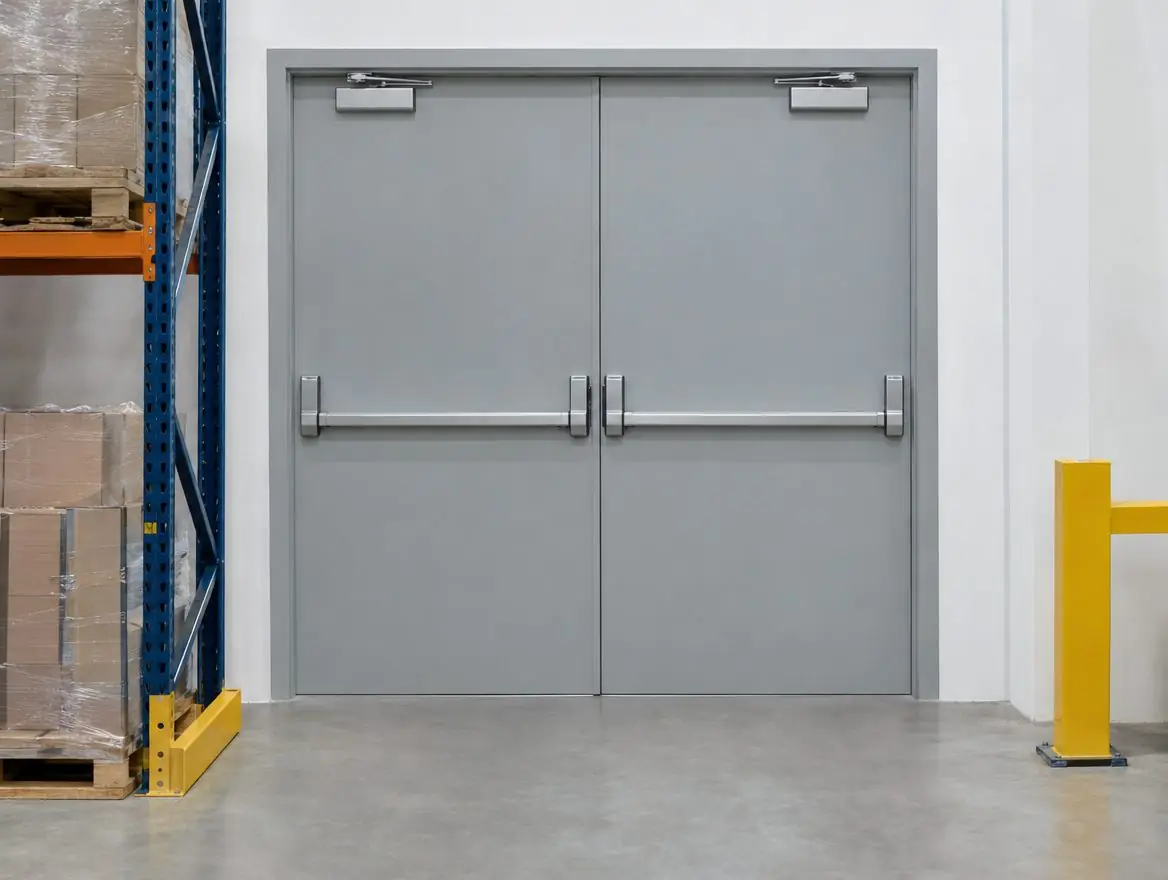
Fire doors for industrial units and warehouses are the steel and heavy-duty doors that separate storage and process areas, protect offices, stairs and plant rooms, and provide fire exits to open air. They face impacts, dust and temperature swings, so robust construction, correct exit hardware and protection from vehicle damage matter as much as the fire rating.
Where are fire doors needed in industrial buildings?
Large sheds are often a single open volume, but compartment walls commonly separate the warehouse floor from offices, welfare areas, plant rooms, battery charging bays and high-hazard stores. Every personnel door through those walls is a fire door, sometimes FD60 or more to match the wall. Mezzanine stairs, internal office blocks and trade counters add further doors, and external escape doors along the perimeter keep travel distances to a final exit within limits. Fire shutters across vehicle openings are a separate product and fall outside fire door installation.
Older industrial estates also contain small brick units, workshops and trade counters, where an office or stair is separated from the workshop by a single fire door that has often been damaged, painted or wedged open for years. These modest openings are frequently the doors a fire risk assessment flags first.
Who is responsible on an industrial site?
The employer or occupier is normally the responsible person under the Fire Safety Order 2005 in England and Wales, and on a multi-unit estate the landlord answers for any shared areas. Where a unit is let on a full repairing lease, the tenant usually maintains the doors but should check whether the landlord retains any obligations. Scottish sites fall under the Fire (Scotland) Act 2005; Northern Ireland sites under the Fire Safety Regulations (NI) 2010. Insurers often take a close interest in doors on compartment walls, so check policy conditions as well.
How is work planned around operations?
Warehouses and factories rarely stop, so work is planned around shifts, deliveries and stock movements. External fire exits are replaced one at a time so the evacuation plan stays valid, with a temporary secure closure if a door must be left overnight. Expect a site induction, permits for hot works or working at height, and exclusion zones around forklift routes. Annual shutdowns, such as the Christmas break, suit larger packages on compartment walls, while single doors can often be swapped during a quiet shift.
Which doors and hardware suit industrial use?
- Steel fire doors on compartment walls, plant rooms and high-hazard stores, where impact resistance and security matter.
- Fire exit doors with panic hardware to BS EN 1125 where visitors or people unfamiliar with the building may use them, or emergency exit hardware to BS EN 179 where only trained staff will.
- Impact protection, such as bollards, kick plates and steel edge guards, to keep forklift damage away from leaves and frames.
- Security-focused external doors whose locking never compromises escape from inside.
Pairs on wide openings need double fire doors with a coordinator, so the leaves close in the right order.
What evidence should be kept?
Industrial sites are visited by insurers, landlords and enforcing authorities, so keep a door schedule with ratings, product certificates and installation records alongside photographs of the fire stopping around each frame, an area easily missed on steel door installations. BS 8214:2026 now covers steel, metal, aluminium and composite doors and strengthens guidance on sealing the gap between frame and structure. A quote can be based on a site survey or on your fire risk assessment action plan.
How do security and escape work together on industrial doors?
Industrial sites face a constant pull between keeping intruders out and letting people escape. Fire exits are frequently found padlocked, chained or blocked by pallets, especially overnight and at weekends when a skeleton crew is on site. Escape doors must open from the inside, without a key, whenever anyone is in the building. Security comes from the outside face of the door instead: steel leaves and frames, anti-jemmy features, hinge bolts, and outside access devices that work alongside the exit hardware rather than overriding it.
Where the site needs to know when an exit is opened, door contacts or alarmed exit devices can be fitted, provided they are compatible with the door's evidence and do not slow escape. A short daily walk round to check exit doors open freely and the route outside is clear is one of the simplest and most effective fire safety habits on any industrial site.
Questions we're asked
Do warehouse fire exit doors need panic bars?
Where an exit may be used by people unfamiliar with the building, such as visitors or the public, panic hardware to BS EN 1125 is normally specified. Where only trained staff use the exit, emergency exit hardware to BS EN 179, such as a lever handle or push pad, may be suitable.
What fire rating do warehouse compartment doors need?
A door normally needs to match the fire resistance of the wall it sits in, which can be 60 minutes or more on compartment walls in large warehouses. The building's fire strategy or fire risk assessment should set the rating for each opening.
Are fire shutters the same as fire doors?
No. Fire shutters close large openings such as vehicle bays and are a separate product, usually motorised and linked to the fire alarm. Fire door installation covers personnel doors, although both need to be considered together in the building's fire strategy.