
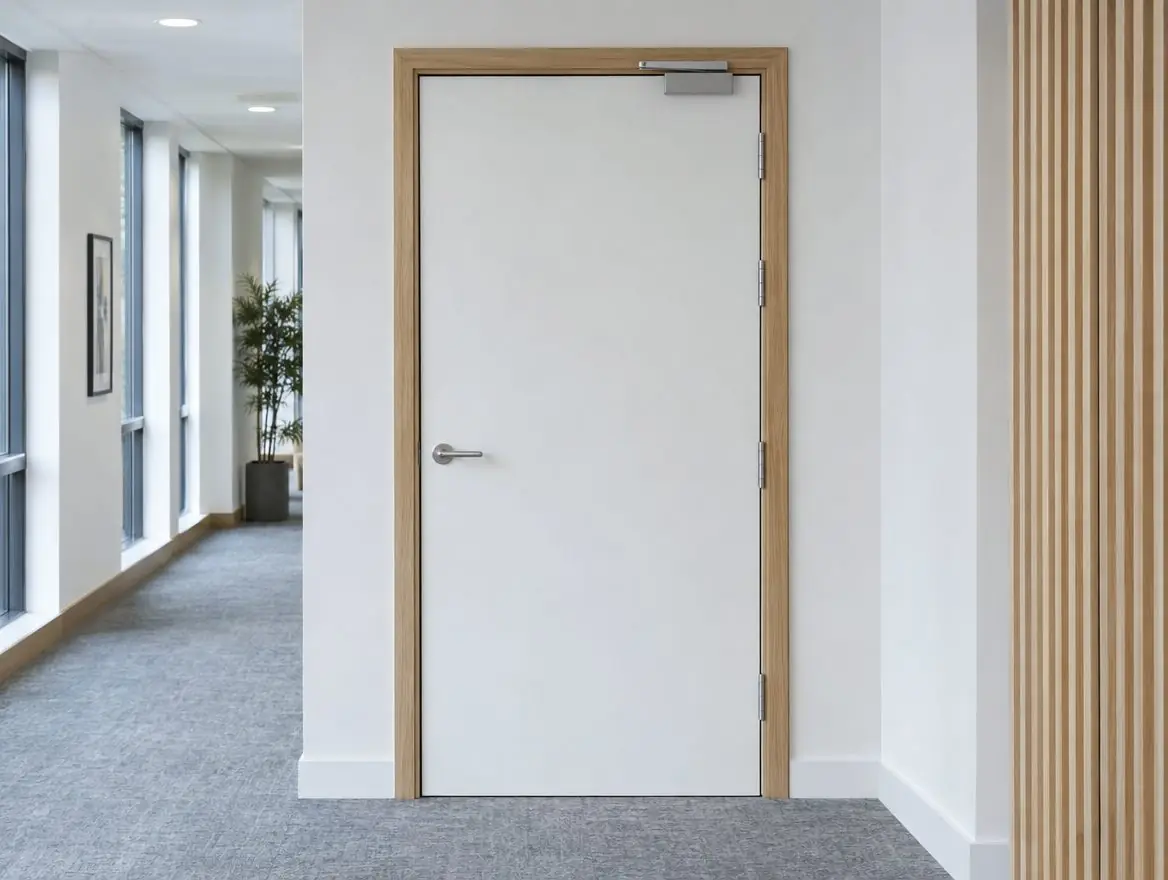
An FD30 fire door is a door assembly that held back fire for at least 30 minutes in a BS 476-22 test; its European counterpart is an E30 classification under BS EN 13501-2. It only performs as tested when the leaf, frame, gaps, seals, hinges and closer match the certification, so installation is as important as the door itself.
Where are FD30 doors used?
FD30 is the rating most buildings rely on. You will find it on flat entrance doors, doors onto escape corridors and stairs in houses in multiple occupation, kitchen doors in HMOs, and most internal doors on escape routes in offices, schools, surgeries and shops. Where smoke control matters too, the door is specified as FD30S (E30Sa), which adds a smoke seal and a tighter threshold.
The rating your building needs comes from its fire strategy or fire risk assessment, not from the door supplier. If you are unsure whether a door should be FD30 or FD60, we check the drawings, the risk assessment and what is installed now before we price anything. Our FD30 vs FD60 guide explains the difference.
Leaf only or a full doorset?
If the existing frame is sound, correctly sized, securely fixed and compatible with the new leaf's certification, a new FD30 leaf can be hung in it. Many frames do not pass that test: old softwood linings, frames that have been cut about for previous doors, or frames with no evidence of how they were fixed. In those cases a certified doorset (leaf, frame and ironmongery tested together) is the cleaner answer and usually the quicker one on site.
We tell you which route each opening needs on the survey, door by door, and why.
What does a correct FD30 installation include?
A typical timber FD30 leaf is around 44mm thick and hangs on at least three fire-tested hinges. The gaps between leaf and frame are set to the manufacturer's data, usually around 3mm. Intumescent strips, and smoke seals where needed, go in the frame or leaf edge as specified. The closer must pull the door shut and latch it from any angle. Every hole cut for a lock, latch or hinge is lined with intumescent material where the certification calls for it.
Then comes the part that is often skipped: sealing the gap between the frame and the wall with a tested material, as BS 8214:2026 now sets out in more detail.
Specification at a glance
- Fire rating
- 30 minutes integrity (FD30 / E30)
- Smoke control
- FD30S / E30Sa with smoke seals
- Typical leaf
- 44mm timber, or certified composite
- Hinges
- 3 fire-tested hinges, commonly grade 13
- Leaf gaps
- Usually around 3mm, per certification
- Closer
- BS EN 1154 overhead, sized to the leaf
What's included
- Survey of the opening, frame and existing ironmongery
- Certified FD30 or FD30S leaf, or full doorset
- Fire-tested hinges, latch or lock and intumescent pads
- Intumescent strips and smoke seals to the certification
- Overhead closer set to close and latch
- Frame-to-wall gap sealed with an evidenced material
- Photo record, product data and certificate references at handover
How the installation runs
- Measure the opening, check the frame and confirm the rating needed
- Order a certified leaf or doorset to size, with matching components
- Remove the old door and assess the frame or structural opening
- Fix the frame and hang the leaf to the certified gap tolerances
- Fit seals, hinges, latch, closer and signage, then test close-and-latch
- Seal the frame-to-wall gap, make good and record the evidence
How much does it cost?
£300 – £1,300 ex VAT
£300–£600 for a leaf into a sound existing frame; £650–£1,300 for a doorset, ex VAT. These are guide figures; your price is fixed after a free survey. See all guide prices or try the guide-price tool.
Questions about FD30 fire doors
Can a new FD30 door go into my old frame?
Sometimes. The frame has to be sound, square, securely fixed and compatible with the new leaf's certification. Many older frames are not, especially softwood linings or frames altered for previous doors. We check each frame on the survey and recommend a doorset only where the frame cannot be relied on.
What is the difference between FD30 and FD30S?
FD30S has been tested for smoke control as well as fire. It adds a smoke seal, usually a brush or blade, and needs a tight threshold gap. Flat entrance doors and doors onto protected escape routes are commonly specified as FD30S.
Do FD30 doors need a closer?
Most do. Doors on escape routes, flat entrance doors and doors in the common parts of buildings need a self-closing device that shuts and latches the door. Some doors inside houses and locked riser doors are exceptions, depending on the fire strategy.
How long does it take to fit an FD30 door?
A leaf into a sound frame is often a few hours. A full doorset including frame removal, fixing, sealing and making good is usually half a day to a day per opening, depending on access and the wall construction.