
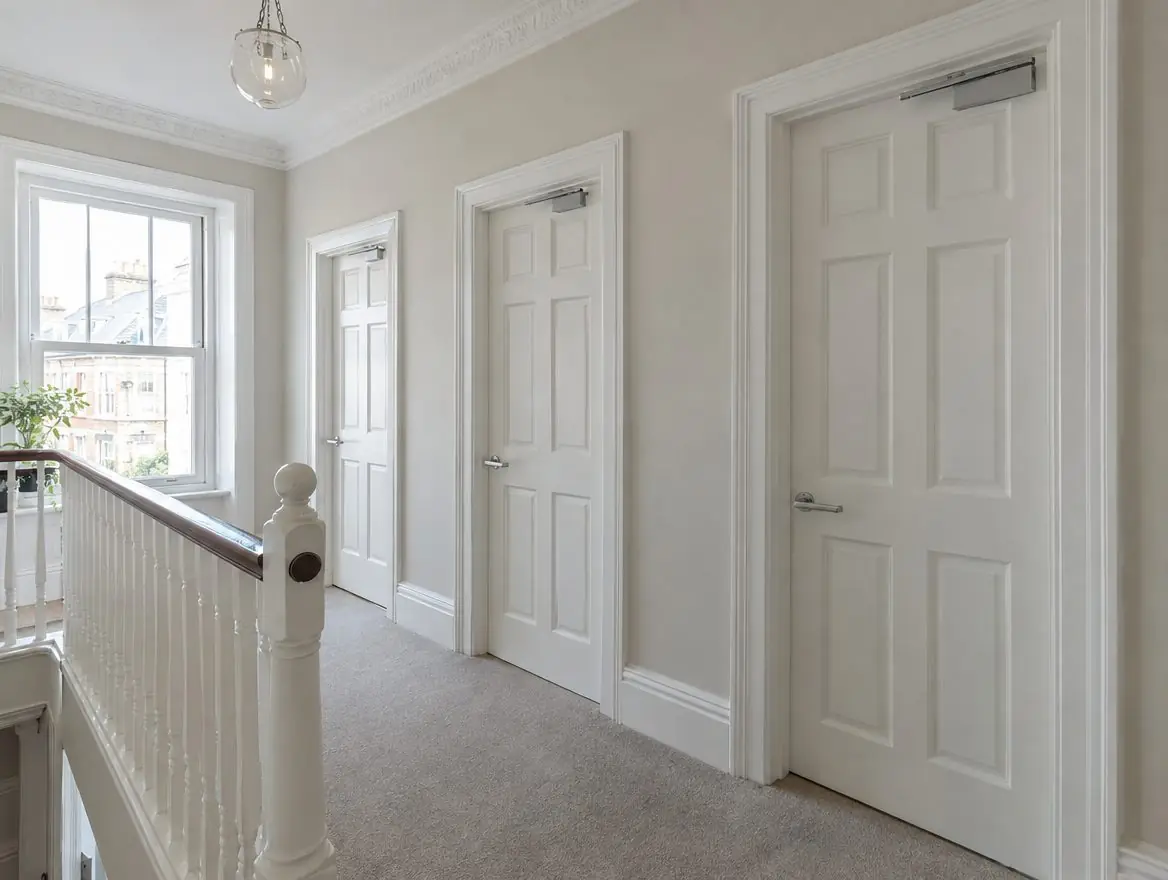
Most HMOs need fire doors to bedrooms, kitchens and other rooms opening onto the escape route. Councils in England commonly use the LACORS fire safety guidance, under which FD30 doors with self-closers, intumescent strips and smoke seals are a typical expectation in many HMOs, with some flexibility for smaller, lower-risk shared houses. The local council's assessment decides what each property needs.
Why are HMOs treated differently from family homes?
In a single-family house, everyone tends to know when someone is cooking or using a heater, and they leave together if there is a fire. In a house in multiple occupation, unrelated tenants live behind their own doors, often with their own appliances, and may be asleep while others cook. A fire in one room may not be noticed until smoke reaches the shared hall and stairs, which are also the only way out.
The aim of HMO fire safety is therefore to protect the escape route. Fire doors on rooms opening onto the hall and stairs, together with an interlinked fire alarm, keep smoke and fire out of the route for long enough for everyone to leave.
What is the LACORS guidance and why does it matter?
The LACORS guidance, Housing: Fire Safety, was produced for local authorities and fire and rescue services as a common approach to fire safety in existing residential accommodation, including HMOs. It is not law, but many councils in England use it when assessing properties and setting licence conditions, and it is referred to elsewhere too.
The guidance takes a risk-based approach. It sets out case studies for different property types, such as two-storey and three-storey shared houses, bedsit-type HMOs and buildings converted into flats, and describes the typical package of fire doors, alarms and other measures for each. The council's officer then applies that approach to the specific property, which is why two similar-looking houses can end up with different requirements.
What fire doors are typically expected?
The table shows common outcomes. Your council's assessment of your property is what counts.
| Type of HMO | Typical fire door expectation |
|---|---|
| Small two-storey shared house, lower risk | Sound, close-fitting conventional doors may be accepted in some cases, though a fire door to the kitchen may still be asked for |
| Three-storey shared house | FD30 doors to rooms opening onto the escape route, often with intumescent strips and smoke seals; self-closers are commonly required, depending on the assessment |
| Bedsit-type HMO, with cooking in rooms | FD30 doors with self-closers, intumescent strips and smoke seals to each letting room, as a general expectation |
| Larger HMOs or buildings with several storeys | FD30S doors throughout the escape route, with greater protection where the layout or height calls for it |
Doors to cupboards under the stairs or to meter cupboards on the escape route often need attention too, as they are common places for fires to start. Our HMO fire doors service covers bedroom, kitchen and cupboard doors.
What makes an HMO fire door acceptable to the council?
- A genuine fire door, with a label or paperwork, hung in a frame suitable for that door.
- A self-closing device that closes the door fully into its frame from any angle. Rising butt hinges are sometimes seen in older HMOs, but councils commonly expect an overhead closer on new work.
- Intumescent strips and smoke seals, fitted in the frame or leaf edge as the door's evidence requires.
- Correct gaps and fire-tested hinges, with all screws in place.
- Suitable locks. Tenants must be able to get out without a key, so thumb-turn locks on the inside of bedroom doors are commonly expected.
Doors that have been planed down, have holes from old locks, or have had their closers disconnected by tenants are some of the most frequent failures. A closer that is too strong also causes problems, because tenants then prop the door open. Our fire door closers guide explains how to balance this.
How does licensing affect fire doors?
Escape windows, fire-resisting construction between rooms, and emergency lighting in larger properties may form part of the same package, so fire doors are best considered alongside the other measures rather than in isolation. A door specification that suits one layout may be more or less than a different layout needs.
In England, mandatory HMO licensing applies to properties occupied by five or more people forming more than one household, and councils can run additional licensing schemes that cover smaller HMOs in their area. A licence application usually involves an inspection, and fire safety conditions are attached to the licence. These often specify the fire doors, the alarm system and how both must be maintained.
Wales, Scotland and Northern Ireland use different definitions and thresholds for HMO licensing, and local authorities there set the detailed conditions. In England, councils can also assess fire as a hazard under the Housing Health and Safety Rating System, whether or not the property is licensed. In England and Wales the Fire Safety Order 2005 generally applies to the common parts of an HMO too, so the landlord or manager also needs a fire risk assessment covering them.
What should landlords do when converting or reviewing an HMO?
- Talk to the council's private sector housing team early, especially before a conversion or licence application.
- Get a fire risk assessment that covers the doors, alarms and escape route.
- Survey every door on the escape route and note its rating, closer, seals, gaps and locks.
- Replace doors that cannot be brought up to standard; see fire door replacement.
- Where a conversion or change of use is building work, involve building control, which has the final say on that work.
- Keep records of the products fitted and of regular checks, and brief tenants on keeping fire doors shut.
How do you keep HMO fire doors compliant once tenants move in?
HMO doors take more abuse than most. Tenants wedge kitchen doors open, unhook closers that feel too heavy, fit extra locks and slam doors. Building a short check of every fire door into each property visit catches the common problems early: does each door close and latch on its own, are the seals intact, are any closers disconnected, and has anyone added a lock or hook? Small repairs are inexpensive if done promptly; see our fire door repairs service. Explaining to tenants why the doors matter, and setting closers so the doors are not unreasonably heavy, does more to keep them shut than any notice on the wall.
Frequently asked questions
Do all HMO bedroom doors need to be fire doors?
Not always. Councils assess each HMO on its risk, often using the LACORS guidance. Three-storey and bedsit-type HMOs typically need FD30 doors with self-closers and seals to each room on the escape route, while some smaller two-storey shared houses may be treated more flexibly. Check with your council.
Is the LACORS guide a legal requirement?
No. It is guidance that many councils in England use when assessing HMO fire safety and setting licence conditions. The legal duties come from housing law, licensing and the Fire Safety Order. In practice, licence conditions based on the guidance can be enforced, so it carries real weight.
Can HMO tenants have locks on their bedroom fire doors?
Yes, but the lock must allow the tenant to get out without a key, so a thumb-turn on the inside is commonly expected. The lock must also be a type the fire door's evidence allows, often with intumescent protection. Adding locks to an existing fire door needs care.
Are rising butt hinges acceptable on HMO fire doors?
Some older HMOs have them, and some councils have accepted them in limited circumstances. Many councils now expect an overhead closer on new or replacement fire doors because rising butts often fail to close the door fully against its seals and latch. Ask your council before relying on them.
This guide is general information about fire doors in the UK, not legal advice. Your fire risk assessor, the responsible person or building control has the final say for your building.