
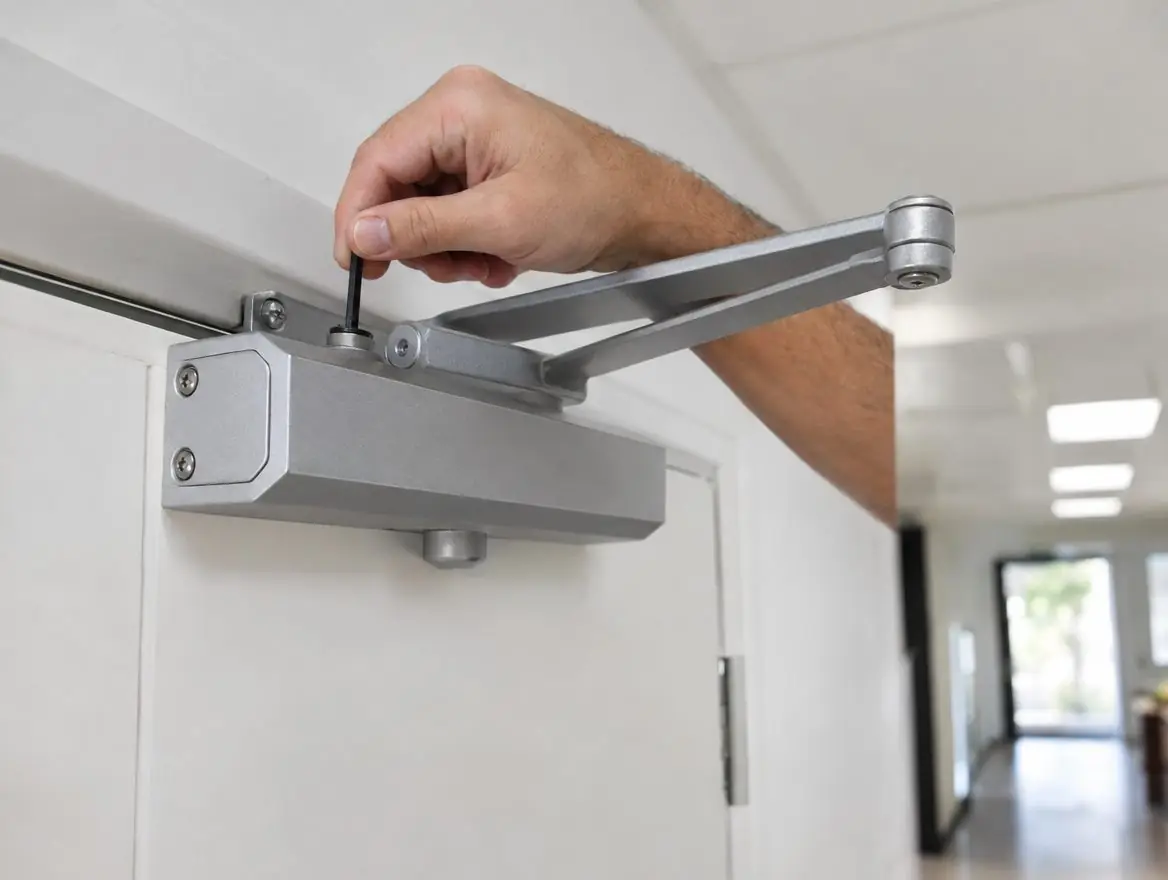
A fire door closer is the device that shuts a fire door automatically after it is opened. To be effective it must close the door fully and engage the latch from any opening angle, while keeping opening forces reasonable; overhead closers for fire doors are usually tested to BS EN 1154.
The most common fire door fault
A fire door that does not close is not doing its job. Closers fail because they are under-powered, out of adjustment, damaged, leaking or disconnected by people who find the door too heavy. Often the fix is a correctly sized closer, set up properly, rather than a new door.
Setting a closer properly
Closers have adjustments for closing speed, latching action and often backcheck. We set them so the door closes from any angle and engages the latch, without slamming. In England, Approved Document M guidance on opening force, no more than 30N for the first 30 degrees and 22.5N from 30 to 60 degrees at the leading edge, is a useful benchmark for usability. Our closers guide has more detail.
Overhead, concealed or free-swing
Overhead closers are the most common and easiest to maintain. Concealed closers keep a clean look and deter tampering, if covered by the door's evidence. Free-swing closers let a door move freely in everyday use and close when the fire alarm sounds, which is useful in care homes and for people who find doors hard to open.
Specification at a glance
- Standard
- BS EN 1154 overhead closers
- Must do
- Close and latch from any angle
- Usability
- Approved Document M opening-force guidance (England)
- Options
- Overhead, concealed, free-swing
- Adjustments
- Speed, latch, backcheck
- Common fault
- Under-powered or disconnected
What's included
- Assessment of door size, weight and use
- Correctly powered closer to BS EN 1154
- Overhead, concealed or free-swing options
- Adjustment of speed, latching and backcheck
- Close-and-latch test from full open
- Record of model and settings
How the installation runs
- Check the door, frame and existing closer
- Select a closer suited to the leaf and use
- Fit to the template and the door's evidence
- Adjust closing and latching speeds
- Test from wide and small opening angles
- Record the closer and its settings
How much does it cost?
£90 – £220 per door ex VAT
£90–£220 per closer supplied and fitted; adjustment visits from £195, ex VAT. These are guide figures; your price is fixed after a free survey. See all guide prices or try the guide-price tool.
Questions about fire door closers
Why won't my fire door latch?
Usually the closer is out of adjustment or under-powered, or the latch and keep are misaligned. Both are normally quick to fix.
Can a fire door closer be too strong?
Yes. An over-powered or badly set closer makes the door hard to open and may lead people to wedge it. The goal is reliable closing with a reasonable opening force.
What is a free-swing closer?
A closer that lets the door swing freely in normal use and closes it when the fire alarm operates. It suits care settings and people who find doors heavy.
Do all fire doors need closers?
Most do. Exceptions include some doors kept locked shut and some doors within houses, depending on the fire strategy.