
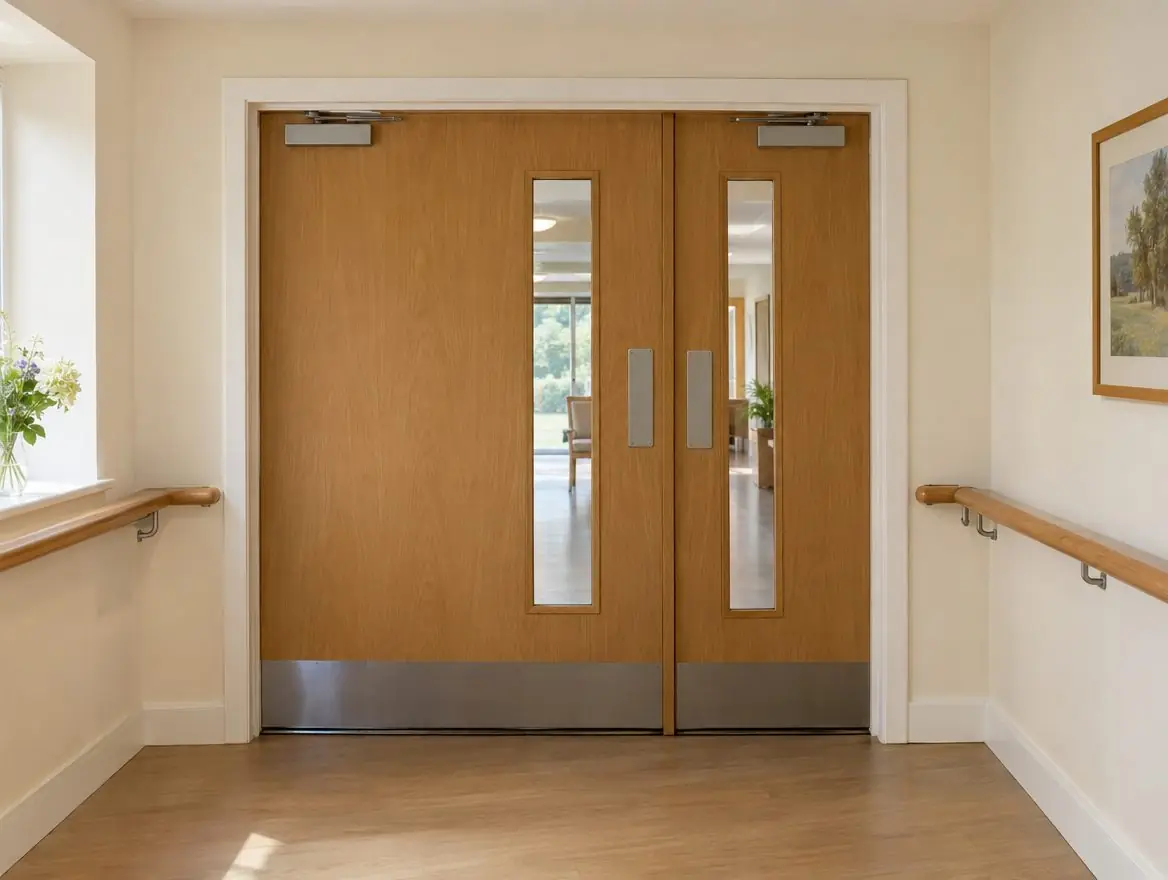
Fire door installation for healthcare premises covers the compartment, ward, corridor and departmental doors in hospitals, clinics and surgeries. These doors must let beds and equipment through, stay open safely in normal use, withstand impact and frequent cleaning, and close reliably when the alarm sounds, all while clinical services continue around the work.
What makes a healthcare fire door estate different?
Hospitals house patients who often cannot escape unaided, so the fire strategy relies on compartmentation and horizontal movement: staff move patients through fire doors into a neighbouring compartment on the same level. That puts unusual demands on the doors. Leaves are wide, often unequal pairs, so beds and trolleys can pass; frames take repeated knocks; and corridors carry constant traffic, which is why so many healthcare doors are held open during the day.
Smaller premises, such as GP surgeries, dental practices and community clinics, have simpler estates but share the same wear problems at reception, consulting room and plant room doors, often in converted buildings never designed for clinical use.
Who holds the fire safety duty?
For NHS and independent hospitals, the responsible person is normally the trust, health board or provider organisation, acting through its estates and fire safety teams. In leased surgeries and clinics, duties can be split between landlord and practice, so confirm in writing who maintains which doors. In England, Health Technical Memorandum 05-02 is the established design guidance for fire safety in healthcare buildings, with related guidance used in Scotland, Wales and Northern Ireland. Scottish premises fall under the Fire (Scotland) Act 2005, and Northern Ireland premises under the Fire and Rescue Services (NI) Order 2006.
How are works phased in a live clinical environment?
Hospitals never close, so fire door works are planned ward by ward with the estates team, infection prevention and the clinical lead. Expect permits to work, an infection control risk assessment and dust-controlled working near patients. Compartment doors are usually replaced one opening at a time, with any temporary measures agreed with the fire safety adviser in advance. Out-of-hours shifts suit outpatient departments and corridors that are busy during the day, while inpatient wards may need work slotted around bed moves and theatre lists.
Materials should arrive cleaned and wrapped, and waste should leave by agreed routes that avoid clinical areas.
Which door types and hardware are typical?
- Unequal pair double fire doors at compartment lines and ward entrances, sized for bed movement.
- Hold-open devices linked to the alarm, so doors stay open for patient flow but close on activation.
- Impact-resistant, wipe-clean leaf finishes with protection plates and edge guards that are covered by the door's evidence.
- Glazed fire doors with vision panels for observation and to avoid collisions.
- Steel fire doors for plant rooms, medical gas stores and service yards where robustness matters more than appearance.
What evidence does the estates team need?
Healthcare estates teams usually want documentation that drops straight into their asset management and planned maintenance systems: a unique reference for every door, product certification, installation records, photographs of fire stopping, and a commissioning sheet for every hold-open device showing release on an alarm test. Agree the format, naming convention and photo standard before work starts so nothing has to be re-surveyed. For how gaps and seals are checked after installation, see fire door gaps explained, and for clinical sites with mixed door ages, how long fire doors last helps plan replacement cycles.
What about GP surgeries, dental practices and clinics?
Primary care premises are often converted houses, shop units or older purpose-built health centres. The fire door estate is smaller, typically the doors to the stair, the plant or meter cupboard, the records store and corridor doors protecting the escape route from consulting rooms, but the evidence behind those doors is often thin. Practices frequently find that a fire risk assessment flags doors with no labels, large gaps or missing closers.
Work can usually be done in a single evening or weekend visit, so surgeries stay open for appointments. Where the building is leased, confirm with the landlord who pays before instructing work, and keep copies of the product evidence for your own records, because practice managers, landlords and the regulator may all ask for it. FD30 fire doors with smoke seals are the most common specification in smaller premises, with FD60 where the fire strategy calls for it.
Questions we're asked
Can hospital fire doors be held open?
Yes, and many are, because constant traffic would otherwise lead to doors being propped. The door must be held by a device to BS EN 1155 linked to the fire alarm, so it releases and closes automatically on alarm activation or power failure. Regular testing should confirm every door closes and latches.
What rating do healthcare compartment doors need?
That depends on the building's fire strategy and the design guidance used. Many compartment and sub-compartment doors are FD30S, while some compartment lines, plant rooms and protected shafts need FD60. The specification should come from the fire strategy rather than being copied from existing doors.
Can fire door work be done without closing a ward?
Usually, yes. Replacing doors one opening at a time, with agreed temporary measures, dust control and out-of-hours working where needed, allows most wards to stay open. The plan should be agreed with the estates, infection prevention and clinical teams before work begins.