
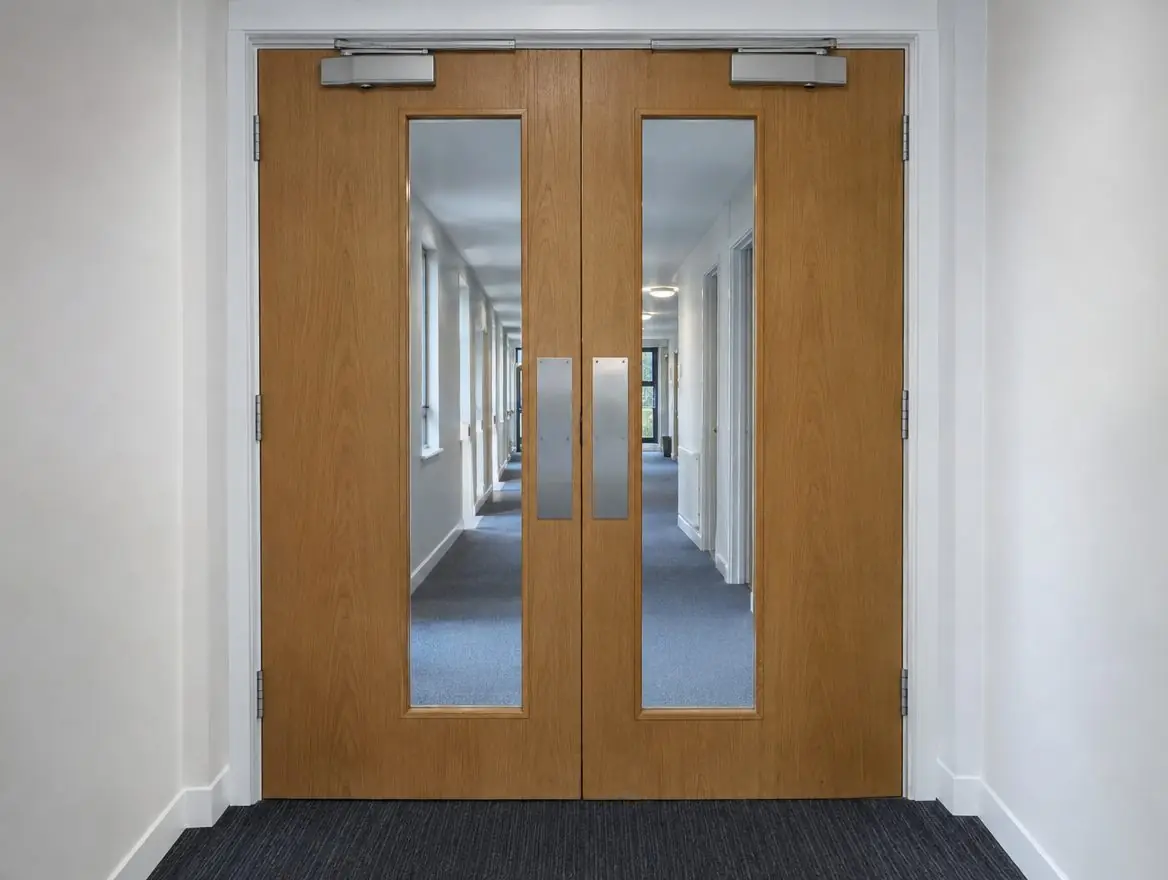
Fire door installation for housing associations is the planned replacement and repair of flat entrance, communal and riser fire doors across an occupied housing stock. It is organised block by block around residents, prioritised by the fire risk assessment, and handed over with a door-by-door evidence trail that supports the landlord's fire safety duties.
What does a typical housing association fire door estate look like?
Most social landlords hold a mixed estate: purpose-built blocks from several decades, converted houses split into flats, sheltered schemes with long internal corridors and newer buildings delivered with certified doorsets. Within one portfolio you can find original timber flat doors with letterplates cut through them, stair doors hanging on worn frames, and recent replacements fitted without any paperwork to prove what they are.
The doors that carry the most risk are the flat entrance fire doors separating each home from the escape route, and the communal fire doors on stairs, lobbies, bin stores and plant rooms. Riser cupboards, often forgotten until an inspection, are the third group, and they matter because services pass through every floor.
Who holds the duty, and how does that change across the UK?
In England and Wales the association is normally the responsible person under the Regulatory Reform (Fire Safety) Order 2005 for the common parts. As landlord it usually controls the flat entrance doors as well, although leasehold and shared ownership flats need the lease checking. In England, buildings above 11 metres fall under regulation 10 of the Fire Safety (England) Regulations 2022: checks of communal fire doors at least every three months, and best-endeavours checks of flat entrance doors at least every 12 months. Blocks of at least 18 metres or seven storeys with two or more homes are higher-risk buildings, with an accountable person under the Building Safety Act 2022.
Regulation 10 is England-only. Welsh associations work to the Fire Safety Order and the Welsh Approved Document B. In Scotland, Part 3 of the Fire (Scotland) Act 2005 mainly covers non-domestic premises, so housing blocks are largely managed through housing law, repairing standards and Scottish Government guidance, with the Building (Scotland) Regulations 2004 and Technical Handbooks governing new work. Northern Ireland landlords use Technical Booklet E for new work, with the Fire and Rescue Services (NI) Order 2006 and Fire Safety Regulations (NI) 2010 applying to premises within their scope.
How are works scheduled around tenants and leaseholders?
Every door on a housing programme is either in someone's home or on their only way out. A workable sequence is to survey and measure each opening, confirm the specification door by door, write to residents with a booked slot, then fit and commission in a single visit so no flat is left without a secure front door overnight. Communal doors are replaced one stair core at a time so an alternative route always remains.
Residents with support needs require extra planning: closer forces they can manage, free-swing or hold-open options where the fire strategy allows, and appointments arranged with support workers or family. Where any leaseholder would contribute more than £250, Section 20 consultation in England and Wales must be completed before work starts, so build those notice periods into the programme from the outset.
Which door types and components come up most often?
- Flat entrance doors: FD30S doorsets with a self-closer, a fire-rated letterplate or none at all, and a fire-rated viewer where residents want one.
- Stair and lobby doors: often double fire doors with vision panels, a door coordinator and smoke seals.
- Riser and cupboard doors: kept locked, correctly signed and fire stopped around the frame.
- Remedial items: closers adjusted or replaced, seals renewed, gaps corrected and frames re-fixed through fire door repairs.
Where a door cannot be brought back within its test evidence, replacement is usually better value over the life of the asset than returning to repair it every inspection cycle.
What evidence should a landlord receive at handover?
Asset and compliance teams need records that will satisfy a fire risk assessor, an internal auditor and, for higher-risk buildings, the Building Safety Regulator. Ask for a schedule listing each door by unique reference, location and rating; the certification or test evidence for each doorset; photographs of the frame-to-wall fire stopping taken before it is covered; and gap and closer readings at completion. Loading that schedule into your asset management system makes the next inspection cycle a comparison rather than a fresh survey.
Our guide on what to do after a failed inspection explains how to link remedial works back to inspection findings, and a quote request can start from your existing door schedule.
What happens when a resident will not give access?
Refused or missed appointments are the most common reason a door programme stalls. Keep a clear audit trail of dated letters, calls, card drops and visit attempts, along with any reason the resident gives. In England, regulation 10 asks for best endeavours on flat entrance door checks, and a documented record of attempts is what demonstrates them. Housing officers can often use tenancy routes to arrange access, and support workers or family members may resolve the concerns of vulnerable residents. Where access is still refused, record the door as outstanding on the fire risk assessment action plan, consider whether interim measures are needed, and keep returning to it rather than closing the job.
Questions we're asked
Are housing associations responsible for tenants' front doors?
In most social rented homes the landlord owns and maintains the flat entrance door, so it sits within the association's fire safety programme. For leasehold and shared ownership flats the lease decides who owns the door, but the landlord still needs it to perform because it protects the shared escape route.
How often must communal fire doors be checked in England?
In residential buildings above 11 metres, regulation 10 of the Fire Safety (England) Regulations 2022 requires checks of communal fire doors at least every three months and best-endeavours checks of flat entrance doors at least every 12 months. Many landlords also inspect lower blocks on a risk-based cycle.
Can a fire door replacement programme be phased over several years?
Yes, provided the order follows risk. Doors on main escape routes, in taller blocks and in schemes for vulnerable residents normally come first, with interim repairs keeping lower-priority doors working. The fire risk assessment should record the plan and the reasoning behind the order.