
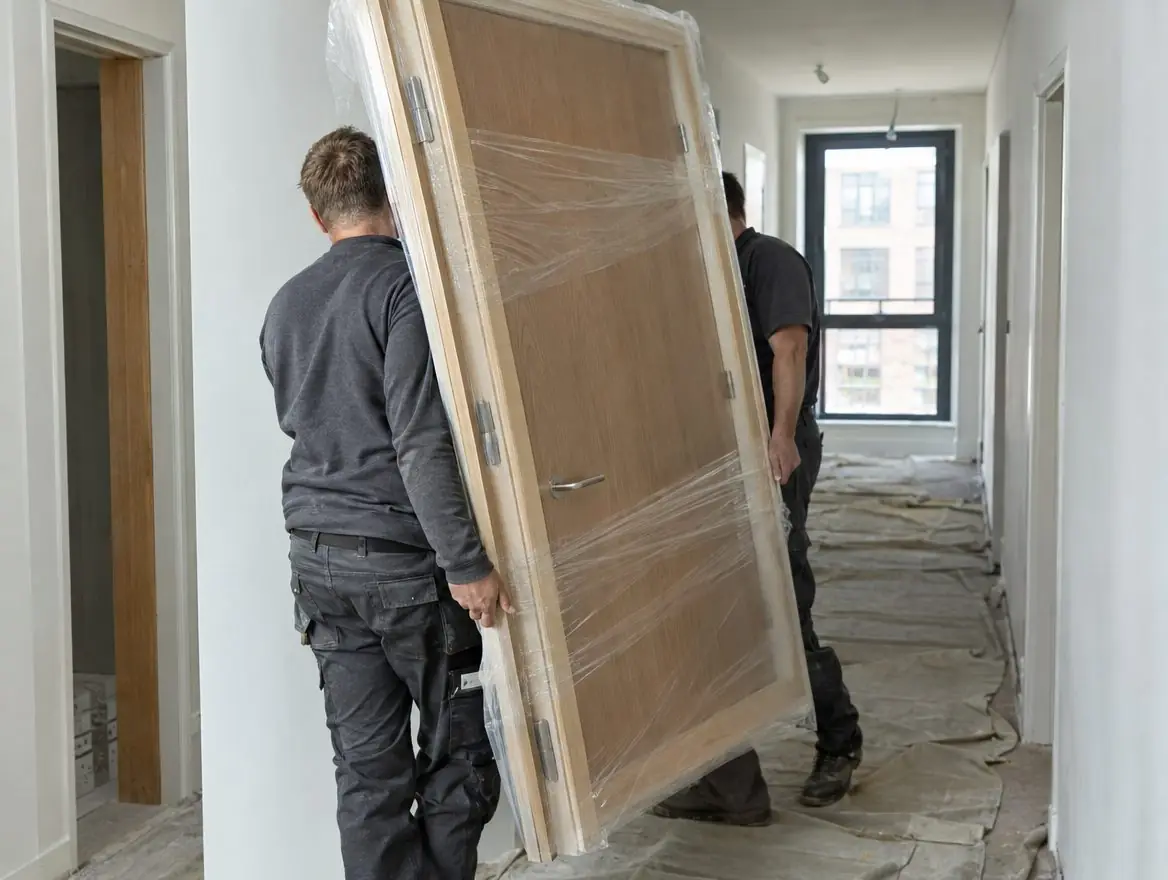
A certified fire doorset is a complete factory-assembled unit, including leaf, frame, hinges and seals and usually the ironmongery, that has been fire tested and is covered by a third-party certification scheme as one product. Certification means production is audited and that the door, built and installed as its certificate describes, matches the performance shown in testing.
Doorset, door assembly or door leaf: what is the difference?
Fire doors reach site in three main forms, and the difference decides how much depends on the people fitting them.
| Form | What is certified | What has to be right on site |
|---|---|---|
| Doorset | The complete unit: leaf, frame, hinges, seals and usually the lock and closer, made and supplied together | Frame fixing, gap sealing to the wall and final adjustment |
| Door assembly or kit | A defined combination of leaf, frame and components, put together on site to the certificate's specification | Every component choice and how each is fitted |
| Certified leaf | The leaf only, with stated requirements for the frame, seals and ironmongery it must be used with | Sourcing a compliant frame and components and assembling them correctly |
Individual components such as hinges, closers, seals and glass also carry their own evidence. That is useful, but a door built from certified components is not a certified door unless the combination itself is covered.
What does third-party certification add to a fire test?
A fire test report records how one specimen performed on one day. Third-party certification builds on that evidence in three ways. The scheme reviews the test and assessment evidence and sets out a clear scope, sometimes called the field of application, describing what can and cannot be varied. It audits the manufacturer's production so that the doors leaving the factory are made the same way as the ones tested. And it gives each product a traceable mark and a listing that anyone can check.
For the building owner, this means a certified product comes with a clear answer to the question every inspector and fire risk assessor asks: what is this door, and how do we know? Without certification, answering that question usually depends on finding the original test reports and proving the door was built to match.
Schemes that buyers commonly look for include BWF Certifire, BM TRADA Q-Mark, FIRAS and IFC. Some cover products, some cover installers and some cover both, so it is worth asking which one applies to what you are buying.
Where is the label and what does it tell you?
Certified leaves usually carry a tamper-evident label or a small plug set into the edge of the leaf, typically on the top edge or the hinge edge. The detail varies between schemes: some use a label with a certificate number and serial number, and in some schemes the colour or marking of a plug indicates the rating. Frames and doorsets may be marked separately.
These marks are easy to lose. Planing the top edge, painting over a label or replacing a lipping can remove them, and without the mark it becomes difficult to prove what the door is. Photograph the labels when a door is installed and keep the photos with the building's records. Never remove a label to tidy up the appearance of a door.
Why is a certified leaf in an untested frame a problem?
When a fire door is tested, the frame is part of the specimen. Its timber density or material, section size, stop depth, joint construction and the position of the intumescent seals all affect how the door performs. In a fire, the frame chars and the leaf bows. A weak frame or a shallow stop can let the leaf pull away and open a gap long before the leaf itself has failed.
This is a common outcome of refurbishment work, where a new certified leaf is hung in an old softwood lining because it looks fine and costs less. The same issue arises when an old frame is rebated to take a thicker leaf, which can leave the stop too shallow or the frame too thin at the point where it matters most. The label on the leaf proves the leaf, not the assembly. An existing frame can sometimes be kept, but only where it meets the frame requirements in the leaf's certification and is in sound condition, which needs checking at survey. Where it does not, a new frame or a complete fire doorset is the safer route; see also fire door frames.
How do you check a certificate?
- Record the mark. Note the certificate number, scheme and any serial number from the label or plug.
- Find the listing. Certification schemes publish online directories of current certificates. Confirm the certificate is valid and the holder matches the manufacturer.
- Read the scope. Check the fire rating, any smoke control, permitted configurations such as single or double, latched or unlatched, and maximum leaf sizes.
- Check the details. Look at the frame specification, approved hinges, locks and closers, permitted glazing systems and aperture sizes, and any rules on trimming or adding letterplates.
- Compare with the door in front of you. Every visible element should match something the certificate allows.
- Keep a copy with the building's fire safety records.
What can quietly invalidate a certified door?
Most problems come from later changes rather than the original product. Common examples are trimming beyond the permitted limits, swapping in ordinary hinges or an unlisted lock, cutting holes for a spyhole, letterplate or second lock, replacing broken glass with whatever was available, painting over seals and removing the closer. Each change outside the certificate's scope means the door no longer matches its evidence. Some alterations can be made legitimately through the manufacturer or an approved converter, and our guide on trimming and altering fire doors explains the limits.
What should you ask for when buying a certified door?
- The certificate number and data sheet before the order is placed, not after delivery.
- Confirmation that the configuration, size, glazing and ironmongery you need are within scope.
- The manufacturer's installation instructions, including frame fixing and gap sealing.
- Installation evidence for each door, including photos of the label and the sealed frame gap.
For flat entrances, where security, smoke control and appearance all matter, a certified flat entrance fire doorset is usually the most straightforward choice.
It also helps to think about the life of the door after handover. Ask what spare parts are available, whether replacement hinges, closers and seals can be bought to match the certificate, and how glass breakage would be dealt with. A door that can only be maintained with parts nobody stocks tends to drift out of its evidence over a few years of patch repairs.
Frequently asked questions
Is a fire test report the same as certification?
No. A test report records how one specimen performed. Certification adds a defined scope, ongoing audits of manufacturing and a traceable mark on each product. Building control may accept test or assessment evidence on its own, but certification makes it much easier for buyers, inspectors and responsible persons to check what they have.
What if my fire door has no label?
It does not automatically mean the door is not a fire door. Labels get painted over or removed, and older doors may never have had one. It does make the door harder to verify. Options include tracing the original paperwork, a specialist assessment or replacement, and the responsible person decides which is appropriate.
Can I choose my own handles and locks for a certified door?
Only items the certificate or the manufacturer's data permits. Locks and latches in particular must be of a type tested with that door, often with intumescent protection around them. Fitting unlisted ironmongery can leave the door outside its evidence, even if the new item looks very similar to the original.
Is a doorset always better than a separate door and frame?
Not always, but a doorset removes many site variables because the leaf, frame and hardware are made to work together. A separate leaf and frame can perform equally well if every component and fixing matches the evidence. Doorsets tend to suit flat entrances and busy communal doors best.
This guide is general information about fire doors in the UK, not legal advice. Your fire risk assessor, the responsible person or building control has the final say for your building.