
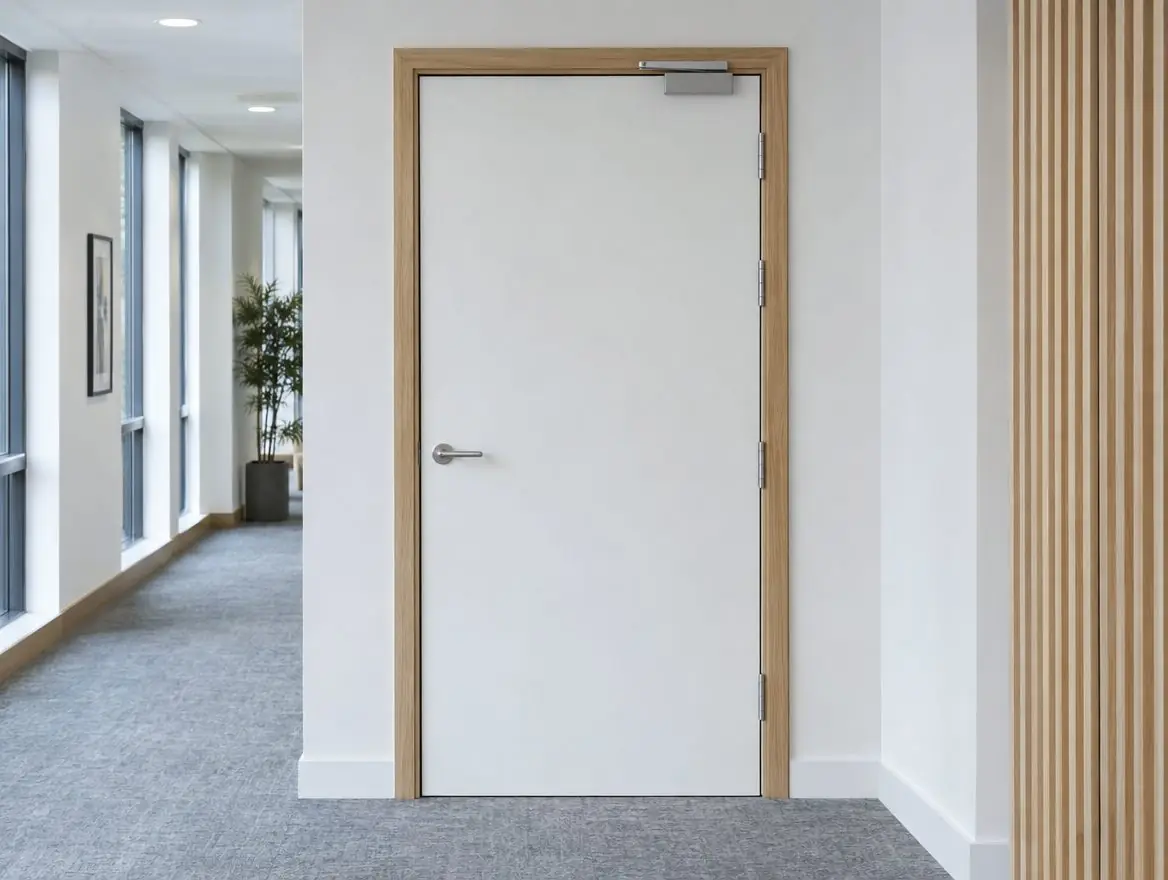
Getting FD30 fire doors right in Kirkby
Our FD30 fire doors service in Kirkby is simple: a survey, a fixed quote, certified products and an installation finished to the manufacturer's evidence.
Buildings in and around Kirkby range from family homes after loft conversions to care homes and small blocks of flats. Whatever the building, the standard is the same: certified products, correct gaps, seals and closers, and a frame sealed to the wall.
For a mixed portfolio in Kirkby, we can survey every FD30 opening in one visit and price leaf-only and doorset options side by side. Each FD30 leaf we supply for Kirkby is sized for the opening, rather than trimmed beyond what its certification allows.
What does a correct FD30 installation include?
A typical timber FD30 leaf is around 44mm thick and hangs on at least three fire-tested hinges. The gaps between leaf and frame are set to the manufacturer's data, usually around 3mm. Intumescent strips, and smoke seals where needed, go in the frame or leaf edge as specified. The closer must pull the door shut and latch it from any angle. Every hole cut for a lock, latch or hinge is lined with intumescent material where the certification calls for it.
Then comes the part that is often skipped: sealing the gap between the frame and the wall with a tested material, as BS 8214:2026 now sets out in more detail.
On a typical job that means:
- Certified FD30 or FD30S leaf, or full doorset
- Fire-tested hinges, latch or lock and intumescent pads
- Photo record, product data and certificate references at handover
- Survey of the opening, frame and existing ironmongery
Rules and responsibilities in Kirkby
The rules that apply to fire doors in Kirkby are England's. The responsible person under the Regulatory Reform (Fire Safety) Order 2005 must keep fire doors in non-domestic premises and the common parts of flats in working order; the Fire Safety Act 2021 confirmed that this includes flat entrance doors onto common parts.
Where a Kirkby block is above 11 metres, regulation 10 of the 2022 regulations means communal doors are checked every three months and flat entrance doors annually on a best-endeavours basis. Replacement doors must also satisfy the Building Regulations, with Approved Document B as the guidance most building control bodies work from.
Where FD30 fire doors fit in Kirkby
From HMOs to care homes, the requirement for FD30 fire doors in Kirkby comes from the fire strategy or risk assessment for the building. We work from that document, or help you interpret your inspection report, before quoting.
The steps on a Kirkby installation
- Measure the opening, check the frame and confirm the rating needed
- Order a certified leaf or doorset to size, with matching components
- Remove the old door and assess the frame or structural opening
- Fix the frame and hang the leaf to the certified gap tolerances
- Fit seals, hinges, latch, closer and signage, then test close-and-latch
- Seal the frame-to-wall gap, make good and record the evidence
What does FD30 fire doors cost in Kirkby?
Budget around £300–£600 for a leaf into a sound existing frame; £650–£1,300 for a doorset, ex VAT for FD30 fire doors. Our guide prices are the same in Kirkby as elsewhere; what changes the cost is the doors themselves. Use our guide-price tool for a quick estimate.
Nearby areas we cover from Kirkby
We also cover towns near Kirkby, including Maghull (5.0 km away), Litherland and Prescot. If your building is in L32 or a neighbouring district, the service and pricing are the same.
Common questions
Do you cover L32 and nearby postcodes?
Yes. We cover Kirkby including L32, and nearby towns such as Maghull and Litherland. The survey and written quote are free.
Can you work from an existing inspection report for my Kirkby building?
Yes. Send it over and we can often price straight from it, then confirm on site. We report back against the same door references so you can close actions off.
What is the difference between FD30 and FD30S?
FD30S has been tested for smoke control as well as fire. It adds a smoke seal, usually a brush or blade, and needs a tight threshold gap. Flat entrance doors and doors onto protected escape routes are commonly specified as FD30S.
Do FD30 doors need a closer?
Most do. Doors on escape routes, flat entrance doors and doors in the common parts of buildings need a self-closing device that shuts and latches the door. Some doors inside houses and locked riser doors are exceptions, depending on the fire strategy.