
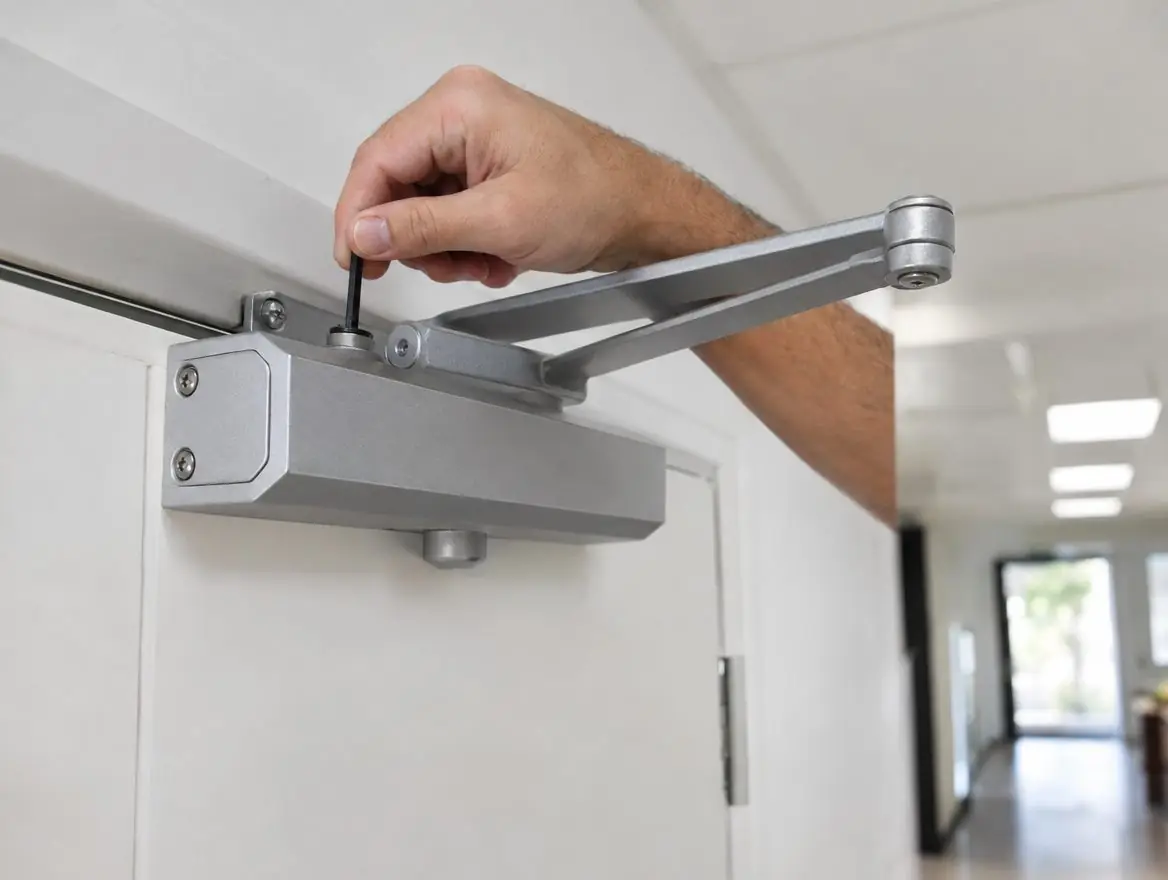
A fire door closer is a self-closing device, usually an overhead closer to BS EN 1154, that returns the door to its closed and latched position after every use. It must be the right power size for the leaf, adjusted so the door closes fully from any angle without slamming, and should keep opening forces low enough for building users, as Approved Document M guidance recommends.
Why does the closer matter so much?
A fire door only protects anyone when it is shut. Doors on escape routes, flat entrances and many other locations are required to be self-closing so they do not rely on people remembering to close them. If the closer fails, is disconnected or is too weak to latch the door, the door may be standing open when a fire starts, and the leaf, seals and frame never get the chance to do their job.
Closers also cause problems when they are too strong. A door that is hard to open is a barrier for children, older people and wheelchair users, and it is the main reason people wedge fire doors open. Getting the balance right is the core of a good closer installation.
What do BS EN 1154 and power sizes mean?
BS EN 1154 is the standard for controlled door closing devices, and overhead closers on fire doors should be tested to it and suitable for fire doors. The standard uses power sizes from EN 1 to EN 7, with higher numbers giving a stronger closing force, suited to wider, heavier leaves or doors exposed to wind or air pressure. Many closers have an adjustable power range, such as EN 2 to 4, set by a valve or spring adjustment.
Fire doors generally need at least power size 3 under common guidance, though the manufacturer's data for both the door and the closer should be followed. The table shows the general relationship between power size and leaf width that closer manufacturers commonly use.
| Power size | Typical maximum leaf width | Typical use |
|---|---|---|
| EN 2 | Around 850mm | Light internal doors, generally not fire doors |
| EN 3 | Around 950mm | Many standard internal fire doors |
| EN 4 | Around 1,100mm | Heavier or wider fire doors, flat entrances |
| EN 5 and above | Around 1,250mm and wider | Large, heavy or external doors |
How should a closer be adjusted?
Most hydraulic overhead closers have separate valves controlling different stages of the closing cycle:
- Closing speed controls how fast the door swings through most of its arc. Too fast and it is a hazard; too slow and the door may be left open for too long.
- Latching action controls the last few degrees, giving a final push to overcome the latch and the resistance of the smoke seals. This is the setting most often responsible for a door that closes but does not latch.
- Backcheck cushions the door as it is opened beyond a certain angle, protecting walls, the leaf and the hinges from being thrown open.
- Delayed action, where fitted, holds the door briefly before it starts to close. It can help some users but must still close the door within a reasonable time.
Test the door from several angles, including just a few degrees open, because a closer may latch the door from 90 degrees but not from a small opening. Our fire door closers service includes setting up and testing closers to suit each door.
How heavy should a fire door be to open?
Approved Document M in England recommends that the opening force at the leading edge of a door should be no more than 30N from 0 to 30 degrees and no more than 22.5N from 30 to 60 degrees of the opening cycle. These figures are used widely as a benchmark for accessibility.
Meeting them with a door that also closes and latches reliably needs a closer of the right type and size, careful adjustment, a well-hung leaf, and seals that are not over-tight. Cam-action closers, which use a slide channel rather than a scissor arm, often achieve lower opening forces for the same closing power because the force drops off as the door opens. Opening force can be checked with a door pressure gauge, and many inspections now include this measurement.
What other closer types are available?
| Type | Where it suits | Points to watch |
|---|---|---|
| Overhead closer with scissor arm | Most fire doors; robust and easy to adjust | Can be heavier to open than cam-action types |
| Cam-action closer with slide arm | Accessibility, flat entrances, neat appearance | Must be compatible with the door's evidence |
| Concealed closer | Homes and hotels where appearance matters | Only use a model tested with that door, often with intumescent protection; some are less powerful |
| Free-swing closer | Care homes and similar settings where users struggle with door weight | Must be linked to the fire alarm so it reverts to closing when the alarm activates |
| Electromagnetic hold-open with closer | Busy corridors where doors would otherwise be propped | Hold-open devices to BS EN 1155 must release on alarm |
Free-swing closers and hold-open devices both rely on the fire alarm to release them. BS 7273-4 covers how that actuation should work. See hold-open devices for more detail.
Are spring hinges and rising butts acceptable?
Spring hinges and rising butt hinges are sometimes found on older fire doors, especially in houses and HMOs. Some have been tested for use on fire doors, but many struggle to close a door fully against its seals and latch, and they offer little control over closing speed. Whether they are acceptable depends on the door's evidence, the location and what the responsible person or building control will accept. Where in doubt, an overhead closer is the more reliable choice. Our HMO fire door guide touches on how councils tend to view them.
What are the most common closer faults?
- The door closes but does not latch, usually because the latching action is set too low or the keep is misaligned.
- The door slams, putting stress on the frame and hinges.
- Oil is leaking from the closer body, which means the closer needs replacing.
- The arm is loose, bent or disconnected, often after being forced.
- The closer is too weak for the leaf, especially on wide or heavy doors.
- The closer has been removed or unhooked, which is a serious defect on any door that needs to be self-closing.
Most of these can be fixed in a single visit. If a closer fault is just one item on a longer list, our guide on failed fire door inspections will help you prioritise.
Frequently asked questions
What power size closer does a fire door need?
Fire doors commonly need at least power size 3 to BS EN 1154, with wider or heavier leaves needing size 4 or more. The door manufacturer's data and the closer manufacturer's sizing guidance should both be followed, and the closer must be suitable for use on fire doors.
Why does my fire door close but not latch?
The usual causes are a latching action valve set too low, a misaligned keep, over-tight smoke seals or a leaf that has dropped on its hinges. Adjusting the latching action and checking the hinges and keep normally solves it. If not, the closer may be undersized or worn.
Can a concealed closer be fitted to a fire door?
Yes, if the concealed closer has been tested with that type of door and is fitted with any intumescent protection its evidence requires. Concealed closers are often less powerful than overhead closers, so check they can close and latch the door reliably, particularly with smoke seals fitted.
Is it legal to wedge a fire door open?
Fire doors that are required to be self-closing should not be wedged open. If a door needs to stand open for everyday use, the correct solution is a hold-open device to BS EN 1155 or a free-swing closer, linked to the fire alarm so the door releases and closes automatically when the alarm activates.
This guide is general information about fire doors in the UK, not legal advice. Your fire risk assessor, the responsible person or building control has the final say for your building.