
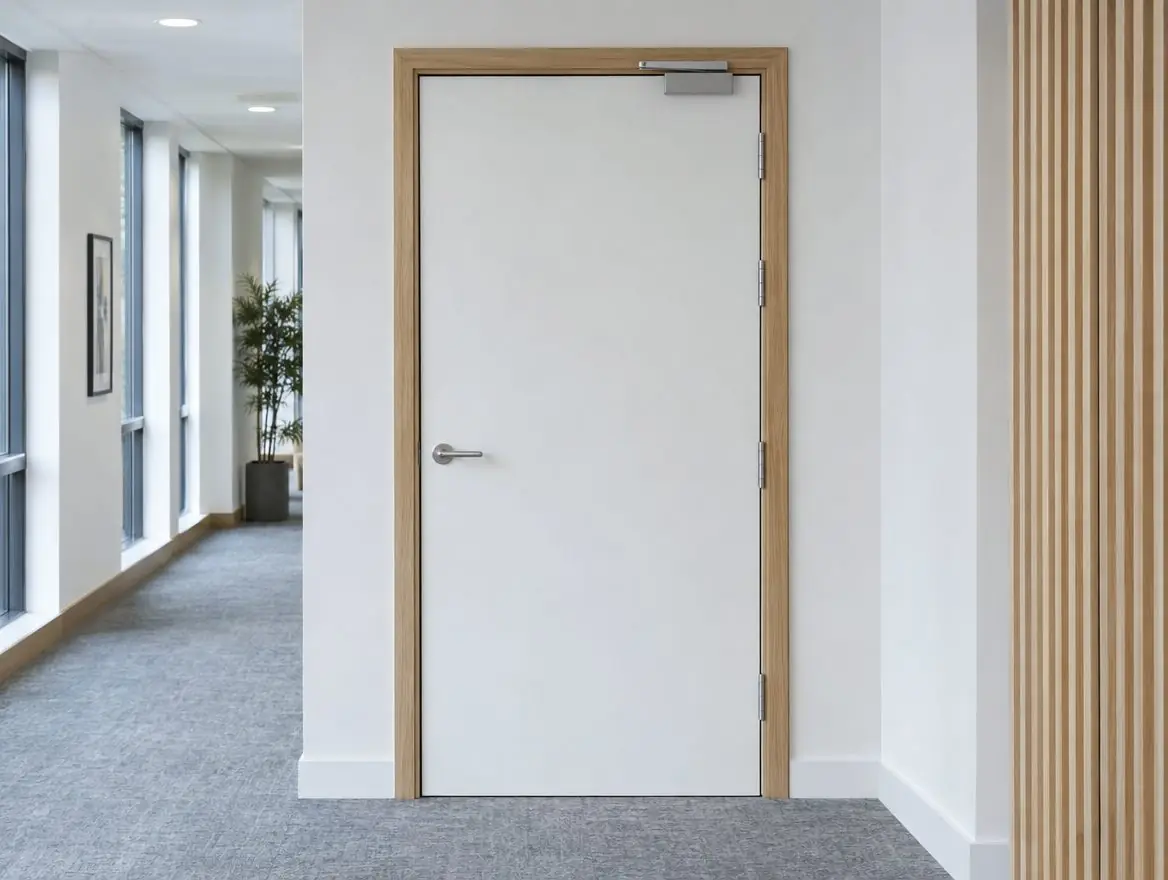
FD30 fire doors in Morley: what's involved
If you need FD30 fire doors in Morley, we can survey, supply and install, then leave you the evidence your fire risk assessor will ask for.
In and around Morley, fire door work covers everything from care homes to low-rise blocks of flats. We plan each job around the people who use the building.
For a mixed portfolio in Morley, we can survey every FD30 opening in one visit and price leaf-only and doorset options side by side. Each FD30 leaf we supply for Morley is sized for the opening, rather than trimmed beyond what its certification allows.
What does a correct FD30 installation include?
A typical timber FD30 leaf is around 44mm thick and hangs on at least three fire-tested hinges. The gaps between leaf and frame are set to the manufacturer's data, usually around 3mm. Intumescent strips, and smoke seals where needed, go in the frame or leaf edge as specified. The closer must pull the door shut and latch it from any angle. Every hole cut for a lock, latch or hinge is lined with intumescent material where the certification calls for it.
Then comes the part that is often skipped: sealing the gap between the frame and the wall with a tested material, as BS 8214:2026 now sets out in more detail.
As standard, the work covers:
- Overhead closer set to close and latch
- Certified FD30 or FD30S leaf, or full doorset
- Fire-tested hinges, latch or lock and intumescent pads
- Survey of the opening, frame and existing ironmongery
The regulations behind fire doors in Morley
In Morley, as elsewhere in England, the starting point is the Fire Safety Order 2005: whoever controls a workplace or the shared parts of a residential block must make sure its fire doors work. When doors are replaced, the Building Regulations and Approved Document B set the standard the new work has to meet.
Blocks above 11 metres have a specific routine under regulation 10 of the Fire Safety (England) Regulations 2022: quarterly checks of communal fire doors and annual best-endeavours checks of flat front doors. If your Morley building is a higher-risk building under the Building Safety Act 2022, we confirm the approval route with the Principal Accountable Person before any work is ordered.
Buildings and duty holders in Morley
Landlords, managing agents, facilities teams and homeowners in Morley can all commission FD30 fire doors from us. The usual settings are offices and schools, though single doors for shops are just as welcome.
The steps on a Morley installation
- Measure the opening, check the frame and confirm the rating needed
- Order a certified leaf or doorset to size, with matching components
- Remove the old door and assess the frame or structural opening
- Fix the frame and hang the leaf to the certified gap tolerances
- Fit seals, hinges, latch, closer and signage, then test close-and-latch
- Seal the frame-to-wall gap, make good and record the evidence
Budgeting for FD30 fire doors in Morley
Budget around £300–£600 for a leaf into a sound existing frame; £650–£1,300 for a doorset, ex VAT for FD30 fire doors. Our guide prices are the same in Morley as elsewhere; what changes the cost is the doors themselves. Use our guide-price tool for a quick estimate.
Morley and neighbouring towns
Morley is about 7.1 km from Leeds, and we cover both, along with nearby Batley and Dewsbury. Send us your postcode and we'll confirm survey dates.
Questions
Do you work in Morley?
Yes, we take on FD30 fire doors in Morley and the surrounding area, including Batley and Dewsbury. Send your postcode and a few details and we'll come back with survey dates.
What happens on a survey in Morley?
We look at every door in scope: the leaf, frame, gaps, seals, hinges, closer, glazing and how the frame is fixed. You then get a written quote that prices each door separately.
How long does it take to fit an FD30 door?
A leaf into a sound frame is often a few hours. A full doorset including frame removal, fixing, sealing and making good is usually half a day to a day per opening, depending on access and the wall construction.
Do FD30 doors need a closer?
Most do. Doors on escape routes, flat entrance doors and doors in the common parts of buildings need a self-closing device that shuts and latches the door. Some doors inside houses and locked riser doors are exceptions, depending on the fire strategy.