
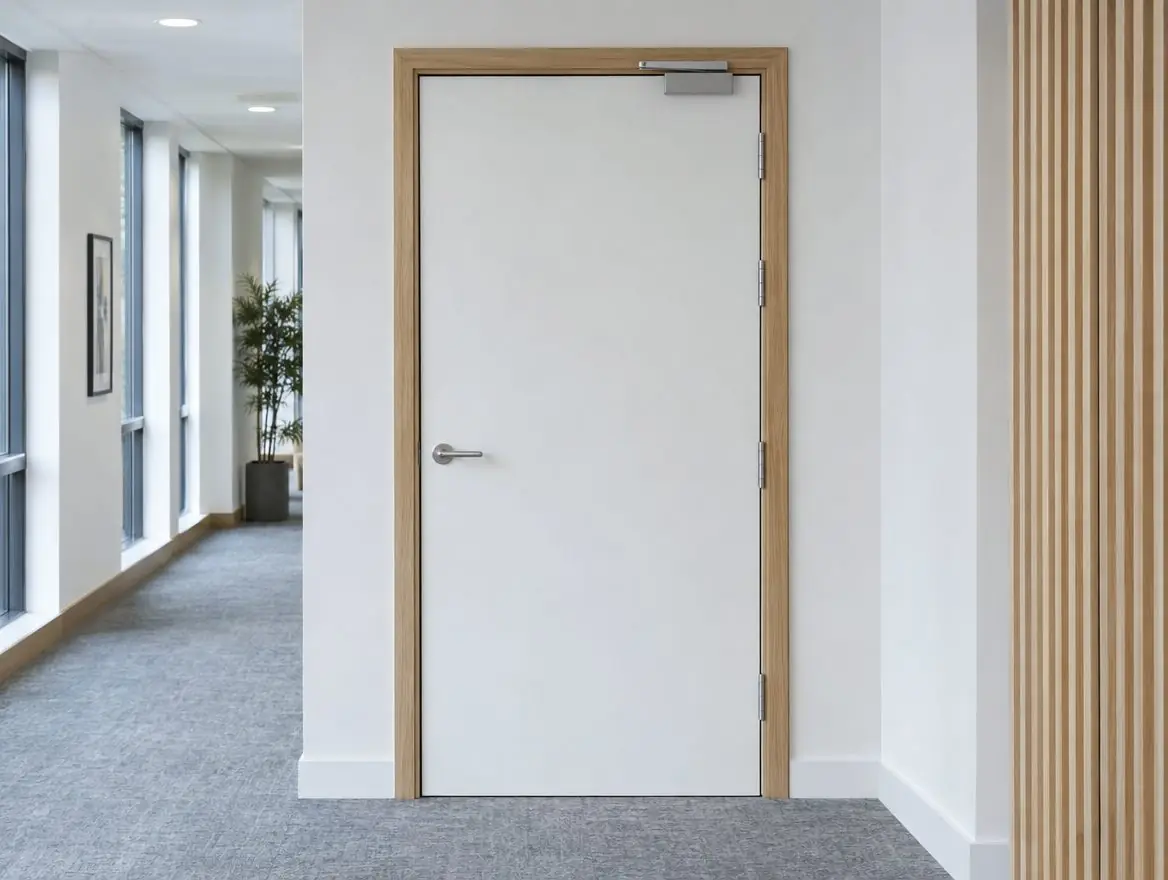
What FD30 fire doors in Maesteg should include
From the CF34 postcode district outwards, we take on FD30 fire doors across Maesteg for homes, blocks and workplaces.
Fire doors in Maesteg protect escape routes in care homes, houses with integral garages and family homes after loft conversions alike. We adapt the programme to the building and its occupants, never the standard of the installation.
In Maesteg, FD30 doors are the usual choice for escape-route corridors, stairs and kitchen doors where the fire strategy asks for 30 minutes. Each FD30 leaf we supply for Maesteg is sized for the opening, rather than trimmed beyond what its certification allows.
Where are FD30 doors used?
FD30 is the rating most buildings rely on. You will find it on flat entrance doors, doors onto escape corridors and stairs in houses in multiple occupation, kitchen doors in HMOs, and most internal doors on escape routes in offices, schools, surgeries and shops. Where smoke control matters too, the door is specified as FD30S (E30Sa), which adds a smoke seal and a tighter threshold.
The rating your building needs comes from its fire strategy or fire risk assessment, not from the door supplier. If you are unsure whether a door should be FD30 or FD60, we check the drawings, the risk assessment and what is installed now before we price anything. Our FD30 vs FD60 guide explains the difference.
As standard, the work covers:
- Intumescent strips and smoke seals to the certification
- Overhead closer set to close and latch
- Certified FD30 or FD30S leaf, or full doorset
- Survey of the opening, frame and existing ironmongery
What the rules say for Maesteg
Because Maesteg is in Wales, we work to the Building Regulations as they apply in Wales and to the Welsh version of Approved Document B. The responsible person duties under the Fire Safety Order 2005 still apply to workplaces and common parts.
England's fire door checking rules for tall residential buildings do not apply in Wales, so the checking frequency for doors in Maesteg comes from your fire risk assessment.
Where FD30 fire doors fit in Maesteg
Landlords, managing agents, facilities teams and homeowners in Maesteg can all commission FD30 fire doors from us. The usual settings are care homes and blocks of flats, though single doors for offices are just as welcome.
From enquiry to handover in Maesteg
- Measure the opening, check the frame and confirm the rating needed
- Order a certified leaf or doorset to size, with matching components
- Remove the old door and assess the frame or structural opening
- Fix the frame and hang the leaf to the certified gap tolerances
- Fit seals, hinges, latch, closer and signage, then test close-and-latch
- Seal the frame-to-wall gap, make good and record the evidence
Budgeting for FD30 fire doors in Maesteg
As a guide, budget £300–£600 for a leaf into a sound existing frame; £650–£1,300 for a doorset, ex VAT for FD30 fire doors. The figure for your Maesteg building depends on the number of doors, the rating, the condition of the frames, finishes, hardware and access. We confirm a fixed price after the free survey.
Covering Maesteg and nearby
Nearby towns we cover include Briton Ferry, Neath and Bridgend. Distance from Maesteg does not change our guide prices, and the survey and quote are free.
Questions from Maesteg
Do you cover CF34 and nearby postcodes?
Yes. We cover Maesteg including CF34, and nearby towns such as Briton Ferry and Neath. The survey and written quote are free.
What happens on a survey in Maesteg?
We look at every door in scope: the leaf, frame, gaps, seals, hinges, closer, glazing and how the frame is fixed. You then get a written quote that prices each door separately.
How long does it take to fit an FD30 door?
A leaf into a sound frame is often a few hours. A full doorset including frame removal, fixing, sealing and making good is usually half a day to a day per opening, depending on access and the wall construction.
Do FD30 doors need a closer?
Most do. Doors on escape routes, flat entrance doors and doors in the common parts of buildings need a self-closing device that shuts and latches the door. Some doors inside houses and locked riser doors are exceptions, depending on the fire strategy.