
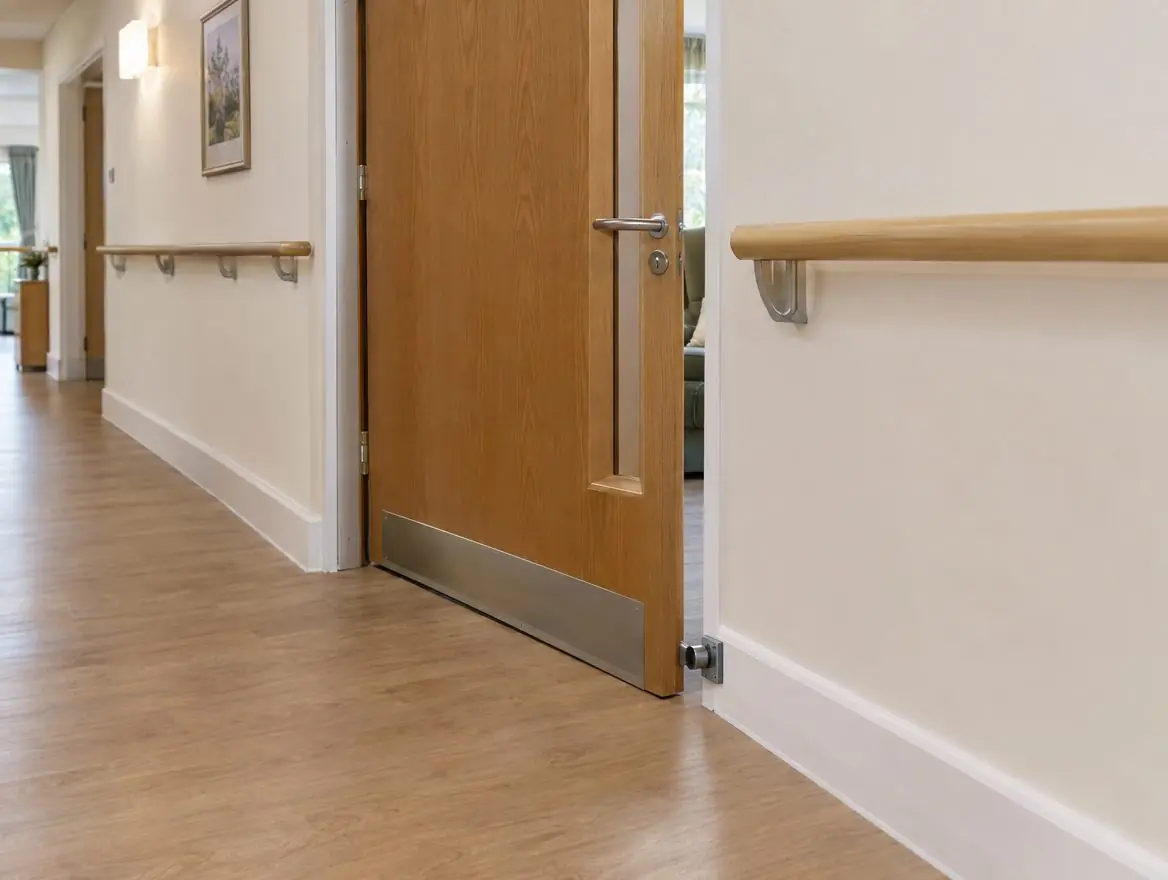
Fire door hold-open devices for Market Harborough buildings
We provide fire door hold-open devices in Market Harborough (LE16 and the surrounding postcodes), from the first survey through to a documented handover.
Around Market Harborough, light industrial buildings, small blocks of flats and houses with integral garages all depend on fire doors that close, latch and seal. We survey each opening and tell you plainly which doors need work and which don't.
Where doors in Market Harborough care homes, schools or offices are being wedged open, a hold-open device is the safe fix. We coordinate with your fire alarm contractor in Market Harborough so every hold-open releases when it should.
Types of hold-open
Electromagnetic door holders are wall or floor magnets wired to the fire alarm. Hold-open closers combine the closer and the hold-open in one unit. Free-swing closers let the door move freely and close it on alarm. Some battery units listen for the alarm sound; these must be suitable for the alarm system and the building. The right choice depends on the door, the alarm and how people use the space.
As standard, the work covers:
- Release testing with the alarm
- Record of devices and test results
- Hold-open and free-swing closers
- Assessment of door use and alarm system
Rules and responsibilities in Market Harborough
Fire doors in Market Harborough fall under English rules. New and replacement doors are covered by the Building Regulations 2010 and Approved Document B. In workplaces and the common parts of blocks, the Regulatory Reform (Fire Safety) Order 2005, as clarified by the Fire Safety Act 2021, puts the duty on the responsible person to keep fire doors suitable and maintained.
For residential buildings in Market Harborough above 11 metres, regulation 10 of the Fire Safety (England) Regulations 2022 adds checks: communal fire doors at least every three months and best-endeavours checks of flat entrance doors at least every twelve months. Higher-risk buildings of at least 18 metres or seven storeys also come under the Building Safety Act 2022, where works may need approval from the Building Safety Regulator.
Which buildings in Market Harborough need fire door hold-open devices?
You are most likely to need fire door hold-open devices if you look after schools, communal corridors or clinics. Whatever the building in Market Harborough, we survey each opening and tell you which doors need work and which do not.
From enquiry to handover in Market Harborough
- Survey the doors and the fire alarm arrangement
- Choose device type for each door
- Agree interface work with the alarm contractor
- Fit and commission the devices
- Test release on alarm activation
- Record results and hand over
Budgeting for fire door hold-open devices in Market Harborough
As a guide, budget £180–£450 per door for the device, excluding fire alarm interface work, ex VAT for fire door hold-open devices. The figure for your Market Harborough building depends on the number of doors, the rating, the condition of the frames, finishes, hardware and access. We confirm a fixed price after the free survey.
Covering Market Harborough and nearby
We also cover towns near Market Harborough, including Corby (15.8 km away), Kettering and Wigston. If your building is in LE16 or a neighbouring district, the service and pricing are the same.
Questions from Market Harborough
Do you cover LE16 and nearby postcodes?
Yes. We cover Market Harborough including LE16, and nearby towns such as Corby and Kettering. The survey and written quote are free.
How quickly can you survey in Market Harborough?
It depends on the number of doors and access, but we offer survey dates as soon as we reply to your enquiry. If an inspection has found urgent safety issues, tell us and we'll prioritise.
What is the difference between a hold-open and a free-swing closer?
A hold-open keeps the door at a fixed open position. A free-swing closer lets the door move freely, as if no closer were fitted, until the alarm sounds.
Who tests hold-open devices?
They should be tested with the fire alarm as part of the routine testing arrangements. We test them at installation and record the results.