
Fire door ironmongery: our service in Washington
Looking for fire door ironmongery in Washington? We supply and fit certified fire doors and components across Washington and the wider Tyne and Wear area, working from a free survey and a fixed written quote.
Washington has a broad mix of buildings, including schools, low-rise blocks of flats and houses with integral garages, and the same fire door principles apply to all of them.
We supply ironmongery for Washington fire doors that matches each door's test evidence. Signage for fire doors in Washington buildings is fitted as part of the job, not as an afterthought.
Why hardware choice matters
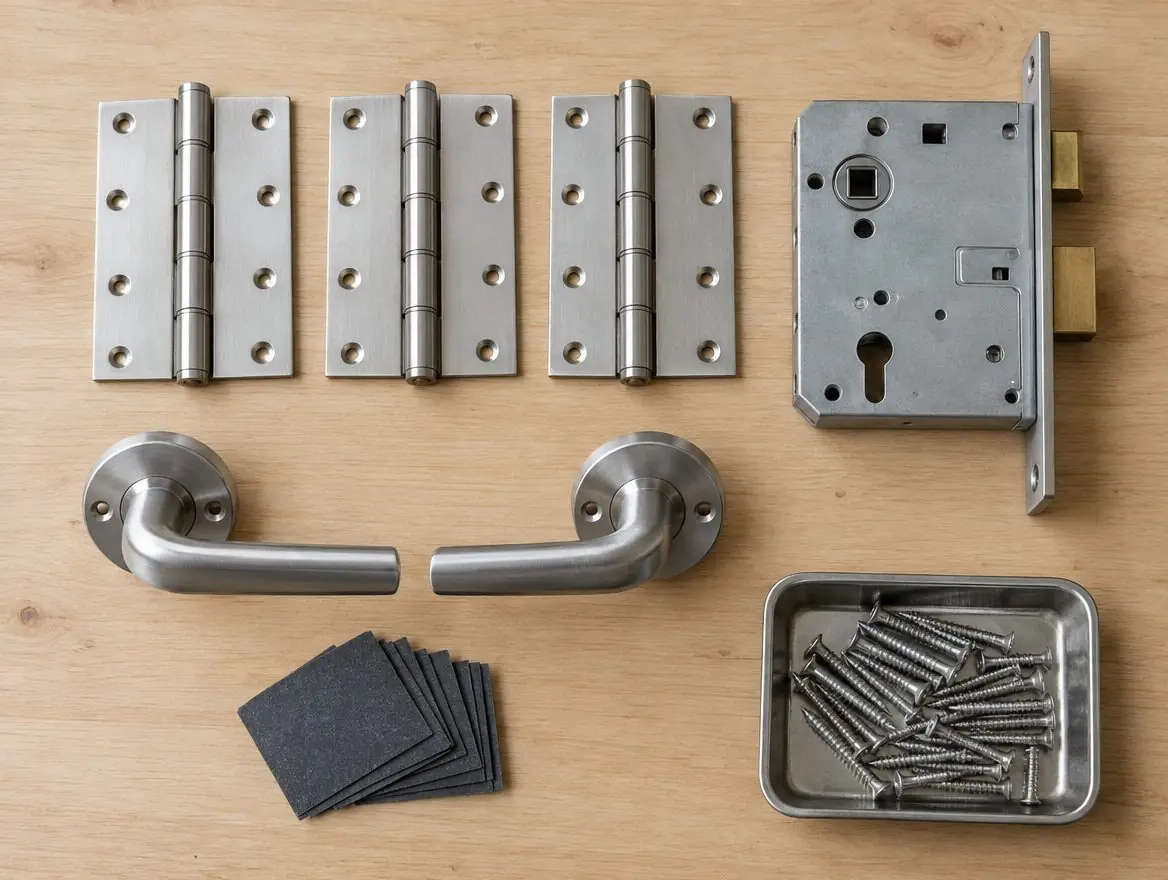
Fire doors are tested with particular hardware. Hinges hold the door in place as it heats up; locks and latches keep it shut against fire pressure; their holes are protected with intumescent linings. Swapping in a cheaper hinge, a larger lock body or a lever on a spindle that melts can change how the door behaves. Hinges for fire doors are commonly grade 13 to BS EN 1935.
As standard, the work covers:
- Lever handles, pull handles and push plates
- Locks and latches covered by the evidence
- Fire-rated hinges, commonly grade 13
- Intumescent pads and lock linings
The regulations behind fire doors in Washington
Fire doors in Washington fall under English rules. New and replacement doors are covered by the Building Regulations 2010 and Approved Document B. In workplaces and the common parts of blocks, the Regulatory Reform (Fire Safety) Order 2005, as clarified by the Fire Safety Act 2021, puts the duty on the responsible person to keep fire doors suitable and maintained.
For residential buildings in Washington above 11 metres, regulation 10 of the Fire Safety (England) Regulations 2022 adds checks: communal fire doors at least every three months and best-endeavours checks of flat entrance doors at least every twelve months. Higher-risk buildings of at least 18 metres or seven storeys also come under the Building Safety Act 2022, where works may need approval from the Building Safety Regulator.
Buildings and duty holders in Washington
Typical settings for fire door ironmongery include schools, offices and hotels. In Washington, as anywhere, the duty holder varies: a responsible person for a workplace, a landlord or managing agent for a block or HMO, or a homeowner after building work. We adjust access, timing and paperwork to suit whoever commissions the work.
Our process in Washington
- Identify the door's certification and hardware schedule
- List items that need replacing
- Supply matching hardware
- Fit with correct pads and linings
- Check operation, closing and latching
- Record what was fitted
Budgeting for fire door ironmongery in Washington
As a guide, budget from £40 for minor items to £350 for a full hardware set per door, ex VAT for fire door ironmongery. The figure for your Washington building depends on the number of doors, the rating, the condition of the frames, finishes, hardware and access. We confirm a fixed price after the free survey.
Covering Washington and nearby
Neighbouring towns such as Chester-le-Street, Felling, Houghton-Le-Spring and Hebburn are covered too, so clients with several buildings can use one installer and one evidence format.
Questions
Do you work in Washington?
Yes, we take on fire door ironmongery in Washington and the surrounding area, including Chester-le-Street and Felling. Send your postcode and a few details and we'll come back with survey dates.
Can you work from an existing inspection report for my Washington building?
Yes. Send it over and we can often price straight from it, then confirm on site. We report back against the same door references so you can close actions off.
Do fire doors need signs?
Most fire doors in non-domestic buildings and common parts should carry signage showing whether they are to be kept shut, kept locked or are automatic.
Are brass hinges acceptable on fire doors?
Only if they are fire tested and covered by the door's evidence. Many decorative hinges are not.