
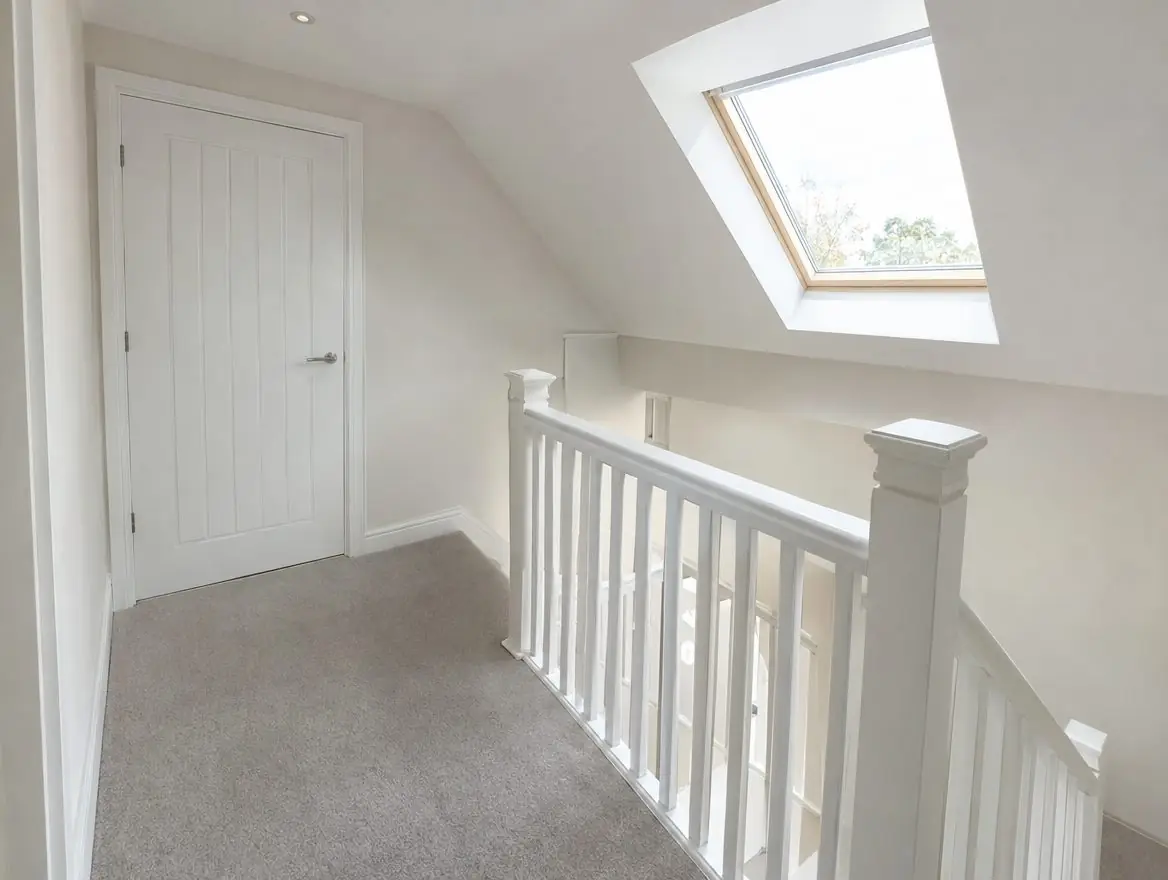
Loft conversion fire doors in Sudbury: what's involved
From the CO10 postcode district outwards, we take on loft conversion fire doors across Sudbury for homes, blocks and workplaces.
Buildings in and around Sudbury range from schools to family homes after loft conversions and houses with integral garages. Whatever the building, the standard is the same: certified products, correct gaps, seals and closers, and a frame sealed to the wall.
For homes in Sudbury, we match fire doors to your existing style wherever certified options allow. A loft conversion in Sudbury that adds a new storey often brings a building control requirement for fire doors on rooms off the stair.
FD20 or FD30?
In England, the guidance generally asks for FD20 (E20) doors in this situation, and self-closers are not usually required within a house. Scotland is different: the domestic Technical Handbook expects doors onto the protected stair enclosure to be self-closing fire doors, so closers are part of the job there. Many homeowners choose FD30 doors anyway, because they are widely available and the price difference is small. Either way, the door must be fitted properly: correct gaps, fire-tested hinges and an intumescent strip where the product requires one.
What you get:
- Check of which openings need fire doors
- Work coordinated with your builder
- Product details for building control
- Fire-tested hinges and intumescent strips as required
Which fire door rules apply in Sudbury?
In Sudbury, as elsewhere in England, the starting point is the Fire Safety Order 2005: whoever controls a workplace or the shared parts of a residential block must make sure its fire doors work. When doors are replaced, the Building Regulations and Approved Document B set the standard the new work has to meet.
Blocks above 11 metres have a specific routine under regulation 10 of the Fire Safety (England) Regulations 2022: quarterly checks of communal fire doors and annual best-endeavours checks of flat front doors. If your Sudbury building is a higher-risk building under the Building Safety Act 2022, we confirm the approval route with the Principal Accountable Person before any work is ordered.
Which buildings in Sudbury need loft conversion fire doors?
Typical settings for loft conversion fire doors include detached family homes, terraced houses and bungalows gaining an upper floor. In Sudbury, as elsewhere, the work is usually commissioned by homeowners, often alongside a builder or after a building control visit, so we fit around the household and leave the product details building control asks for.
The steps on a Sudbury installation
- Review the building control requirements or drawings
- Survey each door opening off the stair
- Agree door style and rating
- Fit doors, hinges and strips
- Check gaps and operation
- Hand over product details
Guide prices in Sudbury
If you need a budget figure first, the guide for loft conversion fire doors is £300–£650 per door supplied and fitted, ex VAT. We firm that up after a survey, pricing each door separately so you can see where the money goes.
Sudbury and neighbouring towns
Nearby towns we cover include Colchester, Haverhill and Braintree. Distance from Sudbury does not change our guide prices, and the survey and quote are free.
Questions from Sudbury
Do you work in Sudbury?
Yes, we take on loft conversion fire doors in Sudbury and the surrounding area, including Colchester and Haverhill. Send your postcode and a few details and we'll come back with survey dates.
Do I need to be there for the survey?
Someone needs to give us access to the doors. For blocks and commercial buildings, a caretaker or site contact is fine; for HMOs and homes, we agree a time with you or your tenants.
Can I just add intumescent strips to my existing doors?
Generally no. A standard internal door is not a fire door, and strips alone will not make it one. Existing doors need to be replaced with certified fire doors.
Do all my doors need to be fire doors after a loft conversion?
Usually the doors from habitable rooms onto the stair do, on every floor. Bathrooms are often excluded. Building control decides for your house.