
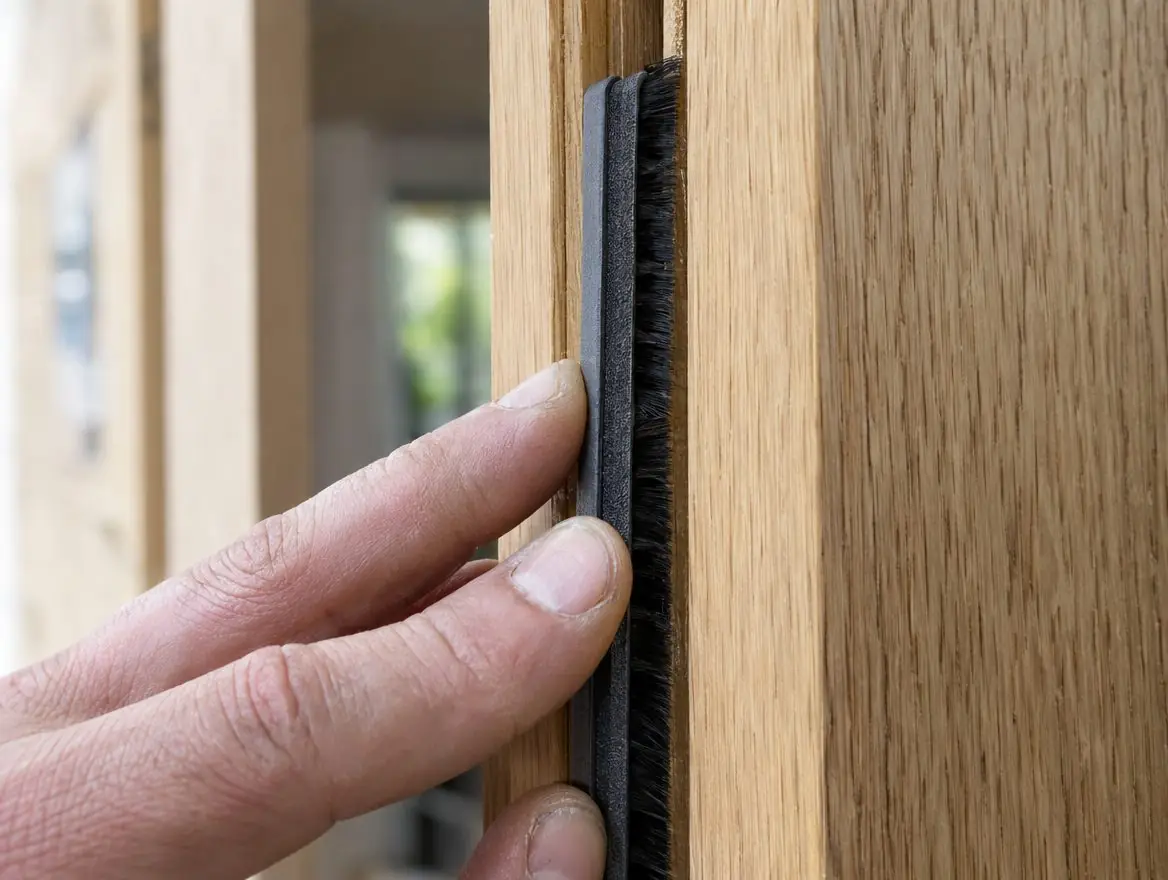
Intumescent strips are seals that swell when heated in a fire, filling the gap between a fire door and its frame so flames and hot gases cannot pass. Smoke seals are brush or blade seals that work at normal room temperature to limit cold smoke spreading in the early stages of a fire. Many doors need both, sometimes combined in one strip.
How does an intumescent strip work?
An intumescent strip contains a material, often based on graphite or sodium silicate, that expands rapidly when heated. In normal use it sits flush in a groove in the frame or the leaf edge and does nothing. When a fire heats the door, the material swells, filling the gap around the leaf and forming a tight, charred seal that blocks flames and hot gases. As the timber at the leaf edge chars and shrinks, the expanded strip continues to fill the space.
Strips come in different widths, thicknesses and expansion types, and their position in the frame matters. Most timber fire doors need intumescent protection at the head and both jambs, and sometimes at the meeting stiles of pairs. The door's certification or test evidence specifies exactly which strips go where, and FD60 doors usually need larger or additional strips compared with FD30.
How does a smoke seal work?
Smoke is the biggest threat to life in most building fires, and it travels long before the heat at a door is enough to activate an intumescent strip. A smoke seal works at ambient temperature. Its job is to close the gap around the door as soon as the door is shut, so that cold smoke does not leak into a corridor or stairway.
Smoke seals are usually one of two types. Brush seals use fine bristles that compress against the leaf, which tolerates slight variations in the gap. Blade or fin seals use a flexible rubber or plastic fin that presses against the leaf or stop. Where smoke control is required, the door is described as FD30S, FD60S, E30Sa or similar, and the seals must be the type tested with that door. The threshold also has to be dealt with, either with a tight gap or a tested threshold or drop-down seal.
What are combined strips?
Many products put both functions in one profile: an intumescent core with a brush or blade attached along one edge. These combined strips fit in a single groove and are common on flat entrance and communal doors that need smoke control. They save space in the frame and keep the installation tidy.
They are not universally interchangeable. A combined strip must still match the size and type specified in the door's evidence. Swapping one brand of combined strip for another, or substituting a combined strip where two separate seals were tested, may change how the door performs.
| Seal type | Works when | Main job | Common location |
|---|---|---|---|
| Intumescent only | Heated in a fire | Closes gaps against flame and hot gases | Frame reveal or leaf edge |
| Smoke seal only | At normal temperatures | Limits cold smoke leakage | Frame stop or reveal |
| Combined strip | Both | Fire and smoke in one profile | Frame reveal, typically one groove |
| Threshold or drop-down seal | At normal temperatures | Limits smoke under the door | Bottom of the leaf |
Does every fire door need smoke seals?
No. Smoke control is required where the fire strategy or guidance calls for it, which typically includes flat entrance doors, doors onto protected stairs and corridors, and the door between a house and an integral garage. Many doors in other locations need fire resistance only. The door schedule, fire strategy or fire risk assessment should show which doors need the S or Sa suffix; our FD30 vs FD60 guide explains the ratings.
That said, adding smoke seals to a door that does not strictly need them is rarely a problem, provided the seals are compatible with the door's evidence and the closer can still close and latch the door against them. Over-specified seals that stop a door latching cause more harm than good.
Can you paint over fire door seals?
You should not. Paint on a smoke seal stiffens the brush or blade so it no longer seals against the leaf. Paint on an intumescent strip can affect how it expands, and several coats can stop it working properly. It is one of the most common inspection findings, usually the result of redecoration rather than installation.
Before decorating, mask the seals carefully or remove them and refit afterwards, if the product allows. If seals have already been painted, the reliable fix is to replace them. Decorators working in blocks of flats and commercial buildings should be told which doors are fire doors and given a simple instruction to avoid seals, hinges, closers and labels.
When should seals be replaced?
- When they are missing, torn, loose or partly pulled out of the groove.
- When brush seals are flattened or blade seals are cracked or brittle.
- When they have been painted over.
- When the door's gaps have been corrected and the existing seals no longer fit.
- After a fire or any event that might have activated the intumescent material.
Replacement seals should be the same type and size as those in the door's evidence, fitted in continuous lengths with clean joints at the corners. Gaps at hinges or keeps should be avoided, and the seal should not be cut short at the threshold if the evidence shows it running down. Our intumescent strips and smoke seals service covers replacing them correctly.
Can new seals fix a door with big gaps?
Not legitimately. Seals are designed to work with the gaps set out in the door's certification, typically around 3mm. Fitting an oversized brush or a thicker strip to hide a gap that is too wide leaves the door outside its evidence and may stop the closer latching it. The correct approach is to fix the cause of the gap first, then fit the right seals. Our guide to fire door gaps explains how gaps are measured and corrected, and our fire door repairs service can do both together.
The same goes for other improvisations seen on site, such as gluing a seal to the face of the stop because the groove is missing, or using draught excluder strip from a hardware shop. A draught strip may reduce draughts, but it has no proven performance against smoke or fire and can melt or burn.
Frequently asked questions
Do intumescent strips do anything in normal use?
No. They sit inactive in their groove and look like a plain strip. They only react when heated well beyond normal room temperatures, which is why they cannot stop cold smoke on their own. The exact activation point depends on the product and its chemistry, so follow the door's evidence when choosing replacements.
Do I need intumescent strips and smoke seals on my flat door?
Flat entrance doors onto common parts are usually expected to provide both fire resistance and smoke control, commonly FD30S or E30Sa. That normally means intumescent protection plus smoke seals, often as a combined strip, along with a suitable threshold arrangement. The door's evidence sets the exact seals.
Can I fit intumescent strips to an ordinary door to make it a fire door?
No. Intumescent strips are only one part of a fire door. The leaf construction, frame, hinges, ironmongery and gaps all contribute to its performance. Adding strips to an ordinary door does not give it a fire rating, though it may form part of a tested upgrade system in specialist cases.
Should fire door seals be in the frame or the door?
Either, depending on the door's certification. Many timber fire doors have seals in grooves in the frame reveal, while others carry them in the leaf edge. What matters is that the position, size and type match the evidence for that door. Changing the location can affect performance.
This guide is general information about fire doors in the UK, not legal advice. Your fire risk assessor, the responsible person or building control has the final say for your building.