
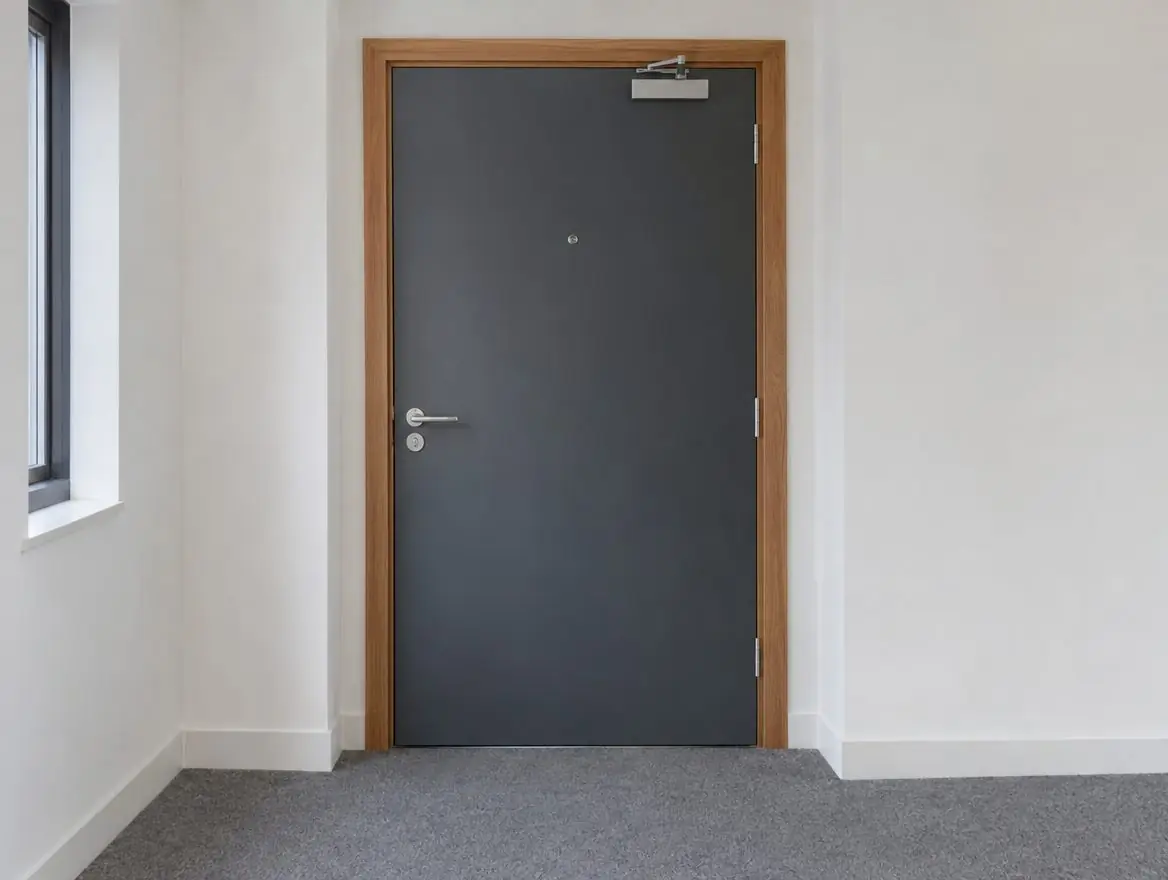
In blocks of flats, fire doors protecting the common escape routes, including flat entrance doors, fall under fire safety law for the building's common parts in England and Wales. In England, residential buildings above 11 metres need communal fire doors checked at least every three months, and best endeavours to check flat entrance doors at least every 12 months.
Why do fire doors matter so much in flats?
Most blocks of flats are designed so that a fire in one flat can be contained there while other residents either stay put or leave by the common stairs. That approach depends on compartmentation, and fire doors are the weakest points in it. The flat entrance door stops fire and smoke leaving the flat of origin. The communal doors across corridors, lobbies and stairs keep the escape routes clear of smoke and protect firefighters using them.
A propped-open stair door or a flat entrance door without a working closer can undermine the whole strategy. That is why the law focuses so much on these doors, and why inspections tend to concentrate on closers, seals and gaps.
What applies in England?
New buildings and building work are covered by the Building Regulations 2010, with practical guidance in Approved Document B. Once a building is occupied, the Regulatory Reform (Fire Safety) Order 2005 applies to the common parts of multi-occupied residential buildings. The Fire Safety Act 2021 clarified that this includes the building's structure, external walls and the flat entrance doors that open onto common parts.
The Fire Safety (England) Regulations 2022 added specific duties. Under regulation 10, in residential buildings above 11 metres in height, the responsible person must:
- use best endeavours to check flat entrance doors, including their self-closing devices, at least every 12 months
- check fire doors in the common parts at least every three months
In all multi-occupied residential buildings, residents must be given information about fire doors, including that they should be kept shut when not in use, that self-closers should not be tampered with, and that faults should be reported.
Higher-risk buildings, those at least 18 metres or seven storeys tall with at least two residential units, also come under the Building Safety Act 2022. For building work in these buildings the Building Safety Regulator acts as the building control authority, so fire door works there may need building control approval. An installer should confirm the route with the Principal Accountable Person before work starts.
What applies in Wales, Scotland and Northern Ireland?
| Nation | Building work | Occupied buildings |
|---|---|---|
| Wales | Building Regulations 2010 as applied in Wales, with the Welsh Approved Document B | The Fire Safety Order 2005 applies. Regulation 10 of the 2022 English regulations does not. |
| Scotland | Building (Scotland) Regulations 2004, with the Technical Handbooks (Section 2: Fire) | The Fire (Scotland) Act 2005 and Fire Safety (Scotland) Regulations 2006 cover non-domestic premises; the common parts of private blocks of flats largely fall outside them. |
| Northern Ireland | Building Regulations (Northern Ireland) 2012, with Technical Booklet E | The Fire and Rescue Services (Northern Ireland) Order 2006 and the Fire Safety Regulations (Northern Ireland) 2010 apply to premises other than domestic premises; how far they reach the common parts of private blocks of flats is limited, so check the building's fire risk assessment and any landlord obligations. |
Even where no fixed inspection frequency is written into law, a regular check of flat entrance and communal doors is widely treated as good practice, and the fire risk assessment for the building will usually set a frequency. Leases, licence conditions and insurers can also add their own requirements.
Who is responsible for which doors?
Under the Fire Safety Order, the responsible person for the common parts is usually the freeholder, a right-to-manage company or a residents' management company, often acting through a managing agent. They are responsible for the communal fire doors and, since the Fire Safety Act 2021, for assessing the risk from flat entrance doors that open onto the common parts.
Ownership of the flat entrance door itself depends on the lease. In some blocks it is part of the leaseholder's demise; in others it is retained by the freeholder. That affects who pays for repair or replacement and who needs whose consent, but it does not remove the responsible person's duty to assess and check it. Our guide on flat front door responsibility goes through the lease questions in more detail. Residents also have a part to play: not wedging doors open, not removing closers and reporting faults promptly.
What does a fire door check involve?
The regulation 10 checks are not full specialist inspections, although many responsible persons commission those as well. A routine check typically looks at whether the door closes fully and latches from any open position, whether the closer is attached and working, whether seals are present and undamaged, whether the gaps look even and reasonable, whether hinges are secure, and whether the leaf, frame or glazing has any damage.
Access to flat entrance doors is the practical difficulty. The regulations ask for best endeavours, so responsible persons usually write to residents, offer more than one appointment and keep records of each attempt. Checking the corridor face of the door gives some information, but the closer and hinges often need the door to be opened.
What do fire door installers do in blocks of flats?
Most work in flats falls into three groups. The first is remedial repairs arising from inspections, such as adjusting or replacing closers, replacing seals, refixing hinges and correcting gaps. The second is replacement of failed or non-compliant flat entrance fire doors with certified doorsets. The third is upgrading communal fire doors on corridors, lobbies and stairs, often with hold-open devices linked to the fire alarm on busy routes.
A good installer will work from the fire risk assessment or inspection report, confirm the rating and smoke control requirement for each door, agree access with residents, and leave door-by-door evidence of what was fitted or repaired. On larger programmes, consultation requirements for leaseholders and, in higher-risk buildings, building control approval may affect timing, so it pays to plan these early.
Where do you start if your block has fire door problems?
- Review the current fire risk assessment and any recent fire door inspection report.
- List every door by location, with its rating, ownership under the lease and condition.
- Deal with any door that does not close and latch first, since that is the most serious common defect.
- Group the remaining defects into repairs and replacements; our guide on failed fire door inspections helps with the triage.
- Set up a checking routine that matches the legal minimum for your building, or the frequency your fire risk assessment recommends.
This guide summarises the framework and is not legal advice. The responsible person, supported by the fire risk assessor and building control where building work is involved, makes the final decisions for each building.
Frequently asked questions
How often must flat entrance fire doors be checked?
In England, for residential buildings above 11 metres, the responsible person must use best endeavours to check flat entrance doors at least every 12 months and communal fire doors at least every three months. Elsewhere, and in lower buildings, the fire risk assessment usually sets the frequency.
Do the 2022 fire door check rules apply in Wales?
No. Regulation 10 of the Fire Safety (England) Regulations 2022 applies in England only. The Fire Safety Order 2005 still applies to the common parts of blocks of flats in Wales, so fire doors should still be assessed and maintained, with frequencies normally set by the fire risk assessment.
What happens if a leaseholder refuses access for a fire door check?
The responsible person is expected to use best endeavours, which usually means writing to the resident, offering alternative times and recording each attempt. Many leases also contain access rights for inspection and repair. Persistent refusals are a matter for the responsible person and, where needed, their legal advisers.
Are flat entrance doors required to have self-closers?
Flat entrance doors opening onto common parts are usually expected to be self-closing fire doors, commonly FD30S or E30Sa. The fire strategy and fire risk assessment set the requirement for each building, and the English regulation 10 checks specifically include whether the self-closing device is working.
This guide is general information about fire doors in the UK, not legal advice. Your fire risk assessor, the responsible person or building control has the final say for your building.