
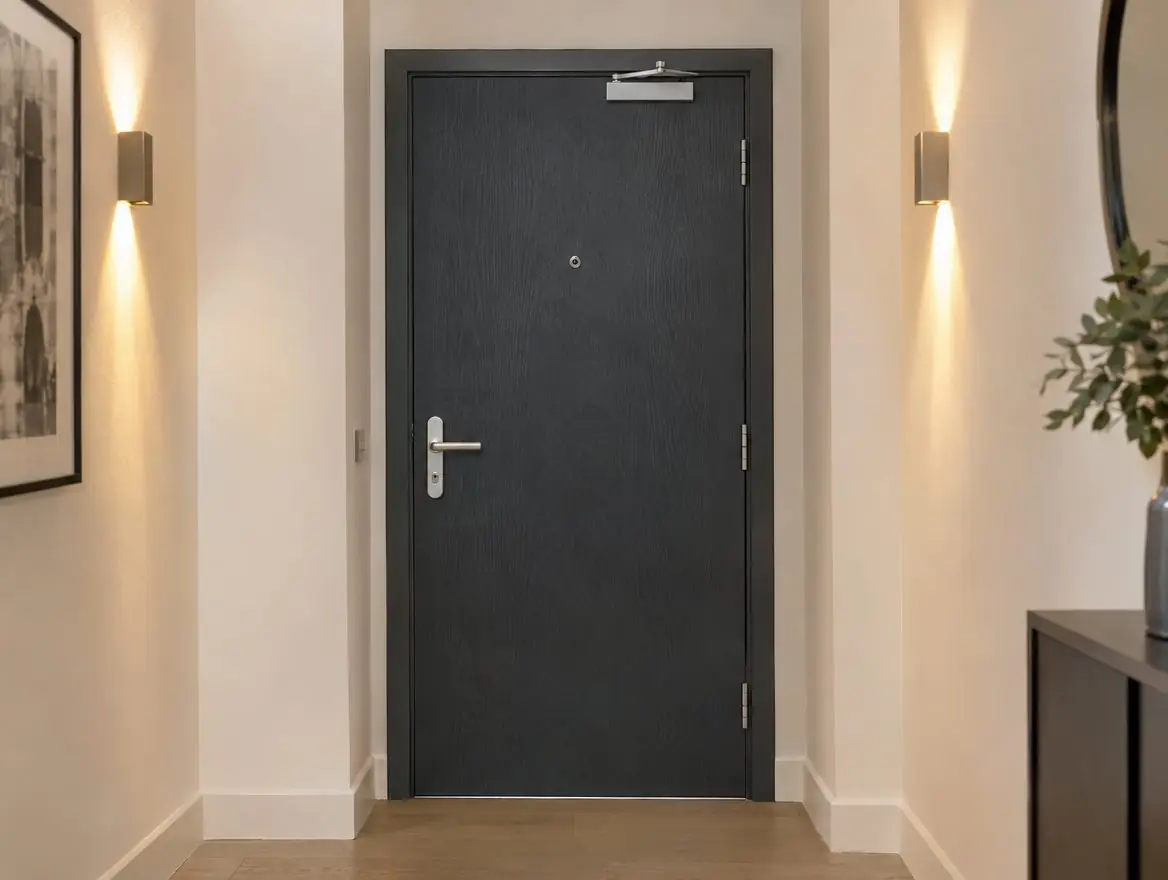
Responsibility for a flat entrance fire door depends on the lease. If the door is within the leaseholder's demise, the leaseholder usually owns and maintains it, often needing landlord consent to change it. If the freeholder retains it, the freeholder does the work, possibly recovering costs through the service charge. Either way, the responsible person must assess and, in some buildings, check it.
Why is the flat front door such a grey area?
A flat entrance door does two jobs at once. To the leaseholder it is their front door, providing security and privacy. To everyone else in the block it is a fire door protecting the shared corridor and stairs. When a fire starts inside a flat, that door is what keeps the smoke out of the escape route that all the other residents rely on.
Leaseholders understandably want to choose their own front door, and many have replaced the original with something more secure or more attractive. Unless the new door is a genuine fire door, fitted correctly with a working closer, that change can weaken the protection for everyone else in the building.
Because of that dual role, decisions about the door can involve the leaseholder, the freeholder, a managing agent, the responsible person under fire safety law and sometimes a residents' management company. Disputes usually arise when a door fails an inspection and nobody is sure who should pay to put it right.
How does the lease decide who owns the door?
Every lease defines the demise, which is the part of the building the leaseholder actually holds. Some leases include the entrance door and frame within the demise; others exclude them and leave them with the freeholder as part of the structure or common parts. Some say nothing clear at all, and the answer then depends on how the lease is read as a whole, including the repairing covenants.
Look for three things in the lease: the definition of the flat or the demised premises, the leaseholder's repairing obligations, and the landlord's repairing obligations, which are often in a separate schedule. If the lease is unclear, a solicitor can advise. This guide gives a general picture and is not legal advice.
What changes under fire safety law?
Whoever owns the door under the lease, fire safety law looks at it from the point of view of the building's common parts. In England and Wales, the Fire Safety Act 2021 confirmed that flat entrance doors opening onto common parts fall within the scope of the Regulatory Reform (Fire Safety) Order 2005. The responsible person for the building therefore has to consider them in the fire risk assessment, even if the leaseholder owns them.
In England, residential buildings above 11 metres are also covered by regulation 10 of the Fire Safety (England) Regulations 2022. The responsible person must use best endeavours to check flat entrance doors at least every 12 months. That duty to check does not by itself make the responsible person liable for the cost of repairs; who pays still depends on the lease. Our guide to fire door regulations for flats covers the rules in each nation.
Do leaseholders need consent to replace their front door?
Very often, yes. Even where the door is within the demise, most leases contain covenants against alterations, or require the landlord's consent before changes to the structure, the exterior or anything visible from the common parts. Many also require the leaseholder to comply with fire safety requirements, which effectively means the replacement must be at least as good as the door it replaces.
A sensible approach for leaseholders is to write to the freeholder or managing agent before ordering, with the proposed door's certification details, rating, smoke control and ironmongery. Some blocks have a standard specification so that all entrance doors match. Replacing a fire door with a non-compliant one, or simply with an attractive door that has no evidence, can lead to a breach of lease and a requirement to replace it again.
How does Section 20 consultation work?
In England and Wales, where the freeholder carries out qualifying works and recovers the cost through the service charge, Section 20 of the Landlord and Tenant Act 1985 requires the landlord to consult leaseholders if any one leaseholder would pay more than £250 towards those works. A block-wide programme of flat entrance door replacements, or major communal door works, will usually cross that threshold.
Consultation involves formal notices, a period for leaseholders to make observations, and the landlord obtaining estimates. If the landlord does not consult properly, the amount it can recover from each leaseholder may be capped at £250 unless a tribunal grants dispensation. Consultation adds weeks to a programme, so it is worth starting early. Our guide to fire door installation costs helps with initial budgeting.
What should a compliant replacement look like?
Whoever arranges it, a replacement flat entrance door should normally be:
- a certified fire doorset or door assembly, commonly FD30S or E30Sa, matching or exceeding the rating the fire risk assessment calls for
- self-closing, with a closer that latches the door from any angle
- fitted with intumescent and smoke seals and a threshold arrangement that meets its smoke control evidence
- fitted with locks, letterplate, viewer and any glazing that its certification covers
- installed with the frame properly fixed and the gap to the wall sealed with tested materials
A certified flat entrance fire doorset is the most straightforward way to meet all of these. Our guide to certified fire doorsets explains how to check the evidence.
What should each party do next?
| If you are | Practical next steps |
|---|---|
| A leaseholder | Check your lease, keep your door's paperwork, get consent before changing it, report faults, and do not remove the closer |
| A freeholder or managing agent | Establish who owns each door under each lease, record its condition, follow consultation rules for service charge works, and keep evidence of checks and access attempts |
| A tenant of a leaseholder | Report faults to your landlord and keep the door closed; your landlord is responsible to the freeholder under the lease |
Where the leaseholder owns the door but the responsible person has identified a problem, a clear written exchange about what is wrong, who is fixing it and by when usually avoids most disputes. If you need a door surveyed to establish what work is needed, you can ask us for a quote.
Frequently asked questions
Who pays to replace a failed flat entrance fire door?
It depends on the lease. If the door is part of the leaseholder's demise, the leaseholder usually pays. If the freeholder retains it, the freeholder arranges the work and may recover the cost through the service charge, subject to consultation rules. A solicitor can advise where the lease is unclear.
Can I fit any fire door I like to my flat?
Usually not without consent. Most leases restrict alterations or require landlord approval, and the replacement must meet the rating and smoke control set out in the fire risk assessment. Send the proposed door's certification details to the freeholder or managing agent before ordering, as some blocks have a standard specification.
Does the Section 20 £250 limit apply in Scotland?
No. Section 20 consultation under the Landlord and Tenant Act 1985 applies in England and Wales. Scotland has a different system of property ownership and management for tenements and flats, usually governed by title deeds and factoring arrangements, so the rules there are different.
Can the freeholder insist on inspecting my front door?
In England, for buildings above 11 metres, the responsible person must use best endeavours to check flat entrance doors at least every 12 months. Many leases also give the landlord rights of access for inspection and repair on reasonable notice. Co-operating with checks is generally in every resident's interest.
This guide is general information about fire doors in the UK, not legal advice. Your fire risk assessor, the responsible person or building control has the final say for your building.