
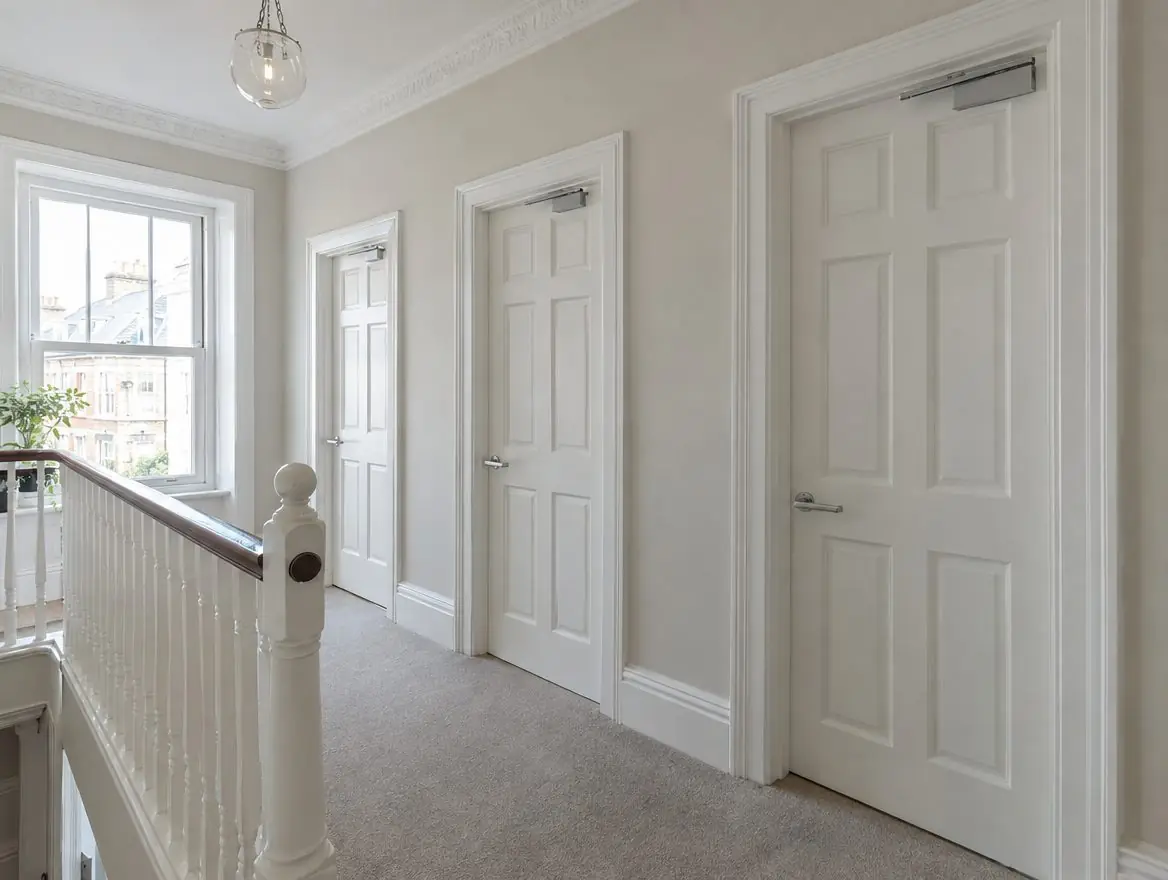
HMO fire doors in Chelsea, done to the evidence
Our HMO fire doors service in Chelsea is simple: a survey, a fixed quote, certified products and an installation finished to the manufacturer's evidence.
Buildings in and around Chelsea range from hotels to shared houses and clinics. Whatever the building, the standard is the same: certified products, correct gaps, seals and closers, and a frame sealed to the wall.
For HMO landlords in Chelsea, fire door work often follows a licence application or a council inspection. We can price an HMO in Chelsea directly from the council's schedule of works and give you evidence to send back.
Fitting around tenants
HMO work happens in people's homes. We agree access with you and your tenants, work room by room, and leave every bedroom lockable at the end of the day. Where thumb-turn locks are needed so occupants can get out without a key, we fit ones that are covered by the door's evidence.
As standard, the work covers:
- FD30 or FD30S doors or doorsets
- Photo record for licensing and inspections
- Survey of bedroom, kitchen and stair doors
- Self-closers set to close without slamming
Rules and responsibilities in Chelsea
England's framework applies in Chelsea. Approved Document B guides the fire performance of new and replacement doors under the Building Regulations 2010. Day-to-day duties sit with the responsible person under the Fire Safety Order 2005, and for multi-occupied residential buildings, the Fire Safety (England) Regulations 2022 add duties such as giving residents information about fire doors. Enforcement of fire safety law in Chelsea sits with the London Fire Brigade.
For blocks over 11 metres in Chelsea, those regulations require communal fire door checks at least every three months and best-endeavours flat entrance door checks each year. In higher-risk buildings, building work is overseen by the Building Safety Regulator, so we check whether approval is needed before starting.
Which buildings in Chelsea need HMO fire doors?
Typical settings for HMO fire doors include student lets, converted period houses and bedsit conversions. In Chelsea, as anywhere, the duty holder varies: a responsible person for a workplace, a landlord or managing agent for a block or HMO, or a homeowner after building work. We adjust access, timing and paperwork to suit whoever commissions the work.
The steps on a Chelsea installation
- Review the council's requirements or schedule of works
- Survey each door and frame
- Agree specification and tenant access
- Fit doors, seals, closers and locks
- Test every door closes and latches
- Hand over evidence for the council
Guide prices in Chelsea
As a guide, budget from around £350 per door in a volume HMO job, up to £900 where frames are replaced, ex VAT for HMO fire doors. The figure for your Chelsea building depends on the number of doors, the rating, the condition of the frames, finishes, hardware and access. We confirm a fixed price after the free survey.
Chelsea and neighbouring towns
We also cover towns near Chelsea, including Battersea (1.7 km away), Fulham and Pimlico. If your building is in SW3 or a neighbouring district, the service and pricing are the same.
Common questions
Is Chelsea within your coverage area?
It is. We cover Chelsea in Greater London and neighbouring towns such as Battersea. There is no charge for the survey.
What happens on a survey in Chelsea?
We look at every door in scope: the leaf, frame, gaps, seals, hinges, closer, glazing and how the frame is fixed. You then get a written quote that prices each door separately.
Can you work to a council schedule of works?
Yes. Send us the schedule and we will price each item, carry out the work and give you evidence to send back.
Do HMO fire doors need closers?
In many HMOs, yes, especially on bedroom and kitchen doors. Your council's schedule of works will say which doors need them.