
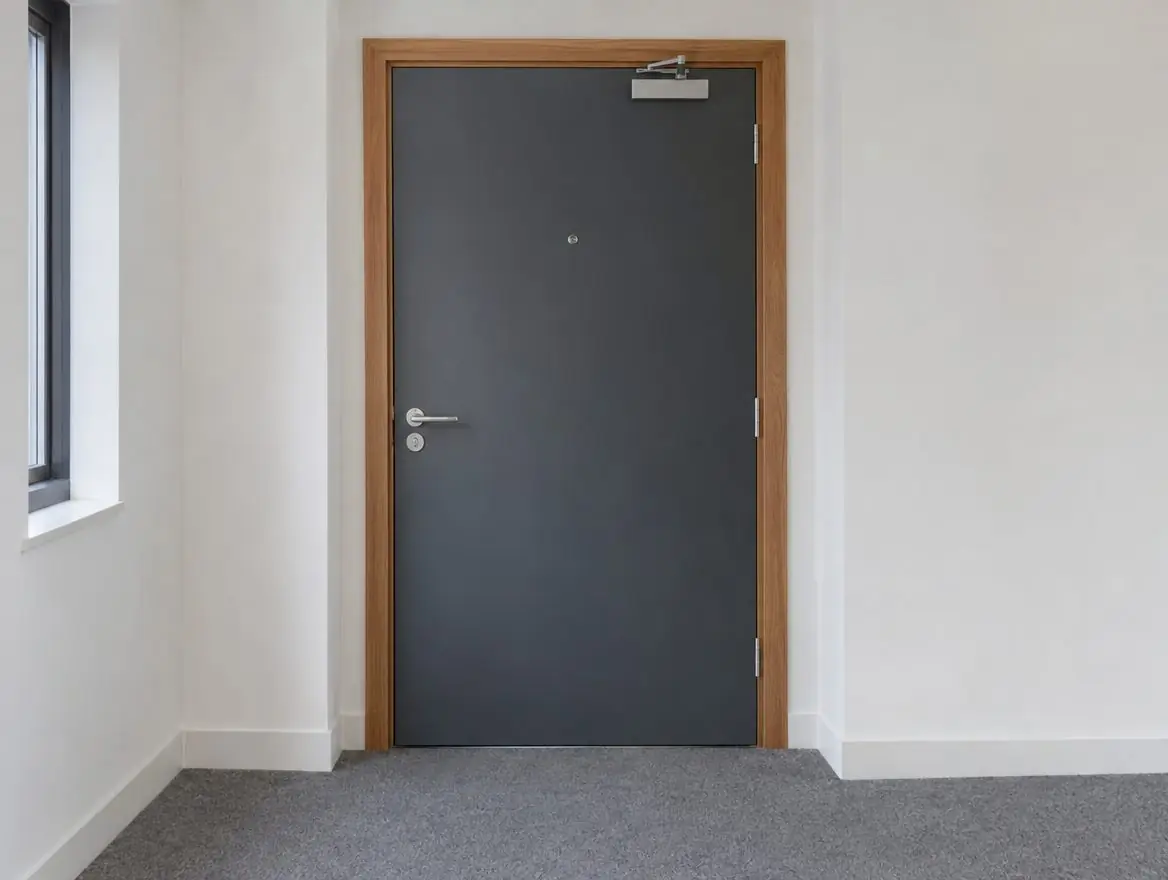
Getting flat entrance fire doors right in Sevenoaks
We provide flat entrance fire doors in Sevenoaks (TN13 and the surrounding postcodes), from the first survey through to a documented handover.
Fire doors in Sevenoaks protect escape routes in small offices, houses with integral garages and light industrial buildings alike. We adapt the programme to the building and its occupants, never the standard of the installation.
We work with freeholders, managing agents and individual leaseholders in Sevenoaks, whoever is responsible for the doors under the lease. In a block of flats in Sevenoaks, each flat's front door is what keeps smoke out of the shared corridor, which is why a working closer matters as much as the door.
What goes into a compliant flat entrance doorset?
We fit certified FD30S doorsets with intumescent and smoke seals, a self-closing device that closes and latches the door from any angle, fire-tested hinges and a lock or latch covered by the certification. Door viewers, spy holes, letterplates, numerals and security hardware can only be fitted if they are part of the doorset's evidence. Where residents want a letterplate, we use one that is covered by the test evidence or recommend a separate post box.
On a typical job that means:
- Resident liaison, photo record and certificate references
- Self-closer set to close and latch
- Survey of door, frame, threshold and ironmongery
- Intumescent and smoke seals, threshold set to evidence
Which fire door rules apply in Sevenoaks?
The rules that apply to fire doors in Sevenoaks are England's. The responsible person under the Regulatory Reform (Fire Safety) Order 2005 must keep fire doors in non-domestic premises and the common parts of flats in working order; the Fire Safety Act 2021 confirmed that this includes flat entrance doors onto common parts.
Where a Sevenoaks block is above 11 metres, regulation 10 of the 2022 regulations means communal doors are checked every three months and flat entrance doors annually on a best-endeavours basis. Replacement doors must also satisfy the Building Regulations, with Approved Document B as the guidance most building control bodies work from.
Who needs flat entrance fire doors in Sevenoaks?
The need for flat entrance fire doors usually arises in converted houses split into flats or purpose-built blocks of flats, and sometimes sheltered housing. Each has its own pressures, such as residents at home or a building that must stay open, so we plan the sequence of work in Sevenoaks to keep escape routes protected throughout.
How a Sevenoaks job runs
- Survey each flat door and agree access with residents
- Confirm specification, finish and hardware with the client
- Order certified doorsets made to measure
- Remove the old door and frame with minimal disruption
- Install, seal, adjust and test the new doorset
- Hand over evidence and resident guidance
What does flat entrance fire doors cost in Sevenoaks?
If you need a budget figure first, the guide for flat entrance fire doors is £1,200–£2,400 per certified flat entrance doorset supplied and fitted, ex VAT. We firm that up after a survey, pricing each door separately so you can see where the money goes.
Around Sevenoaks
Sevenoaks is about 22.8 km from Maidstone, and we cover both, along with nearby Tonbridge and Swanley. Send us your postcode and we'll confirm survey dates.
Common questions
Do you work in Sevenoaks?
Yes, we take on flat entrance fire doors in Sevenoaks and the surrounding area, including Tonbridge and Swanley. Send your postcode and a few details and we'll come back with survey dates.
Do I need to be there for the survey?
Someone needs to give us access to the doors. For blocks and commercial buildings, a caretaker or site contact is fine; for HMOs and homes, we agree a time with you or your tenants.
How long does a flat door replacement take?
Typically half a day per door, with the flat secure at the end of the visit. We agree access times with residents in advance and keep the corridor clear while we work.
Who is responsible for replacing flat front doors?
It depends on the lease. Sometimes the leaseholder owns the door, sometimes the freeholder does. Either way, the replacement has to meet the building's fire strategy, so we can work with whoever commissions it.