
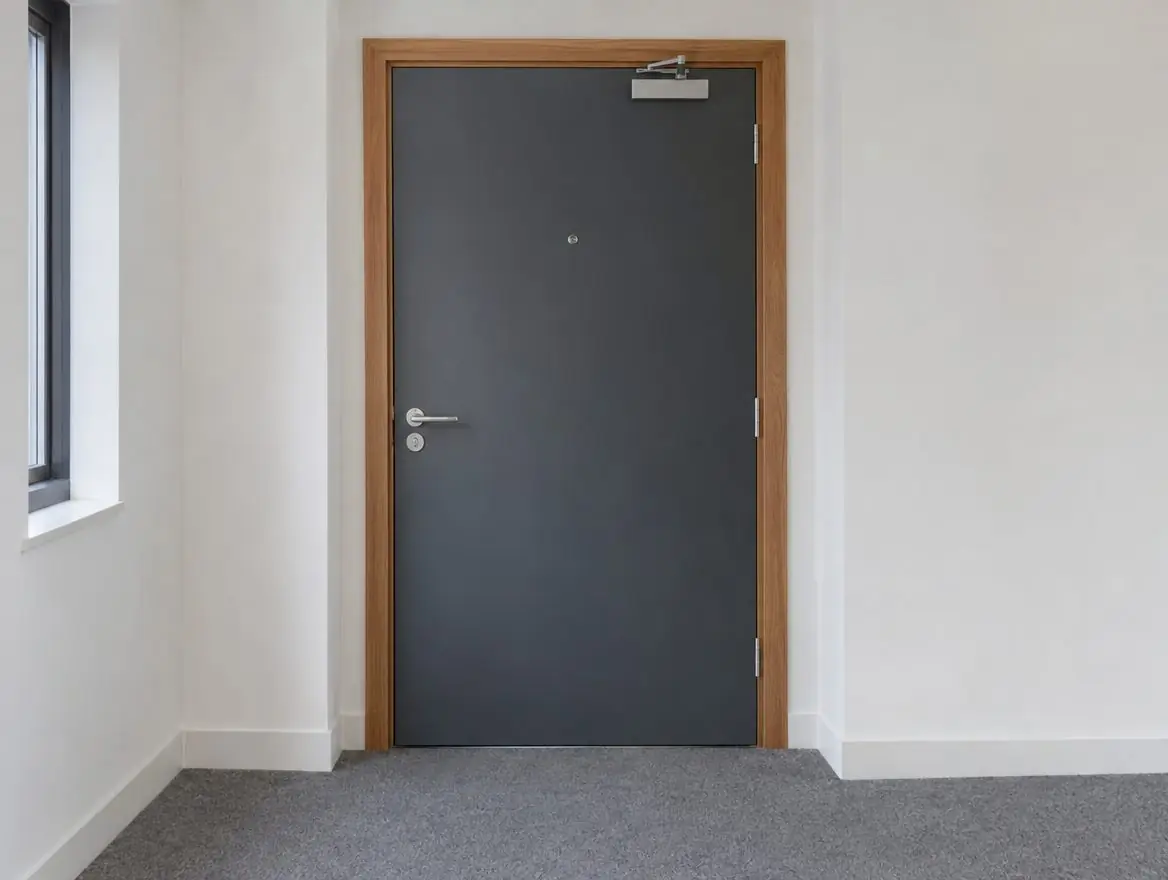
Flat entrance fire doors: our service in Rochester
For property owners, landlords and managing agents in Rochester, we offer flat entrance fire doors with one team for the survey, the product and the installation.
Around Rochester, small blocks of flats, schools and care homes all depend on fire doors that close, latch and seal. We survey each opening and tell you plainly which doors need work and which don't.
Flat entrance door programmes in Rochester are scheduled around residents, with access agreed in advance and each flat left secure the same day. We work with freeholders, managing agents and individual leaseholders in Rochester, whoever is responsible for the doors under the lease.
Who pays and who decides?
Flat entrance doors often sit on the boundary between the leaseholder's flat and the freeholder's building. Ownership depends on the lease, and leaseholder consent, landlord consent and Section 20 consultation can all come into it. We work with freeholders, managing agents, housing providers and individual leaseholders, and our responsibility guide covers the common questions.
As standard, the work covers:
- Self-closer set to close and latch
- Certified FD30S doorset in timber or composite
- Survey of door, frame, threshold and ironmongery
- Resident liaison, photo record and certificate references
Fire door law for Rochester properties
In Rochester, as elsewhere in England, the starting point is the Fire Safety Order 2005: whoever controls a workplace or the shared parts of a residential block must make sure its fire doors work. When doors are replaced, the Building Regulations and Approved Document B set the standard the new work has to meet.
Blocks above 11 metres have a specific routine under regulation 10 of the Fire Safety (England) Regulations 2022: quarterly checks of communal fire doors and annual best-endeavours checks of flat front doors. If your Rochester building is a higher-risk building under the Building Safety Act 2022, we confirm the approval route with the Principal Accountable Person before any work is ordered.
Who needs flat entrance fire doors in Rochester?
From sheltered housing to converted houses split into flats, the requirement for flat entrance fire doors in Rochester comes from the fire strategy or risk assessment for the building. We work from that document, or help you interpret your inspection report, before quoting.
How a Rochester job runs
- Survey each flat door and agree access with residents
- Confirm specification, finish and hardware with the client
- Order certified doorsets made to measure
- Remove the old door and frame with minimal disruption
- Install, seal, adjust and test the new doorset
- Hand over evidence and resident guidance
Budgeting for flat entrance fire doors in Rochester
Guide pricing for flat entrance fire doors: £1,200–£2,400 per certified flat entrance doorset supplied and fitted, ex VAT. Volume work across several doors in one Rochester building usually brings the per-door cost down. Your written quote is fixed once we have surveyed.
Nearby areas we cover from Rochester
We also cover towns near Rochester, including Chatham (1.8 km away), Strood and Gillingham. If your building is in ME1 or a neighbouring district, the service and pricing are the same.
Common questions
Do you cover ME1 and nearby postcodes?
Yes. We cover Rochester including ME1, and nearby towns such as Chatham and Strood. The survey and written quote are free.
How quickly can you survey in Rochester?
It depends on the number of doors and access, but we offer survey dates as soon as we reply to your enquiry. If an inspection has found urgent safety issues, tell us and we'll prioritise.
Can a flat door have a letterbox?
Only if the letterplate is covered by the doorset's test evidence. A standard letterplate cut into a fire door breaks the rating. Many managing agents choose external post boxes instead.
Can residents choose the colour of their front door?
Often, within the range the doorset manufacturer offers and within any rules the freeholder sets for the corridor. Factory finishes are better than site painting, which can clog seals and hide labels.