
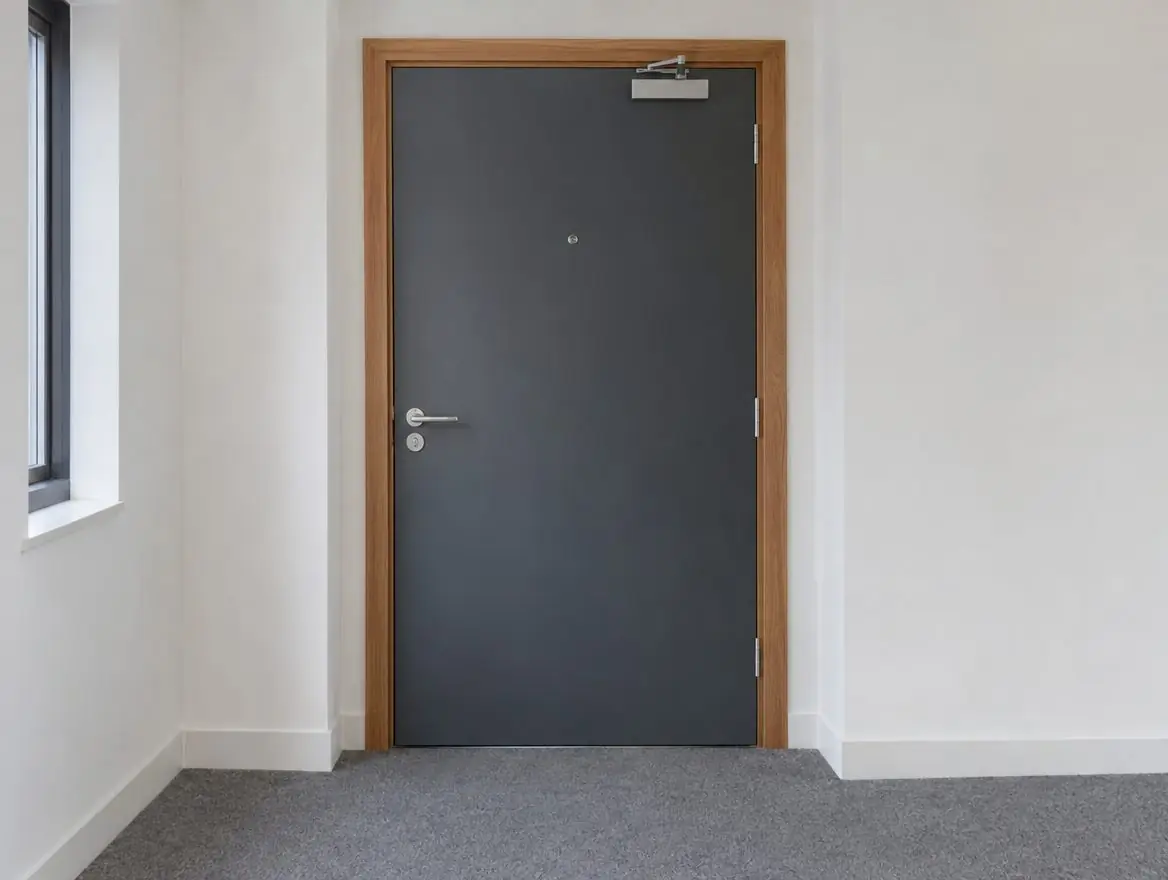
Flat entrance fire doors for March buildings
Our flat entrance fire doors service in March is simple: a survey, a fixed quote, certified products and an installation finished to the manufacturer's evidence.
March has a broad mix of buildings, including small offices, houses with integral garages and schools, and the same fire door principles apply to all of them.
We work with freeholders, managing agents and individual leaseholders in March, whoever is responsible for the doors under the lease. In a block of flats in March, each flat's front door is what keeps smoke out of the shared corridor, which is why a working closer matters as much as the door.
What goes into a compliant flat entrance doorset?
We fit certified FD30S doorsets with intumescent and smoke seals, a self-closing device that closes and latches the door from any angle, fire-tested hinges and a lock or latch covered by the certification. Door viewers, spy holes, letterplates, numerals and security hardware can only be fitted if they are part of the doorset's evidence. Where residents want a letterplate, we use one that is covered by the test evidence or recommend a separate post box.
On a typical job that means:
- Self-closer set to close and latch
- Intumescent and smoke seals, threshold set to evidence
- Survey of door, frame, threshold and ironmongery
- Resident liaison, photo record and certificate references
Rules and responsibilities in March
In March, as elsewhere in England, the starting point is the Fire Safety Order 2005: whoever controls a workplace or the shared parts of a residential block must make sure its fire doors work. When doors are replaced, the Building Regulations and Approved Document B set the standard the new work has to meet.
Blocks above 11 metres have a specific routine under regulation 10 of the Fire Safety (England) Regulations 2022: quarterly checks of communal fire doors and annual best-endeavours checks of flat front doors. If your March building is a higher-risk building under the Building Safety Act 2022, we confirm the approval route with the Principal Accountable Person before any work is ordered.
Where flat entrance fire doors fit in March
The need for flat entrance fire doors usually arises in flats above shops or converted houses split into flats, and sometimes sheltered housing. Each has its own pressures, such as residents at home or a building that must stay open, so we plan the sequence of work in March to keep escape routes protected throughout.
The steps on a March installation
- Survey each flat door and agree access with residents
- Confirm specification, finish and hardware with the client
- Order certified doorsets made to measure
- Remove the old door and frame with minimal disruption
- Install, seal, adjust and test the new doorset
- Hand over evidence and resident guidance
What does flat entrance fire doors cost in March?
If you need a budget figure first, the guide for flat entrance fire doors is £1,200–£2,400 per certified flat entrance doorset supplied and fitted, ex VAT. We firm that up after a survey, pricing each door separately so you can see where the money goes.
Around March
March is about 22.9 km from Peterborough, and we cover both, along with nearby Wisbech and Ely. Send us your postcode and we'll confirm survey dates.
Questions from March
Do you cover PE15 and nearby postcodes?
Yes. We cover March including PE15, and nearby towns such as Wisbech and Ely. The survey and written quote are free.
Can you work from an existing inspection report for my March building?
Yes. Send it over and we can often price straight from it, then confirm on site. We report back against the same door references so you can close actions off.
How long does a flat door replacement take?
Typically half a day per door, with the flat secure at the end of the visit. We agree access times with residents in advance and keep the corridor clear while we work.
Can residents choose the colour of their front door?
Often, within the range the doorset manufacturer offers and within any rules the freeholder sets for the corridor. Factory finishes are better than site painting, which can clog seals and hide labels.