
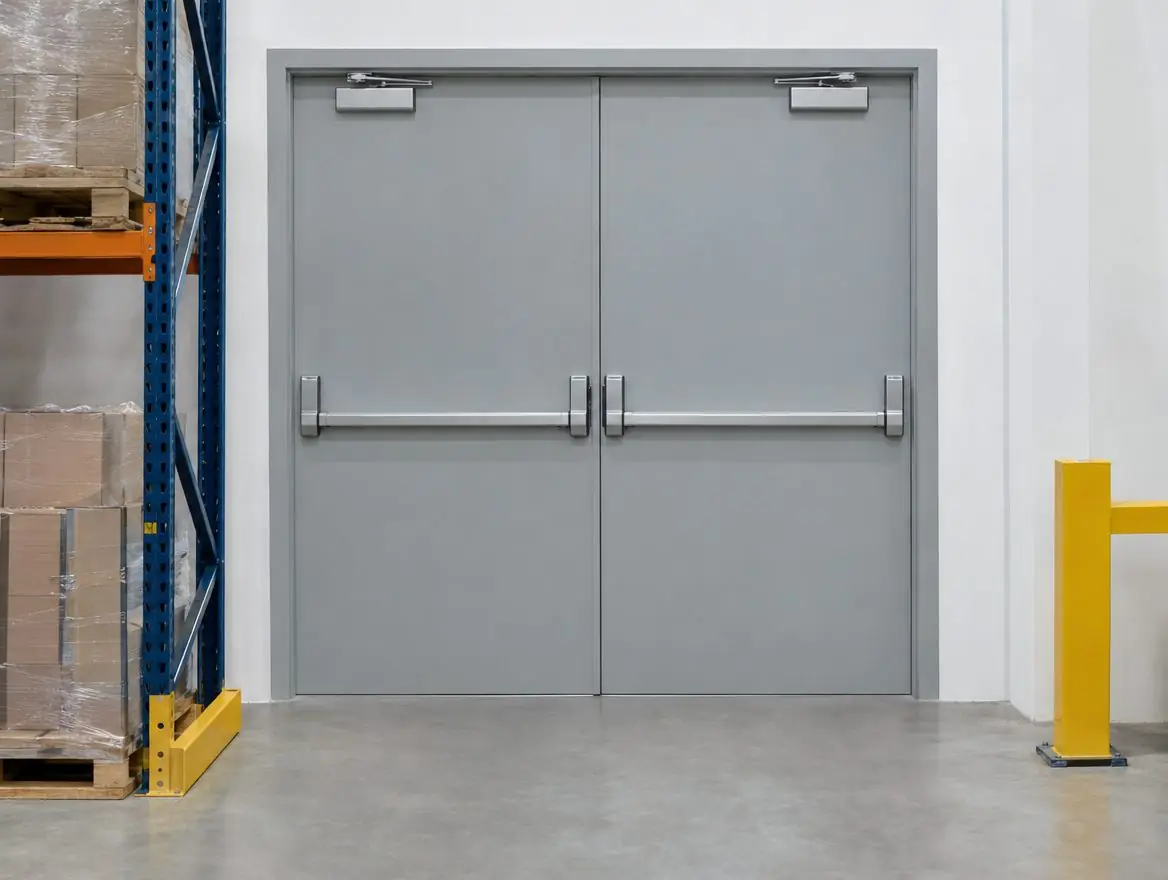
Fire exit doors for Nailsea buildings
When you book fire exit doors in Nailsea, the aim is simple: doors that close, latch and seal as tested, with records that prove it.
Fire doors in Nailsea protect escape routes in houses with integral garages, small blocks of flats and schools alike. We adapt the programme to the building and its occupants, never the standard of the installation.
Before quoting for an exit door in Nailsea, we check whether it needs fire resistance, so you only pay for what the strategy requires. Exit doors in Nailsea can be fitted with outside access and alarm options that never stop people getting out.
Is every fire exit door a fire door?
Not necessarily. A final exit door leading straight outside often does not need fire resistance, but it must open easily in the direction of escape and be secure the rest of the time. If the exit door also sits in a wall that the fire strategy requires to resist fire, it needs to be a certified fire doorset as well. We check which applies before quoting, so you do not pay for fire resistance you do not need, or miss it where you do.
Each installation includes:
- Weather and threshold detailing
- Outside access devices and alarmed options
- Commissioning and handover
- BS EN 1125 panic hardware or BS EN 179 emergency hardware
Rules and responsibilities in Nailsea
Fire doors in Nailsea fall under English rules. New and replacement doors are covered by the Building Regulations 2010 and Approved Document B. In workplaces and the common parts of blocks, the Regulatory Reform (Fire Safety) Order 2005, as clarified by the Fire Safety Act 2021, puts the duty on the responsible person to keep fire doors suitable and maintained.
For residential buildings in Nailsea above 11 metres, regulation 10 of the Fire Safety (England) Regulations 2022 adds checks: communal fire doors at least every three months and best-endeavours checks of flat entrance doors at least every twelve months. Higher-risk buildings of at least 18 metres or seven storeys also come under the Building Safety Act 2022, where works may need approval from the Building Safety Regulator.
Which buildings in Nailsea need fire exit doors?
Typical settings for fire exit doors include shops, offices and hospitality venues. In Nailsea, as anywhere, the duty holder varies: a responsible person for a workplace, a landlord or managing agent for a block or HMO, or a homeowner after building work. We adjust access, timing and paperwork to suit whoever commissions the work.
From enquiry to handover in Nailsea
- Check the fire strategy and who uses the exit
- Select door type, rating and exit hardware
- Order doorset and hardware set
- Remove the existing door and prepare the opening
- Install, seal and weather the doorset
- Test exit operation, closers and security features
Guide prices in Nailsea
Guide pricing for fire exit doors: £1,100–£2,600 per exit doorset with hardware, supplied and fitted, ex VAT. Volume work across several doors in one Nailsea building usually brings the per-door cost down. Your written quote is fixed once we have surveyed.
Around Nailsea
We also cover towns near Nailsea, including Portishead (5.6 km away), Clevedon and Bristol. If your building is in BS48 or a neighbouring district, the service and pricing are the same.
Questions from Nailsea
Do you cover BS48 and nearby postcodes?
Yes. We cover Nailsea including BS48, and nearby towns such as Portishead and Clevedon. The survey and written quote are free.
Can you work from an existing inspection report for my Nailsea building?
Yes. Send it over and we can often price straight from it, then confirm on site. We report back against the same door references so you can close actions off.
Do fire exit doors have to open outwards?
Exit doors generally open in the direction of escape, especially where many people use them. Your fire strategy or risk assessment sets the requirement for each door.
Which is better, a push bar or a push pad?
Push bars (panic hardware) suit public areas; push pads and levers (emergency exit hardware) suit areas used by trained staff. The choice depends on who will use the door in an emergency.