
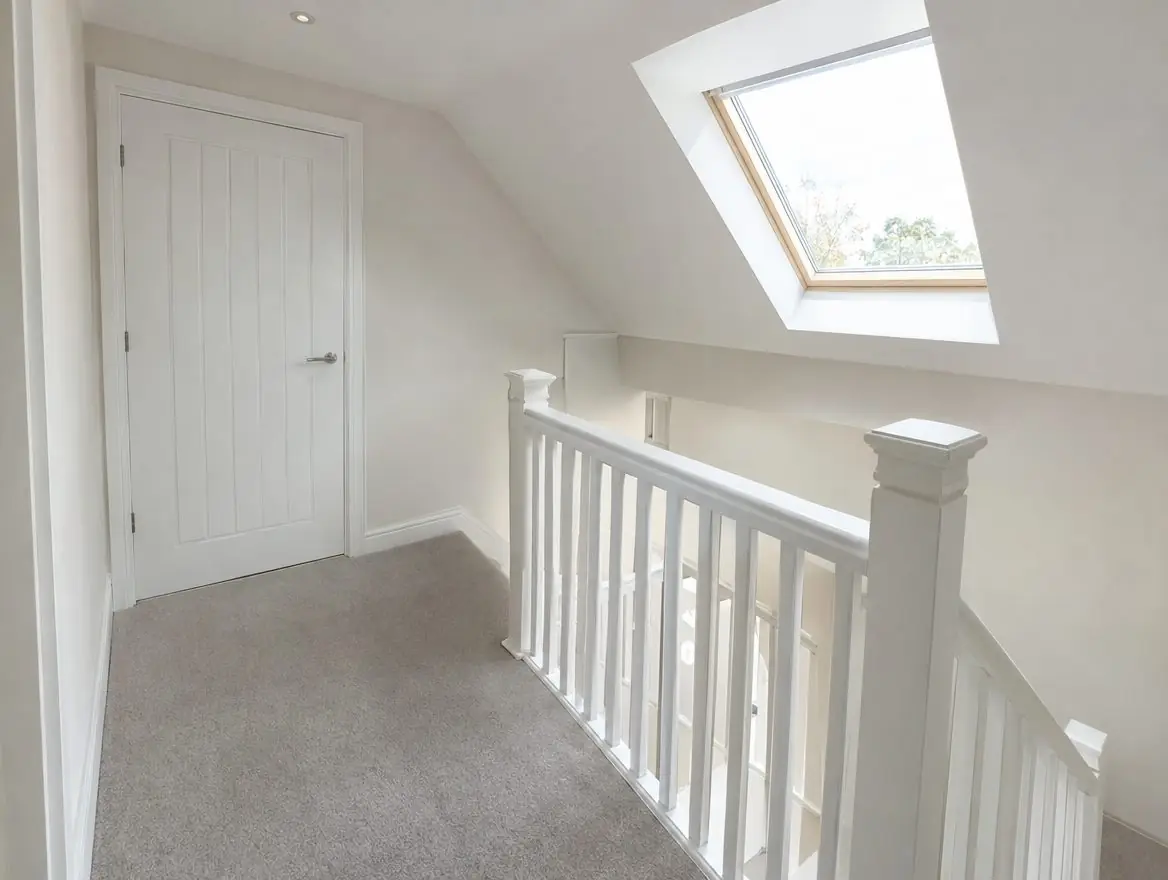
Getting loft conversion fire doors right in Barking
Our loft conversion fire doors service covers Barking and the wider Greater London area. Every job starts with a survey of the openings, so the quote reflects your actual doors rather than a guess.
Buildings in and around Barking range from clinics to mixed-use office buildings and converted flats. Whatever the building, the standard is the same: certified products, correct gaps, seals and closers, and a frame sealed to the wall.
For homes in Barking, we match fire doors to your existing style wherever certified options allow. A loft conversion in Barking that adds a new storey often brings a building control requirement for fire doors on rooms off the stair.
FD20 or FD30?
In England, the guidance generally asks for FD20 (E20) doors in this situation, and self-closers are not usually required within a house. Scotland is different: the domestic Technical Handbook expects doors onto the protected stair enclosure to be self-closing fire doors, so closers are part of the job there. Many homeowners choose FD30 doors anyway, because they are widely available and the price difference is small. Either way, the door must be fitted properly: correct gaps, fire-tested hinges and an intumescent strip where the product requires one.
As standard, the work covers:
- FD20 or FD30 doors in your chosen style
- Fire-tested hinges and intumescent strips as required
- Work coordinated with your builder
- Frame repairs or new linings where needed
Fire door law for Barking properties
In Barking, as elsewhere in England, the starting point is the Fire Safety Order 2005: whoever controls a workplace or the shared parts of a residential block must make sure its fire doors work. When doors are replaced, the Building Regulations and Approved Document B set the standard the new work has to meet. Enforcement of fire safety law in Barking sits with the London Fire Brigade.
Blocks above 11 metres have a specific routine under regulation 10 of the Fire Safety (England) Regulations 2022: quarterly checks of communal fire doors and annual best-endeavours checks of flat front doors. If your Barking building is a higher-risk building under the Building Safety Act 2022, we confirm the approval route with the Principal Accountable Person before any work is ordered.
Who needs loft conversion fire doors in Barking?
The need for loft conversion fire doors usually arises in semi-detached houses or bungalows gaining an upper floor, and sometimes detached family homes. In Barking we can work for you directly or alongside your builder, and single doors are as welcome as whole-house jobs.
From enquiry to handover in Barking
- Review the building control requirements or drawings
- Survey each door opening off the stair
- Agree door style and rating
- Fit doors, hinges and strips
- Check gaps and operation
- Hand over product details
Prices for loft conversion fire doors in Barking
Guide pricing for loft conversion fire doors: £300–£650 per door supplied and fitted, ex VAT. Volume work across several doors in one Barking building usually brings the per-door cost down. Your written quote is fixed once we have surveyed.
Covering Barking and nearby
We also cover towns near Barking, including Ilford (2.8 km away), Becontree and Thamesmead. If your building is in IG11 or a neighbouring district, the service and pricing are the same.
Questions from Barking
Do you work in Barking?
Yes, we take on loft conversion fire doors in Barking and the surrounding area, including Ilford and Becontree. Send your postcode and a few details and we'll come back with survey dates.
What happens on a survey in Barking?
We look at every door in scope: the leaf, frame, gaps, seals, hinges, closer, glazing and how the frame is fixed. You then get a written quote that prices each door separately.
Can I just add intumescent strips to my existing doors?
Generally no. A standard internal door is not a fire door, and strips alone will not make it one. Existing doors need to be replaced with certified fire doors.
Do loft conversion fire doors need closers?
Not usually within a single-family house in England. In Scotland, doors onto the protected stair enclosure are expected to be self-closing. Wales and Northern Ireland have their own guidance, and your building control body may ask for something different in particular layouts.