
What fire door closers in Barking should include
If you need fire door closers in Barking, we can survey, supply and install, then leave you the evidence your fire risk assessor will ask for.
Fire doors in Barking protect escape routes in restaurants, purpose-built blocks of flats and hotels alike. We adapt the programme to the building and its occupants, never the standard of the installation.
We set closers in Barking buildings so doors close fully without becoming too heavy to open. Free-swing closers are a practical option for Barking care homes and supported living.
Setting a closer properly
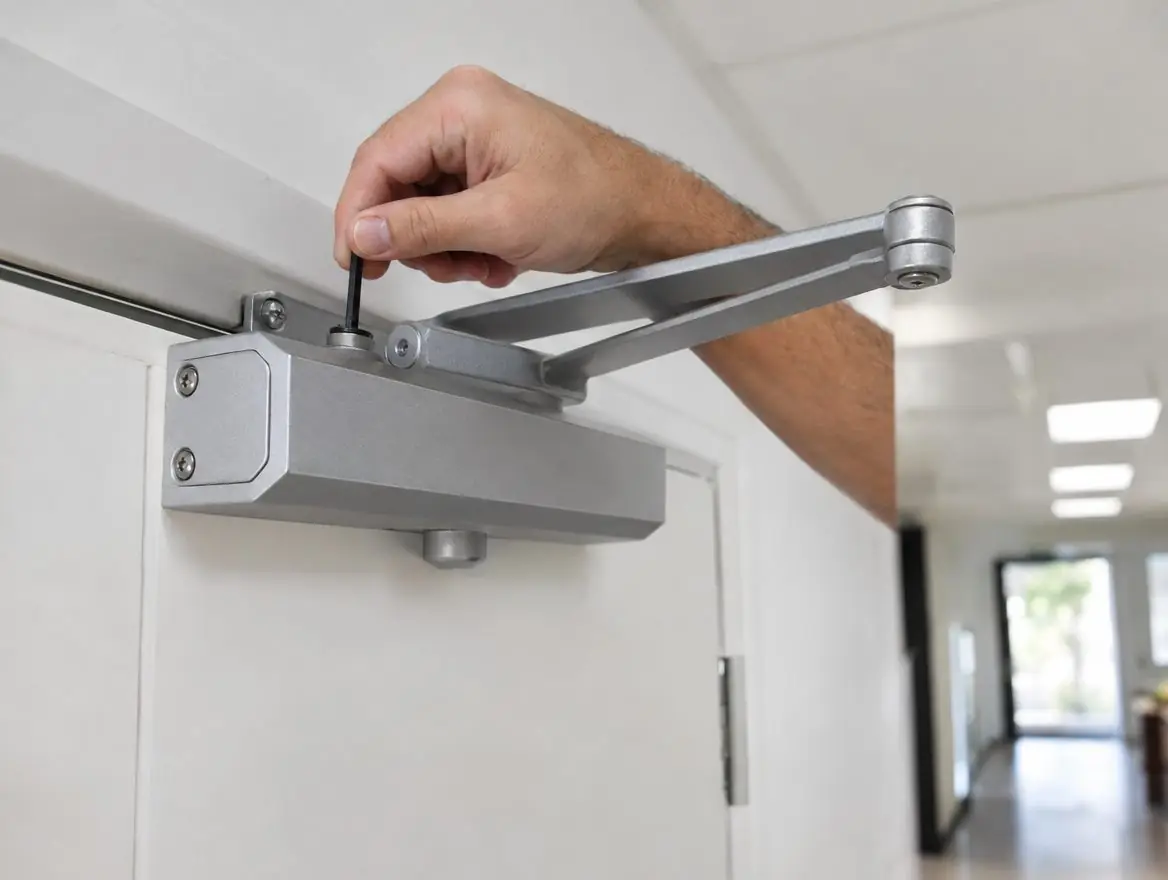
Closers have adjustments for closing speed, latching action and often backcheck. We set them so the door closes from any angle and engages the latch, without slamming. In England, Approved Document M guidance on opening force, no more than 30N for the first 30 degrees and 22.5N from 30 to 60 degrees at the leading edge, is a useful benchmark for usability. Our closers guide has more detail.
What you get:
- Correctly powered closer to BS EN 1154
- Overhead, concealed or free-swing options
- Assessment of door size, weight and use
- Adjustment of speed, latching and backcheck
Rules and responsibilities in Barking
Fire doors in Barking fall under English rules. New and replacement doors are covered by the Building Regulations 2010 and Approved Document B. In workplaces and the common parts of blocks, the Regulatory Reform (Fire Safety) Order 2005, as clarified by the Fire Safety Act 2021, puts the duty on the responsible person to keep fire doors suitable and maintained. Enforcement of fire safety law in Barking sits with the London Fire Brigade.
For residential buildings in Barking above 11 metres, regulation 10 of the Fire Safety (England) Regulations 2022 adds checks: communal fire doors at least every three months and best-endeavours checks of flat entrance doors at least every twelve months. Higher-risk buildings of at least 18 metres or seven storeys also come under the Building Safety Act 2022, where works may need approval from the Building Safety Regulator.
Buildings and duty holders in Barking
Typical settings for fire door closers include schools, care homes and offices. In Barking, as anywhere, the duty holder varies: a responsible person for a workplace, a landlord or managing agent for a block or HMO, or a homeowner after building work. We adjust access, timing and paperwork to suit whoever commissions the work.
How a Barking job runs
- Check the door, frame and existing closer
- Select a closer suited to the leaf and use
- Fit to the template and the door's evidence
- Adjust closing and latching speeds
- Test from wide and small opening angles
- Record the closer and its settings
Budgeting for fire door closers in Barking
As a guide, budget £90–£220 per closer supplied and fitted; adjustment visits from £195, ex VAT for fire door closers. The figure for your Barking building depends on the number of doors, the rating, the condition of the frames, finishes, hardware and access. We confirm a fixed price after the free survey.
Covering Barking and nearby
Neighbouring towns such as Ilford, Becontree, Thamesmead and Canning Town are covered too, so clients with several buildings can use one installer and one evidence format.
Questions
Is Barking within your coverage area?
It is. We cover Barking in Greater London and neighbouring towns such as Ilford. There is no charge for the survey.
How quickly can you survey in Barking?
It depends on the number of doors and access, but we offer survey dates as soon as we reply to your enquiry. If an inspection has found urgent safety issues, tell us and we'll prioritise.
Why won't my fire door latch?
Usually the closer is out of adjustment or under-powered, or the latch and keep are misaligned. Both are normally quick to fix.
Do all fire doors need closers?
Most do. Exceptions include some doors kept locked shut and some doors within houses, depending on the fire strategy.