
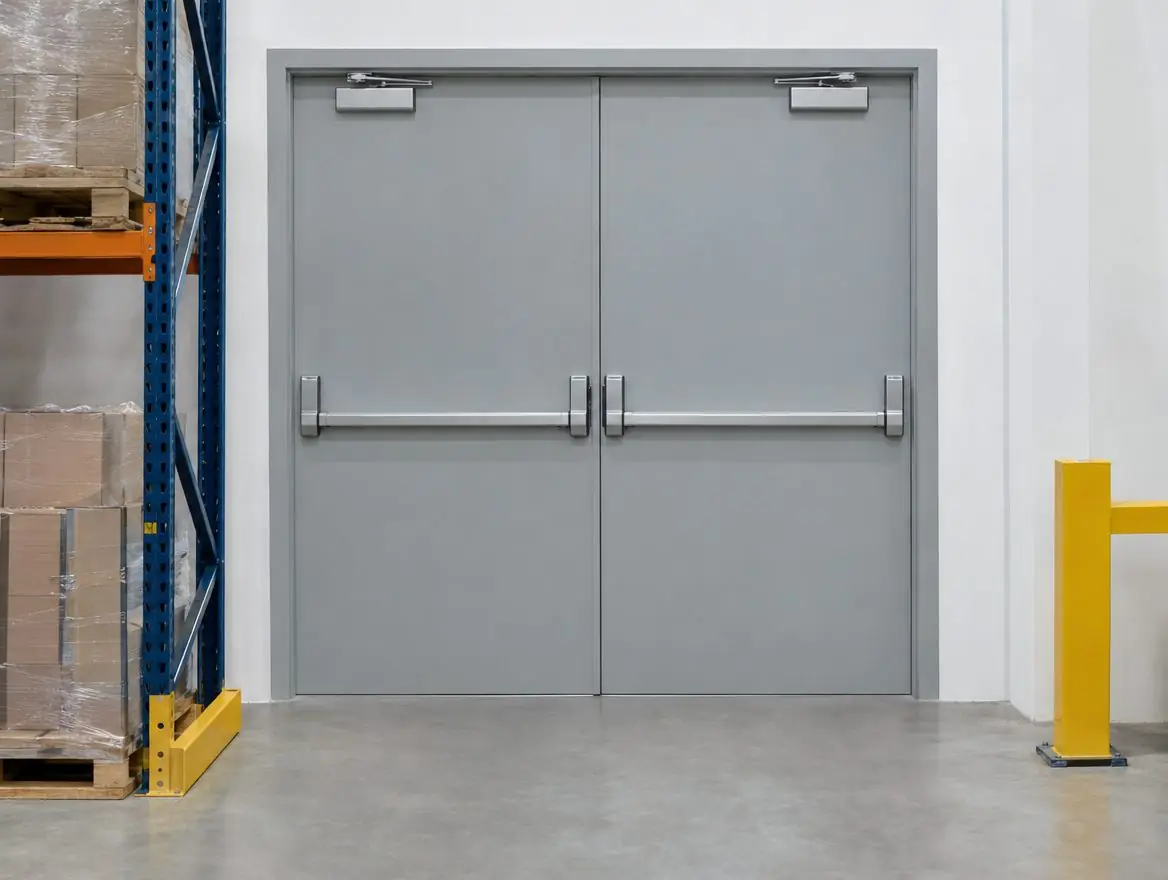
Fire exit doors in Leytonstone: what's involved
If you need fire exit doors in Leytonstone, we can survey, supply and install, then leave you the evidence your fire risk assessor will ask for.
Buildings in and around Leytonstone range from care homes to converted flats and restaurants. Whatever the building, the standard is the same: certified products, correct gaps, seals and closers, and a frame sealed to the wall.
Shops, warehouses and schools in Leytonstone each need exit hardware matched to who will use the door in an emergency. Exit doors in Leytonstone can be fitted with outside access and alarm options that never stop people getting out.
Is every fire exit door a fire door?
Not necessarily. A final exit door leading straight outside often does not need fire resistance, but it must open easily in the direction of escape and be secure the rest of the time. If the exit door also sits in a wall that the fire strategy requires to resist fire, it needs to be a certified fire doorset as well. We check which applies before quoting, so you do not pay for fire resistance you do not need, or miss it where you do.
As standard, the work covers:
- BS EN 1125 panic hardware or BS EN 179 emergency hardware
- Outside access devices and alarmed options
- Commissioning and handover
- Weather and threshold detailing
Which fire door rules apply in Leytonstone?
Fire doors in Leytonstone fall under English rules. New and replacement doors are covered by the Building Regulations 2010 and Approved Document B. In workplaces and the common parts of blocks, the Regulatory Reform (Fire Safety) Order 2005, as clarified by the Fire Safety Act 2021, puts the duty on the responsible person to keep fire doors suitable and maintained. In London, the London Fire Brigade is the enforcing authority for fire safety law.
For residential buildings in Leytonstone above 11 metres, regulation 10 of the Fire Safety (England) Regulations 2022 adds checks: communal fire doors at least every three months and best-endeavours checks of flat entrance doors at least every twelve months. Higher-risk buildings of at least 18 metres or seven storeys also come under the Building Safety Act 2022, where works may need approval from the Building Safety Regulator.
Buildings and duty holders in Leytonstone
Typical settings for fire exit doors include schools, shops and warehouses. In Leytonstone, as anywhere, the duty holder varies: a responsible person for a workplace, a landlord or managing agent for a block or HMO, or a homeowner after building work. We adjust access, timing and paperwork to suit whoever commissions the work.
The steps on a Leytonstone installation
- Check the fire strategy and who uses the exit
- Select door type, rating and exit hardware
- Order doorset and hardware set
- Remove the existing door and prepare the opening
- Install, seal and weather the doorset
- Test exit operation, closers and security features
Guide prices in Leytonstone
Budget around £1,100–£2,600 per exit doorset with hardware, supplied and fitted, ex VAT for fire exit doors. Our guide prices are the same in Leytonstone as elsewhere; what changes the cost is the doors themselves. Use our guide-price tool for a quick estimate.
Leytonstone and neighbouring towns
Neighbouring towns such as Walthamstow, Stratford, Ilford and Woodford Green are covered too, so clients with several buildings can use one installer and one evidence format.
Questions from Leytonstone
Is Leytonstone within your coverage area?
It is. We cover Leytonstone in Greater London and neighbouring towns such as Walthamstow. There is no charge for the survey.
What happens on a survey in Leytonstone?
We look at every door in scope: the leaf, frame, gaps, seals, hinges, closer, glazing and how the frame is fixed. You then get a written quote that prices each door separately.
Which is better, a push bar or a push pad?
Push bars (panic hardware) suit public areas; push pads and levers (emergency exit hardware) suit areas used by trained staff. The choice depends on who will use the door in an emergency.
Do fire exit doors have to open outwards?
Exit doors generally open in the direction of escape, especially where many people use them. Your fire strategy or risk assessment sets the requirement for each door.