
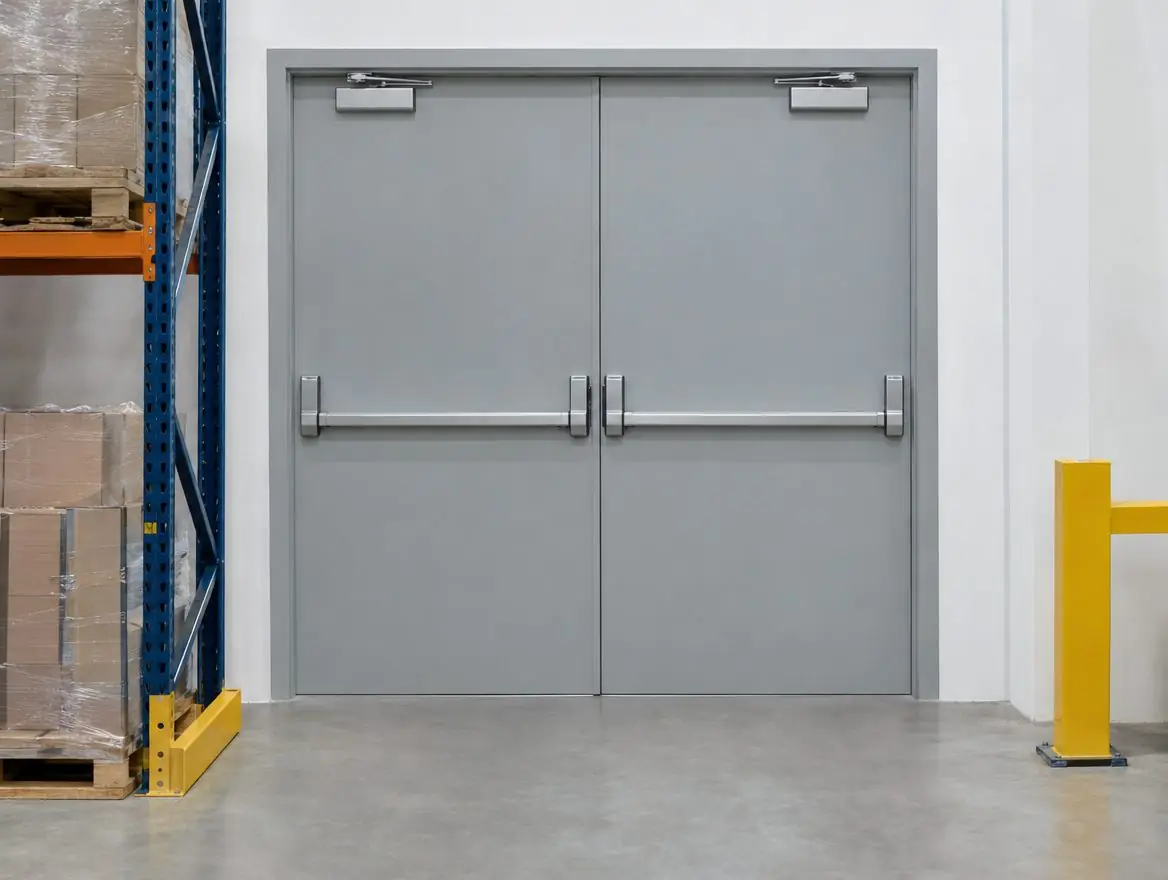
What fire exit doors in Tottenham should include
When you book fire exit doors in Tottenham, the aim is simple: doors that close, latch and seal as tested, with records that prove it.
Fire doors in Tottenham protect escape routes in mixed-use office buildings, hotels and restaurants alike. We adapt the programme to the building and its occupants, never the standard of the installation.
Shops, warehouses and schools in Tottenham each need exit hardware matched to who will use the door in an emergency. Exit doors in Tottenham can be fitted with outside access and alarm options that never stop people getting out.
Is every fire exit door a fire door?
Not necessarily. A final exit door leading straight outside often does not need fire resistance, but it must open easily in the direction of escape and be secure the rest of the time. If the exit door also sits in a wall that the fire strategy requires to resist fire, it needs to be a certified fire doorset as well. We check which applies before quoting, so you do not pay for fire resistance you do not need, or miss it where you do.
As standard, the work covers:
- Outside access devices and alarmed options
- Weather and threshold detailing
- BS EN 1125 panic hardware or BS EN 179 emergency hardware
- Single and double exit doors in steel or timber
The regulations behind fire doors in Tottenham
In Tottenham, as elsewhere in England, the starting point is the Fire Safety Order 2005: whoever controls a workplace or the shared parts of a residential block must make sure its fire doors work. When doors are replaced, the Building Regulations and Approved Document B set the standard the new work has to meet. In London, the London Fire Brigade is the enforcing authority for fire safety law.
Blocks above 11 metres have a specific routine under regulation 10 of the Fire Safety (England) Regulations 2022: quarterly checks of communal fire doors and annual best-endeavours checks of flat front doors. If your Tottenham building is a higher-risk building under the Building Safety Act 2022, we confirm the approval route with the Principal Accountable Person before any work is ordered.
Who needs fire exit doors in Tottenham?
Typical settings for fire exit doors include offices, schools and hospitality venues. In Tottenham, as anywhere, the duty holder varies: a responsible person for a workplace, a landlord or managing agent for a block or HMO, or a homeowner after building work. We adjust access, timing and paperwork to suit whoever commissions the work.
The steps on a Tottenham installation
- Check the fire strategy and who uses the exit
- Select door type, rating and exit hardware
- Order doorset and hardware set
- Remove the existing door and prepare the opening
- Install, seal and weather the doorset
- Test exit operation, closers and security features
Budgeting for fire exit doors in Tottenham
If you need a budget figure first, the guide for fire exit doors is £1,100–£2,600 per exit doorset with hardware, supplied and fitted, ex VAT. We firm that up after a survey, pricing each door separately so you can see where the money goes.
Around Tottenham
Nearby towns we cover include Edmonton, Wood Green and Walthamstow. Distance from Tottenham does not change our guide prices, and the survey and quote are free.
Common questions
Do you work in Tottenham?
Yes, we take on fire exit doors in Tottenham and the surrounding area, including Edmonton and Wood Green. Send your postcode and a few details and we'll come back with survey dates.
Can you work from an existing inspection report for my Tottenham building?
Yes. Send it over and we can often price straight from it, then confirm on site. We report back against the same door references so you can close actions off.
Do fire exit doors have to open outwards?
Exit doors generally open in the direction of escape, especially where many people use them. Your fire strategy or risk assessment sets the requirement for each door.
Which is better, a push bar or a push pad?
Push bars (panic hardware) suit public areas; push pads and levers (emergency exit hardware) suit areas used by trained staff. The choice depends on who will use the door in an emergency.