
Fire door closers in Bury, done to the evidence
When you book fire door closers in Bury, the aim is simple: doors that close, latch and seal as tested, with records that prove it.
Around Bury, industrial estates, care homes and high-street shops all depend on fire doors that close, latch and seal. We survey each opening and tell you plainly which doors need work and which don't.
We set closers in Bury buildings so doors close fully without becoming too heavy to open. Free-swing closers are a practical option for Bury care homes and supported living.
Setting a closer properly
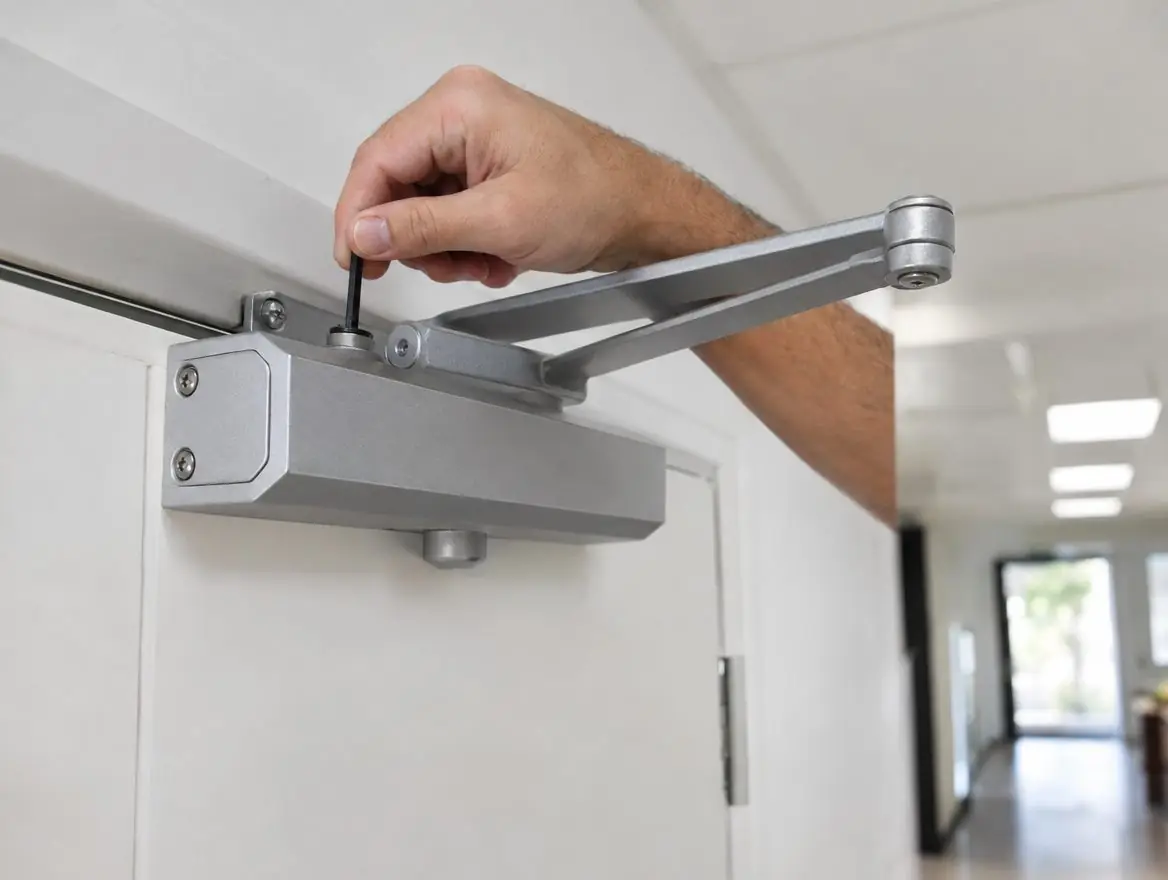
Closers have adjustments for closing speed, latching action and often backcheck. We set them so the door closes from any angle and engages the latch, without slamming. In England, Approved Document M guidance on opening force, no more than 30N for the first 30 degrees and 22.5N from 30 to 60 degrees at the leading edge, is a useful benchmark for usability. Our closers guide has more detail.
On a typical job that means:
- Correctly powered closer to BS EN 1154
- Assessment of door size, weight and use
- Close-and-latch test from full open
- Overhead, concealed or free-swing options
Fire door law for Bury properties
The rules that apply to fire doors in Bury are England's. The responsible person under the Regulatory Reform (Fire Safety) Order 2005 must keep fire doors in non-domestic premises and the common parts of flats in working order; the Fire Safety Act 2021 confirmed that this includes flat entrance doors onto common parts.
Where a Bury block is above 11 metres, regulation 10 of the 2022 regulations means communal doors are checked every three months and flat entrance doors annually on a best-endeavours basis. Replacement doors must also satisfy the Building Regulations, with Approved Document B as the guidance most building control bodies work from.
Who needs fire door closers in Bury?
From blocks of flats to HMOs, the requirement for fire door closers in Bury comes from the fire strategy or risk assessment for the building. We work from that document, or help you interpret your inspection report, before quoting.
How a Bury job runs
- Check the door, frame and existing closer
- Select a closer suited to the leaf and use
- Fit to the template and the door's evidence
- Adjust closing and latching speeds
- Test from wide and small opening angles
- Record the closer and its settings
Prices for fire door closers in Bury
If you need a budget figure first, the guide for fire door closers is £90–£220 per closer supplied and fitted; adjustment visits from £195, ex VAT. We firm that up after a survey, pricing each door separately so you can see where the money goes.
Bury and neighbouring towns
We also cover towns near Bury, including Radcliffe (4.5 km away), Heywood and Whitefield. If your building is in BL9 or a neighbouring district, the service and pricing are the same.
Common questions
Do you work in Bury?
Yes, we take on fire door closers in Bury and the surrounding area, including Radcliffe and Heywood. Send your postcode and a few details and we'll come back with survey dates.
Do I need to be there for the survey?
Someone needs to give us access to the doors. For blocks and commercial buildings, a caretaker or site contact is fine; for HMOs and homes, we agree a time with you or your tenants.
Do all fire doors need closers?
Most do. Exceptions include some doors kept locked shut and some doors within houses, depending on the fire strategy.
What is a free-swing closer?
A closer that lets the door swing freely in normal use and closes it when the fire alarm operates. It suits care settings and people who find doors heavy.