
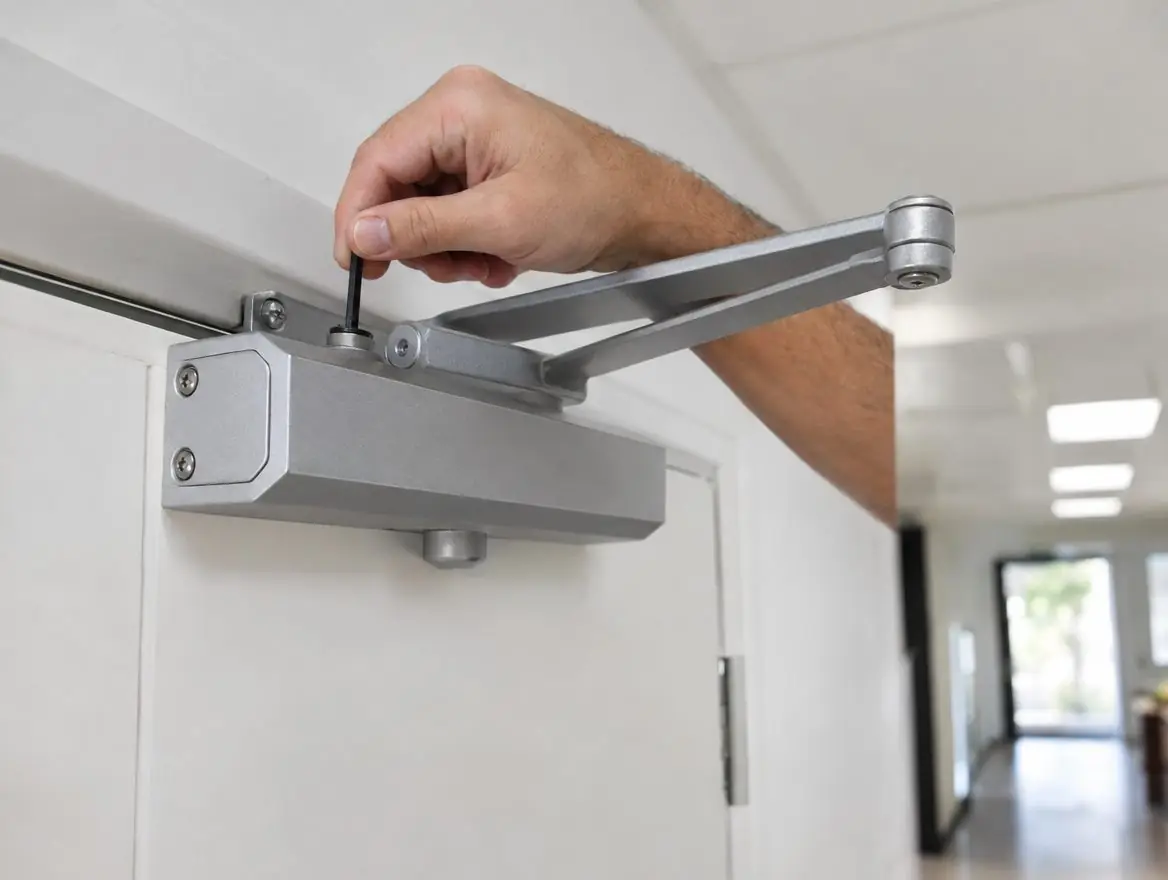
What fire door closers in Colchester should include
For property owners, landlords and managing agents in Colchester, we offer fire door closers with one team for the survey, the product and the installation.
Around Colchester, HMOs, converted period houses and industrial units all depend on fire doors that close, latch and seal. We survey each opening and tell you plainly which doors need work and which don't.
A closer that fails to latch the door is one of the first things we put right on Colchester fire doors. We set closers in Colchester buildings so doors close fully without becoming too heavy to open.
Overhead, concealed or free-swing
Overhead closers are the most common and easiest to maintain. Concealed closers keep a clean look and deter tampering, if covered by the door's evidence. Free-swing closers let a door move freely in everyday use and close when the fire alarm sounds, which is useful in care homes and for people who find doors hard to open.
As standard, the work covers:
- Assessment of door size, weight and use
- Record of model and settings
- Adjustment of speed, latching and backcheck
- Overhead, concealed or free-swing options
Fire door law for Colchester properties
In Colchester, as elsewhere in England, the starting point is the Fire Safety Order 2005: whoever controls a workplace or the shared parts of a residential block must make sure its fire doors work. When doors are replaced, the Building Regulations and Approved Document B set the standard the new work has to meet.
Blocks above 11 metres have a specific routine under regulation 10 of the Fire Safety (England) Regulations 2022: quarterly checks of communal fire doors and annual best-endeavours checks of flat front doors. If your Colchester building is a higher-risk building under the Building Safety Act 2022, we confirm the approval route with the Principal Accountable Person before any work is ordered.
Who needs fire door closers in Colchester?
You are most likely to need fire door closers if you look after HMOs, care homes or blocks of flats. Whatever the building in Colchester, we survey each opening and tell you which doors need work and which do not.
Our process in Colchester
- Check the door, frame and existing closer
- Select a closer suited to the leaf and use
- Fit to the template and the door's evidence
- Adjust closing and latching speeds
- Test from wide and small opening angles
- Record the closer and its settings
Guide prices in Colchester
As a guide, budget £90–£220 per closer supplied and fitted; adjustment visits from £195, ex VAT for fire door closers. The figure for your Colchester building depends on the number of doors, the rating, the condition of the frames, finishes, hardware and access. We confirm a fixed price after the free survey.
Around Colchester
Neighbouring towns such as Sudbury, Clacton-on-Sea, Witham and Maldon are covered too, so clients with several buildings can use one installer and one evidence format.
Questions from Colchester
Do you work in Colchester?
Yes, we take on fire door closers in Colchester and the surrounding area, including Sudbury and Clacton-on-Sea. Send your postcode and a few details and we'll come back with survey dates.
What happens on a survey in Colchester?
We look at every door in scope: the leaf, frame, gaps, seals, hinges, closer, glazing and how the frame is fixed. You then get a written quote that prices each door separately.
Can a fire door closer be too strong?
Yes. An over-powered or badly set closer makes the door hard to open and may lead people to wedge it. The goal is reliable closing with a reasonable opening force.
Do all fire doors need closers?
Most do. Exceptions include some doors kept locked shut and some doors within houses, depending on the fire strategy.