
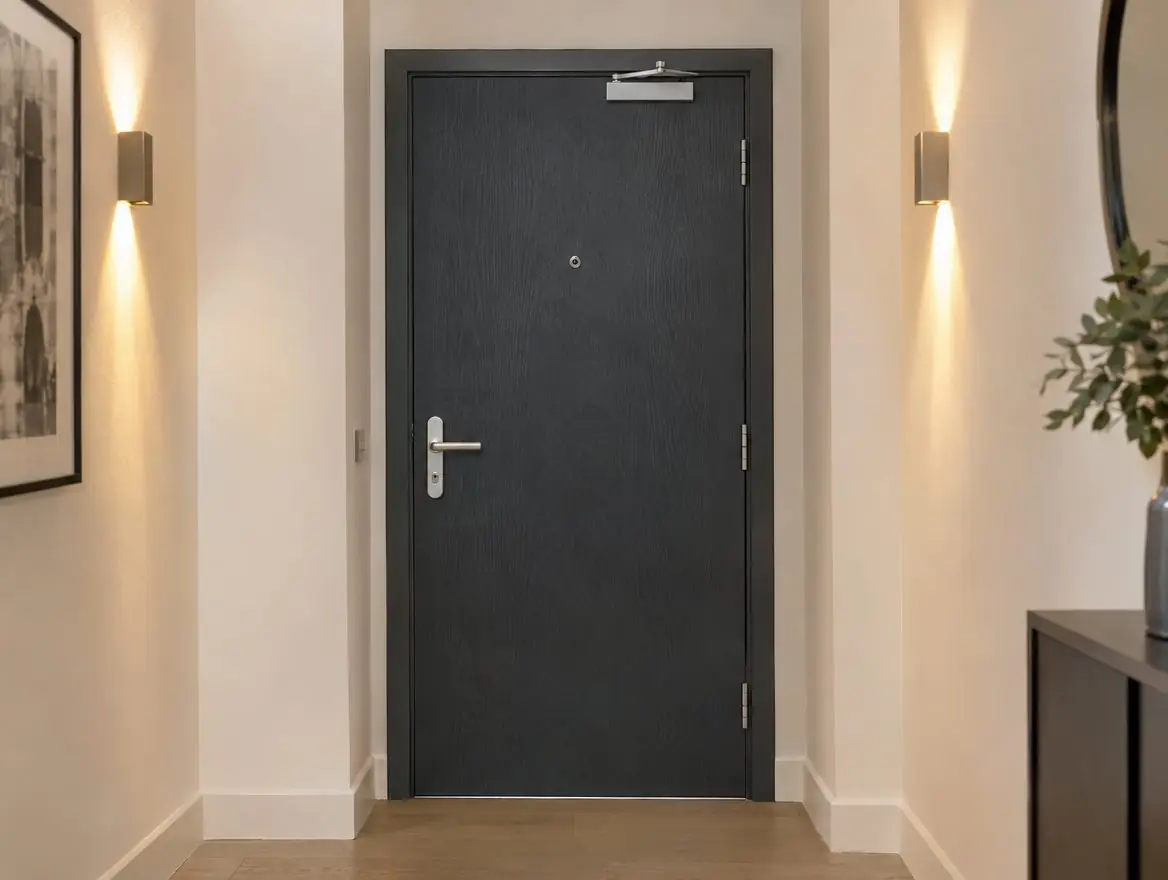
Composite fire doors for Birmingham buildings
For property owners, landlords and managing agents in Birmingham, we offer composite fire doors with one team for the survey, the product and the installation.
In and around Birmingham, fire door work covers everything from shared houses to restaurants. We plan each job around the people who use the building.
For deck-access blocks in and around Birmingham, we specify composite doors certified for external use, with the right threshold detail. We only fit composite doors in Birmingham in configurations covered by the product's certification.
What to check before you buy
Composite doors vary widely. The certification must cover the whole doorset as supplied: the core, skin, frame, glazing, letterplate, viewer and every item of hardware. Ask to see the certificate and the installation instructions, and check that the door's configuration, such as a side panel or glazed panel, is actually covered. BS 8214:2026 now includes maintenance guidance for composite and metal doors, reflecting how common they have become.
On a typical job that means:
- Weather detailing for external deck-access doors
- Certificate reference and photo record
- Viewer, numerals and security hardware within evidence
- FD30S composite doorset made to measure
What the rules say for Birmingham
England's framework applies in Birmingham. Approved Document B guides the fire performance of new and replacement doors under the Building Regulations 2010. Day-to-day duties sit with the responsible person under the Fire Safety Order 2005, and for multi-occupied residential buildings, the Fire Safety (England) Regulations 2022 add duties such as giving residents information about fire doors.
For blocks over 11 metres in Birmingham, those regulations require communal fire door checks at least every three months and best-endeavours flat entrance door checks each year. In higher-risk buildings, building work is overseen by the Building Safety Regulator, so we check whether approval is needed before starting.
Who needs composite fire doors in Birmingham?
Typical settings for composite fire doors include converted flats, purpose-built blocks of flats and deck-access blocks. In Birmingham, as anywhere, the duty holder varies: a responsible person for a workplace, a landlord or managing agent for a block or HMO, or a homeowner after building work. We adjust access, timing and paperwork to suit whoever commissions the work.
What happens after you enquire
- Survey opening, threshold and exposure
- Agree colour, glazing and hardware within the certified range
- Order doorset to measure
- Remove existing door and frame
- Install, seal and adjust to the manufacturer's instructions
- Test closer and locks and hand over evidence
What does composite fire doors cost in Birmingham?
Guide pricing for composite fire doors: £1,400–£2,600 per composite flat entrance doorset supplied and fitted, ex VAT. Volume work across several doors in one Birmingham building usually brings the per-door cost down. Your written quote is fixed once we have surveyed.
Covering Birmingham and nearby
As well as Birmingham, we cover neighbouring towns including Aston, Smethwick and Washwood Heath. The survey and quote are free.
Questions from Birmingham
Do you work in Birmingham?
Yes, we take on composite fire doors in Birmingham and the surrounding area, including Aston and Smethwick. Send your postcode and a few details and we'll come back with survey dates.
What happens on a survey in Birmingham?
We look at every door in scope: the leaf, frame, gaps, seals, hinges, closer, glazing and how the frame is fixed. You then get a written quote that prices each door separately.
Are composite fire doors as good as timber ones?
Both can perform well when they are certified and installed correctly. Composite doors offer low maintenance and colour choice; timber doorsets offer more flexibility on sizes and finishes. The certification and installation matter more than the material.
Do composite fire doors need a closer?
Yes, as flat entrance doors they need a self-closing device that closes and latches them. This can be overhead or concealed, depending on the certified options.