
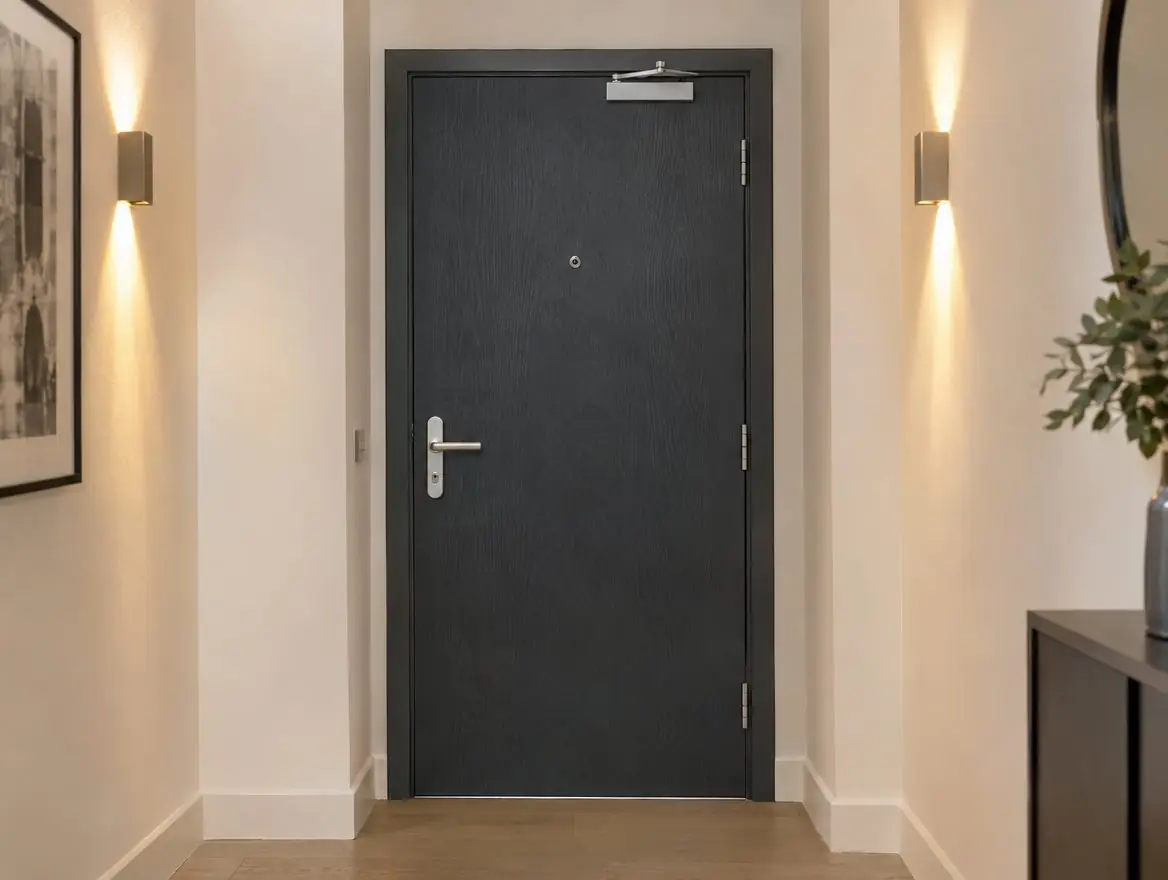
Composite fire doors in Harrogate, done to the evidence
For property owners, landlords and managing agents in Harrogate, we offer composite fire doors with one team for the survey, the product and the installation.
Buildings in and around Harrogate range from low-rise blocks of flats to care homes and houses with integral garages. Whatever the building, the standard is the same: certified products, correct gaps, seals and closers, and a frame sealed to the wall.
We only fit composite doors in Harrogate in configurations covered by the product's certification. Composite doorsets are a popular option for flat entrance programmes, and in Harrogate they suit blocks where residents want colour choice and low maintenance.
Where do composite fire doors make sense?
Composite doorsets are widely used as flat entrance doors, both inside corridors and on external deck-access walkways where the door faces the weather. Their factory finish avoids repainting, which matters because paint build-up is a common reason seals stop working. Many products also offer security features alongside the fire rating.
Each installation includes:
- Advice on certified composite products and options
- FD30S composite doorset made to measure
- Weather detailing for external deck-access doors
- Self-closer, smoke and intumescent seals
The regulations behind fire doors in Harrogate
England's framework applies in Harrogate. Approved Document B guides the fire performance of new and replacement doors under the Building Regulations 2010. Day-to-day duties sit with the responsible person under the Fire Safety Order 2005, and for multi-occupied residential buildings, the Fire Safety (England) Regulations 2022 add duties such as giving residents information about fire doors.
For blocks over 11 metres in Harrogate, those regulations require communal fire door checks at least every three months and best-endeavours flat entrance door checks each year. In higher-risk buildings, building work is overseen by the Building Safety Regulator, so we check whether approval is needed before starting.
Who needs composite fire doors in Harrogate?
Typical settings for composite fire doors include housing association estates, purpose-built blocks of flats and converted flats. In Harrogate, as anywhere, the duty holder varies: a responsible person for a workplace, a landlord or managing agent for a block or HMO, or a homeowner after building work. We adjust access, timing and paperwork to suit whoever commissions the work.
Our process in Harrogate
- Survey opening, threshold and exposure
- Agree colour, glazing and hardware within the certified range
- Order doorset to measure
- Remove existing door and frame
- Install, seal and adjust to the manufacturer's instructions
- Test closer and locks and hand over evidence
Budgeting for composite fire doors in Harrogate
Guide pricing for composite fire doors: £1,400–£2,600 per composite flat entrance doorset supplied and fitted, ex VAT. Volume work across several doors in one Harrogate building usually brings the per-door cost down. Your written quote is fixed once we have surveyed.
Harrogate and neighbouring towns
Neighbouring towns such as Yeadon, Guiseley, Leeds and Shipley are covered too, so clients with several buildings can use one installer and one evidence format.
Common questions
Is Harrogate within your coverage area?
It is. We cover Harrogate in North Yorkshire and neighbouring towns such as Yeadon. There is no charge for the survey.
How quickly can you survey in Harrogate?
It depends on the number of doors and access, but we offer survey dates as soon as we reply to your enquiry. If an inspection has found urgent safety issues, tell us and we'll prioritise.
Are composite fire doors as good as timber ones?
Both can perform well when they are certified and installed correctly. Composite doors offer low maintenance and colour choice; timber doorsets offer more flexibility on sizes and finishes. The certification and installation matter more than the material.
Do composite fire doors need a closer?
Yes, as flat entrance doors they need a self-closing device that closes and latches them. This can be overhead or concealed, depending on the certified options.