
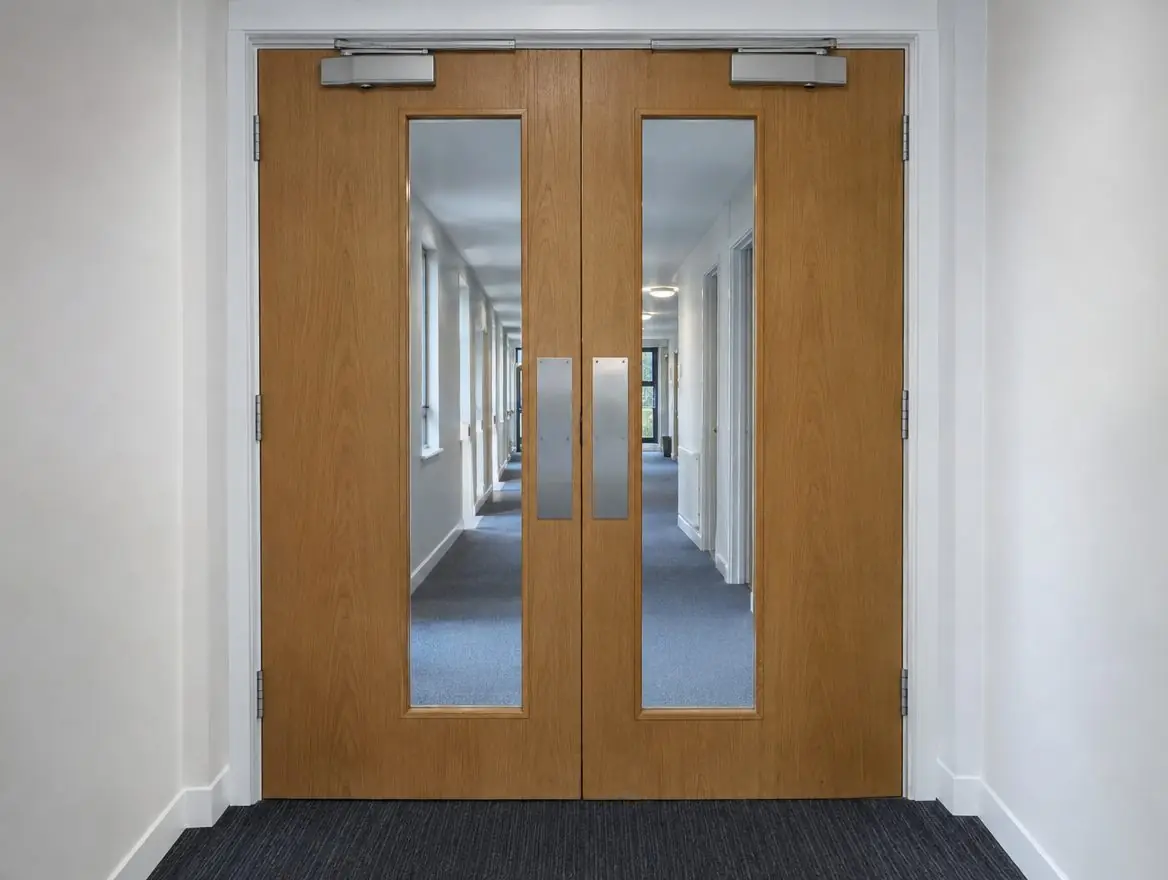
Communal fire doors in Tamworth, done to the evidence
Looking for communal fire doors in Tamworth? We supply and fit certified fire doors and components across Tamworth and the wider Staffordshire area, working from a free survey and a fixed written quote.
Buildings in and around Tamworth range from family homes after loft conversions to high-street shops and low-rise blocks of flats. Whatever the building, the standard is the same: certified products, correct gaps, seals and closers, and a frame sealed to the wall.
Communal corridors and stairs in Tamworth buildings take the heaviest use, so we choose finishes and hardware that keep working between checks. The evidence pack for each communal door in Tamworth is set out to support whatever checking regime your fire risk assessment sets.
Pairs, vision panels and robust finishes
We fit single, double and leaf-and-a-half communal doors, with vision panels in tested glazing systems and finishes chosen to stand up to use, such as laminates and kick plates covered by the certification. For pairs, the meeting edges, rebates and any door coordinator must match the evidence; see our double fire doors page.
On a typical job that means:
- Survey of every communal opening and its use
- Evidence pack suitable for regulation 10 records
- Certified single, double or leaf-and-a-half doorsets
- Tested vision panels and durable finishes
The regulations behind fire doors in Tamworth
The rules that apply to fire doors in Tamworth are England's. The responsible person under the Regulatory Reform (Fire Safety) Order 2005 must keep fire doors in non-domestic premises and the common parts of flats in working order; the Fire Safety Act 2021 confirmed that this includes flat entrance doors onto common parts.
Where a Tamworth block is above 11 metres, regulation 10 of the 2022 regulations means communal doors are checked every three months and flat entrance doors annually on a best-endeavours basis. Replacement doors must also satisfy the Building Regulations, with Approved Document B as the guidance most building control bodies work from.
Who needs communal fire doors in Tamworth?
Landlords, managing agents, facilities teams and homeowners in Tamworth can all commission communal fire doors from us. The usual settings are hotels and sheltered and supported housing, though single doors for blocks of flats are just as welcome.
The steps on a Tamworth installation
- Survey communal doors and plan a phased sequence
- Agree working hours and resident notices with the client
- Order doorsets to size with matching hardware
- Replace doors one route section at a time
- Commission closers and hold-opens with the alarm contractor
- Hand over evidence for your fire safety records
What does communal fire doors cost in Tamworth?
Guide pricing for communal fire doors: from around £800 for a single communal doorset to £3,200 for a glazed pair, ex VAT. Volume work across several doors in one Tamworth building usually brings the per-door cost down. Your written quote is fixed once we have surveyed.
Covering Tamworth and nearby
Neighbouring towns such as Lichfield, Sutton Coldfield, Aldridge and Burntwood are covered too, so clients with several buildings can use one installer and one evidence format.
Questions
Do you cover B77 and nearby postcodes?
Yes. We cover Tamworth including B77, and nearby towns such as Lichfield and Sutton Coldfield. The survey and written quote are free.
Can you work from an existing inspection report for my Tamworth building?
Yes. Send it over and we can often price straight from it, then confirm on site. We report back against the same door references so you can close actions off.
How often should communal fire doors be checked?
In England, every three months for residential buildings above 11 metres under regulation 10. Your fire risk assessment may set other frequencies for other buildings and nations.
Can communal fire doors be held open?
Only with a proper hold-open device that releases the door when the fire alarm operates. Wedges and hooks are not acceptable. Electromagnetic holders or free-swing closers are the usual solutions.