
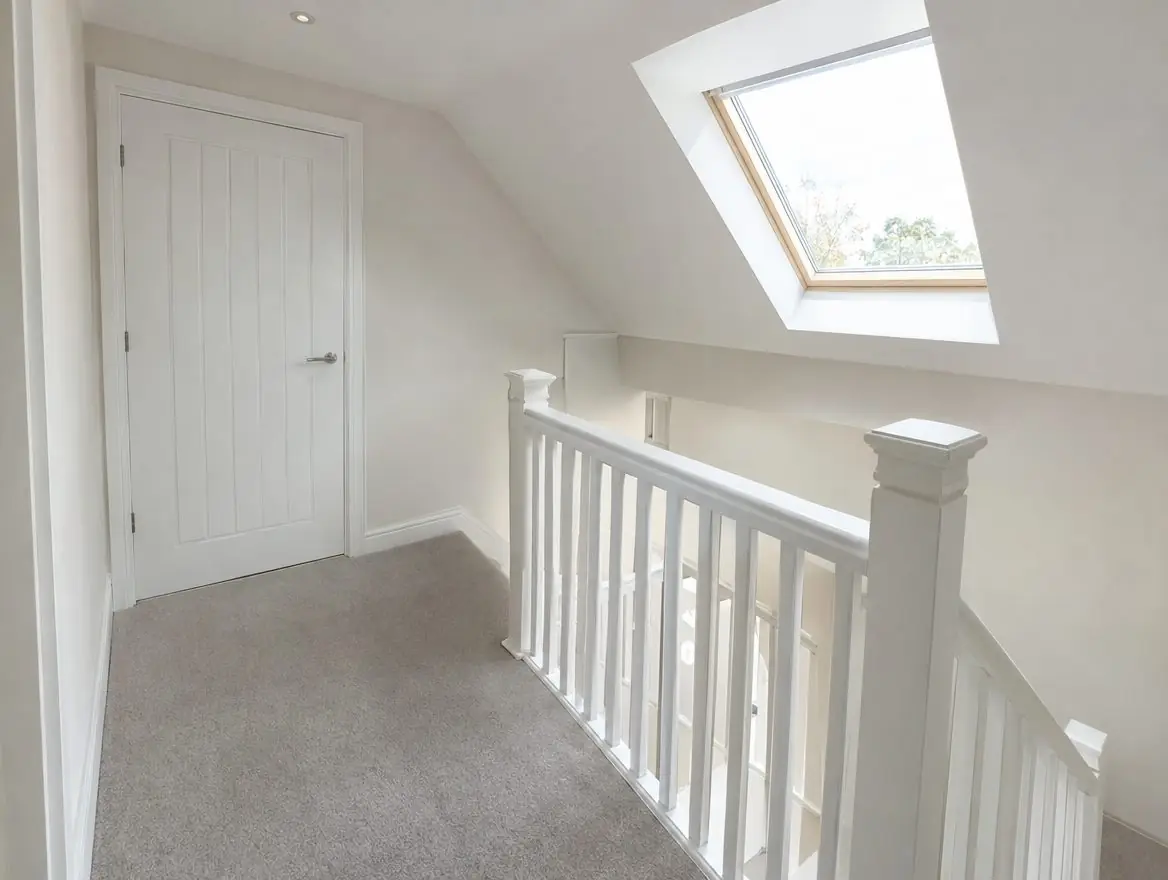
Getting loft conversion fire doors right in Hornchurch
For property owners, landlords and managing agents in Hornchurch, we offer loft conversion fire doors with one team for the survey, the product and the installation.
Fire doors in Hornchurch protect escape routes in mixed-use office buildings, clinics and shared houses alike. We adapt the programme to the building and its occupants, never the standard of the installation.
We can fit loft conversion fire doors in Hornchurch as your builder's subcontractor or directly for you. For homes in Hornchurch, we match fire doors to your existing style wherever certified options allow.
FD20 or FD30?
In England, the guidance generally asks for FD20 (E20) doors in this situation, and self-closers are not usually required within a house. Scotland is different: the domestic Technical Handbook expects doors onto the protected stair enclosure to be self-closing fire doors, so closers are part of the job there. Many homeowners choose FD30 doors anyway, because they are widely available and the price difference is small. Either way, the door must be fitted properly: correct gaps, fire-tested hinges and an intumescent strip where the product requires one.
Each installation includes:
- Check of which openings need fire doors
- Work coordinated with your builder
- Product details for building control
- FD20 or FD30 doors in your chosen style
The regulations behind fire doors in Hornchurch
Fire doors in Hornchurch fall under English rules. New and replacement doors are covered by the Building Regulations 2010 and Approved Document B. In workplaces and the common parts of blocks, the Regulatory Reform (Fire Safety) Order 2005, as clarified by the Fire Safety Act 2021, puts the duty on the responsible person to keep fire doors suitable and maintained. In London, the London Fire Brigade is the enforcing authority for fire safety law.
For residential buildings in Hornchurch above 11 metres, regulation 10 of the Fire Safety (England) Regulations 2022 adds checks: communal fire doors at least every three months and best-endeavours checks of flat entrance doors at least every twelve months. Higher-risk buildings of at least 18 metres or seven storeys also come under the Building Safety Act 2022, where works may need approval from the Building Safety Regulator.
Where loft conversion fire doors fit in Hornchurch
Typical settings for loft conversion fire doors include detached family homes, semi-detached houses and bungalows gaining an upper floor. In Hornchurch, as elsewhere, the work is usually commissioned by homeowners, often alongside a builder or after a building control visit, so we fit around the household and leave the product details building control asks for.
The steps on a Hornchurch installation
- Review the building control requirements or drawings
- Survey each door opening off the stair
- Agree door style and rating
- Fit doors, hinges and strips
- Check gaps and operation
- Hand over product details
Prices for loft conversion fire doors in Hornchurch
If you need a budget figure first, the guide for loft conversion fire doors is £300–£650 per door supplied and fitted, ex VAT. We firm that up after a survey, pricing each door separately so you can see where the money goes.
Nearby areas we cover from Hornchurch
We also cover towns near Hornchurch, including Romford (2.9 km away), Dagenham and Becontree. If your building is in RM12 or a neighbouring district, the service and pricing are the same.
Questions
Do you work in Hornchurch?
Yes, we take on loft conversion fire doors in Hornchurch and the surrounding area, including Romford and Dagenham. Send your postcode and a few details and we'll come back with survey dates.
What happens on a survey in Hornchurch?
We look at every door in scope: the leaf, frame, gaps, seals, hinges, closer, glazing and how the frame is fixed. You then get a written quote that prices each door separately.
Do all my doors need to be fire doors after a loft conversion?
Usually the doors from habitable rooms onto the stair do, on every floor. Bathrooms are often excluded. Building control decides for your house.
Can I just add intumescent strips to my existing doors?
Generally no. A standard internal door is not a fire door, and strips alone will not make it one. Existing doors need to be replaced with certified fire doors.