
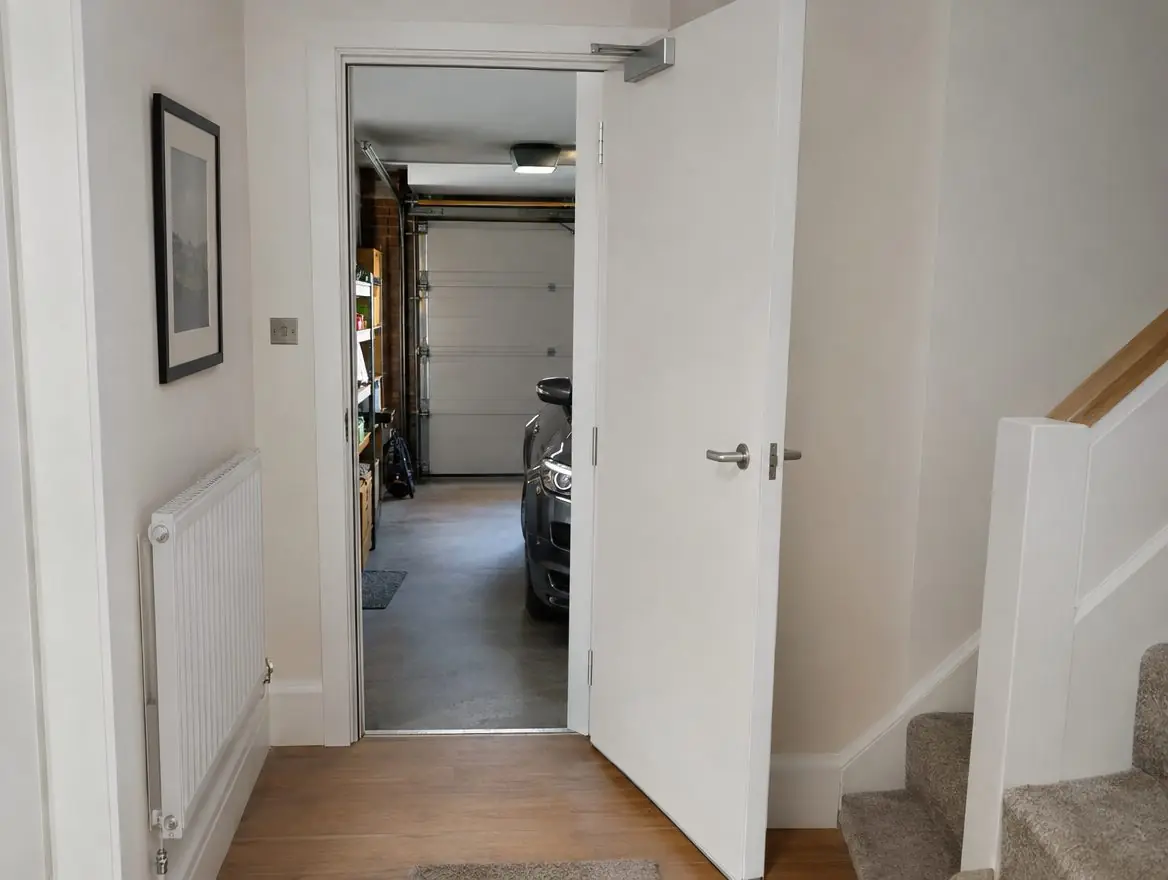
Integral garage fire doors for Bolton buildings
For property owners, landlords and managing agents in Bolton, we offer integral garage fire doors with one team for the survey, the product and the installation.
Buildings in and around Bolton range from schools to purpose-built flats and converted period houses. Whatever the building, the standard is the same: certified products, correct gaps, seals and closers, and a frame sealed to the wall.
For homes in Bolton with an integral garage, the door into the house is one of the few internal doors expected to be fire-rated and self-closing. If you are selling a home in Bolton, we can leave product details for your solicitor along with the door.
Why the garage door matters
Fires that start in garages can grow quickly and fill a hallway with smoke. The door between the garage and the house is the barrier that buys time for everyone inside to get out. It is one of the few doors inside a home that is expected to be both fire-rated and self-closing, and it often has a step or threshold that needs careful detailing.
On a typical job that means:
- Product details for building control or your solicitor
- Self-closer set gently but positively
- Survey of the opening, threshold and step
- Intumescent and smoke seals
The regulations behind fire doors in Bolton
Fire doors in Bolton fall under English rules. New and replacement doors are covered by the Building Regulations 2010 and Approved Document B. In workplaces and the common parts of blocks, the Regulatory Reform (Fire Safety) Order 2005, as clarified by the Fire Safety Act 2021, puts the duty on the responsible person to keep fire doors suitable and maintained.
For residential buildings in Bolton above 11 metres, regulation 10 of the Fire Safety (England) Regulations 2022 adds checks: communal fire doors at least every three months and best-endeavours checks of flat entrance doors at least every twelve months. Higher-risk buildings of at least 18 metres or seven storeys also come under the Building Safety Act 2022, where works may need approval from the Building Safety Regulator.
Buildings and duty holders in Bolton
Typical settings for integral garage fire doors include homes being extended, houses with integral garages and new-build homes. In Bolton, as elsewhere, the work is usually commissioned by homeowners, often alongside a builder or after a building control visit, so we fit around the household and leave the product details building control asks for.
The steps on a Bolton installation
- Visit to measure the opening and check the frame
- Agree door style and finish
- Order certified door or doorset
- Fit door, seals and closer
- Adjust threshold and latching
- Leave product information for your records
Prices for integral garage fire doors in Bolton
As a guide, budget £550–£1,100 supplied and fitted, depending on whether the frame is replaced, ex VAT for integral garage fire doors. The figure for your Bolton building depends on the number of doors, the rating, the condition of the frames, finishes, hardware and access. We confirm a fixed price after the free survey.
Covering Bolton and nearby
Nearby towns we cover include Farnworth, Westhoughton and Radcliffe. Distance from Bolton does not change our guide prices, and the survey and quote are free.
Common questions
Is Bolton within your coverage area?
It is. We cover Bolton in Greater Manchester and neighbouring towns such as Farnworth. There is no charge for the survey.
How quickly can you survey in Bolton?
It depends on the number of doors and access, but we offer survey dates as soon as we reply to your enquiry. If an inspection has found urgent safety issues, tell us and we'll prioritise.
Will building control accept the door?
We supply certified products and leave product and certificate details so your building control body or solicitor can see what was fitted. The final decision is theirs.
Does my garage door need to be a fire door?
If the garage is integral to the house, Approved Document B in England expects the connecting door to be a fire door with smoke control. Requirements in Wales, Scotland and Northern Ireland are similar in purpose but set out in their own guidance.