
Getting certified fire doorsets right in Lancaster
Our certified fire doorsets service covers Lancaster and the wider Lancashire area. Every job starts with a survey of the openings, so the quote reflects your actual doors rather than a guess.
Around Lancaster, care homes, light industrial buildings and houses with integral garages all depend on fire doors that close, latch and seal. We survey each opening and tell you plainly which doors need work and which don't.
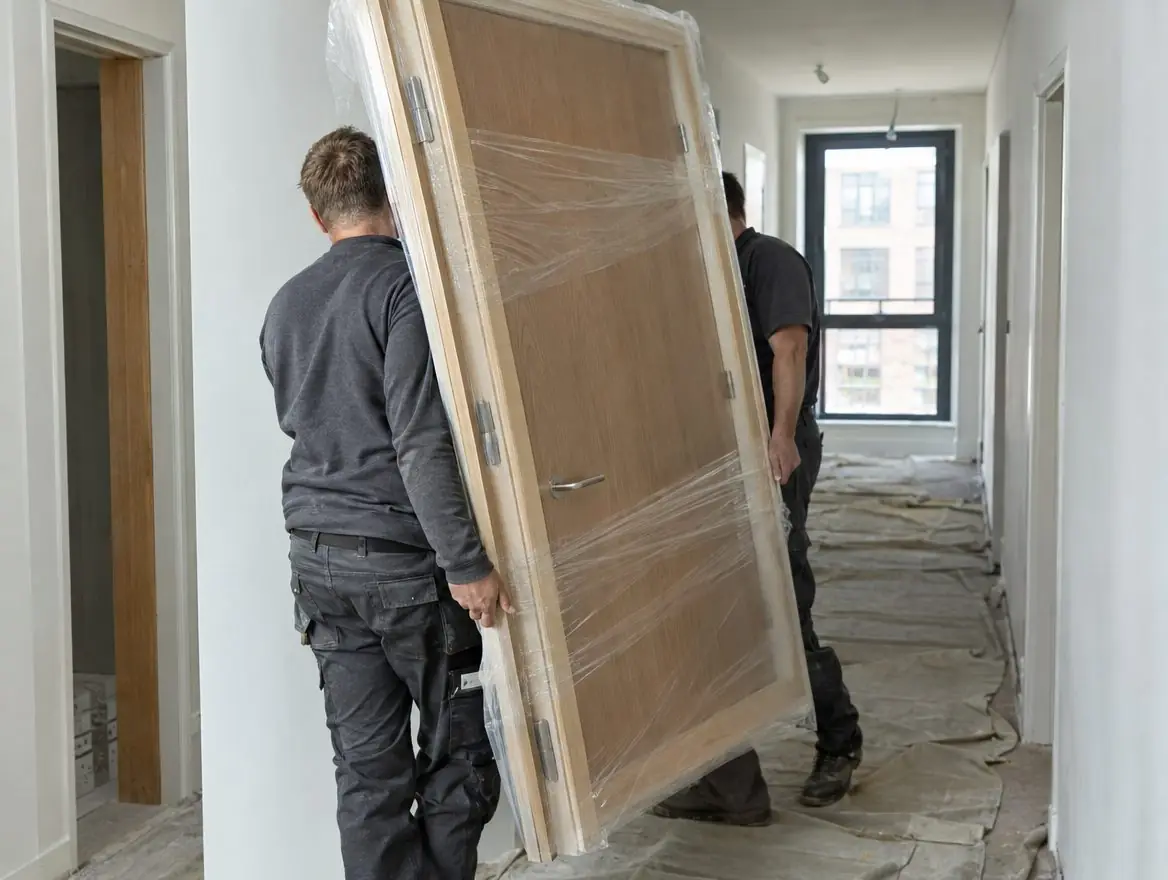
Pre-hung doorsets keep disruption down in occupied buildings in Lancaster, with less cutting and fewer return visits. Every doorset we fit in Lancaster is handed over with its certificate reference and photographs of the frame fixing and gap sealing.
How is a doorset installed?
The opening is prepared to the size and tolerances in the manufacturer's instructions. The frame is fixed with the specified fixings at the specified centres, packed where needed, and checked for square, plumb and twist. The gap between frame and wall is then sealed with a material covered by the evidence, which BS 8214:2026 now describes in more detail. Finally the leaf is adjusted, the closer is set and the assembly is tested before the architraves go on.
Each installation includes:
- Pre-hung, pre-machined doorsets where available
- Frame fixing and frame-to-wall gap sealing
- Certificate references and photo record per opening
- Doorset selection to rating, size and use
Rules and responsibilities in Lancaster
The rules that apply to fire doors in Lancaster are England's. The responsible person under the Regulatory Reform (Fire Safety) Order 2005 must keep fire doors in non-domestic premises and the common parts of flats in working order; the Fire Safety Act 2021 confirmed that this includes flat entrance doors onto common parts.
Where a Lancaster block is above 11 metres, regulation 10 of the 2022 regulations means communal doors are checked every three months and flat entrance doors annually on a best-endeavours basis. Replacement doors must also satisfy the Building Regulations, with Approved Document B as the guidance most building control bodies work from.
Which buildings in Lancaster need certified fire doorsets?
From blocks of flats to refurbishment programmes, the requirement for certified fire doorsets in Lancaster comes from the fire strategy or risk assessment for the building. We work from that document, or help you interpret your inspection report, before quoting.
How a Lancaster job runs
- Survey and measure every structural opening
- Specify doorsets by rating, size, hand, finish and hardware
- Prepare openings and remove existing doors and linings
- Fix and seal the frames to the structure
- Hang, adjust and test each leaf and closer
- Fit architraves, make good and hand over evidence
What does certified fire doorsets cost in Lancaster?
If you need a budget figure first, the guide for certified fire doorsets is £650–£1,300 for an FD30 doorset and £850–£1,800 for FD60, supplied and fitted, ex VAT. We firm that up after a survey, pricing each door separately so you can see where the money goes.
Nearby areas we cover from Lancaster
Neighbouring towns such as Morecambe, Fleetwood, Thornton-Cleveleys and Barrow-in-Furness are covered too, so clients with several buildings can use one installer and one evidence format.
Questions from Lancaster
Do you cover LA1 and nearby postcodes?
Yes. We cover Lancaster including LA1, and nearby towns such as Morecambe and Fleetwood. The survey and written quote are free.
Can you work from an existing inspection report for my Lancaster building?
Yes. Send it over and we can often price straight from it, then confirm on site. We report back against the same door references so you can close actions off.
Are doorsets more expensive than a leaf?
The product costs more, but the labour is often lower and the result is better evidenced. Where a frame would need replacing anyway, a doorset is usually the better value.
Do doorsets come painted?
They can be supplied primed, factory painted, veneered, laminated or with a composite skin, depending on the product. Factory finishes avoid painting over seals and labels on site.