
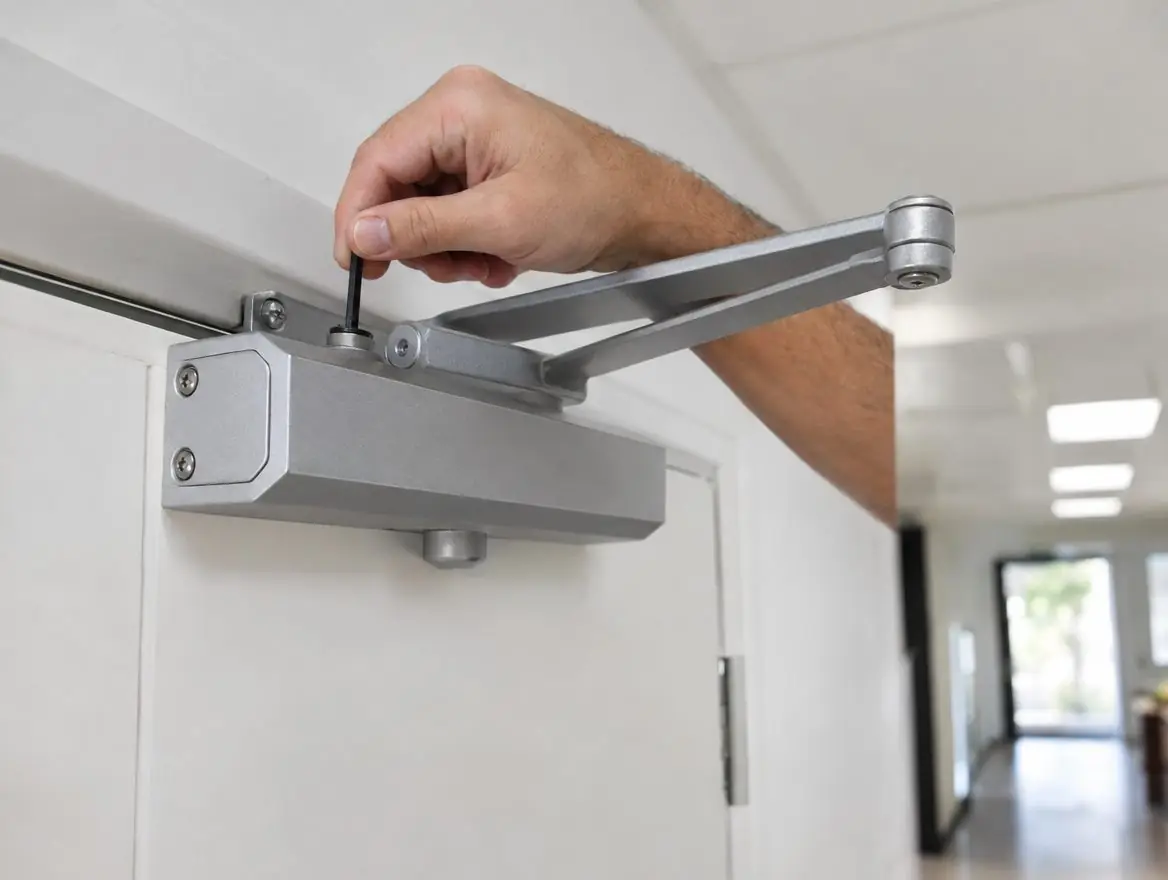
What fire door closers in Reading should include
Our fire door closers service covers Reading and the wider Berkshire area. Every job starts with a survey of the openings, so the quote reflects your actual doors rather than a guess.
Buildings in and around Reading range from student accommodation to schools and shared houses. Whatever the building, the standard is the same: certified products, correct gaps, seals and closers, and a frame sealed to the wall.
Free-swing closers are a practical option for Reading care homes and supported living. A closer that fails to latch the door is one of the first things we put right on Reading fire doors.
Overhead, concealed or free-swing
Overhead closers are the most common and easiest to maintain. Concealed closers keep a clean look and deter tampering, if covered by the door's evidence. Free-swing closers let a door move freely in everyday use and close when the fire alarm sounds, which is useful in care homes and for people who find doors hard to open.
What you get:
- Overhead, concealed or free-swing options
- Adjustment of speed, latching and backcheck
- Record of model and settings
- Close-and-latch test from full open
Rules and responsibilities in Reading
Fire doors in Reading fall under English rules. New and replacement doors are covered by the Building Regulations 2010 and Approved Document B. In workplaces and the common parts of blocks, the Regulatory Reform (Fire Safety) Order 2005, as clarified by the Fire Safety Act 2021, puts the duty on the responsible person to keep fire doors suitable and maintained.
For residential buildings in Reading above 11 metres, regulation 10 of the Fire Safety (England) Regulations 2022 adds checks: communal fire doors at least every three months and best-endeavours checks of flat entrance doors at least every twelve months. Higher-risk buildings of at least 18 metres or seven storeys also come under the Building Safety Act 2022, where works may need approval from the Building Safety Regulator.
Who needs fire door closers in Reading?
You are most likely to need fire door closers if you look after blocks of flats, schools or care homes. Whatever the building in Reading, we survey each opening and tell you which doors need work and which do not.
What happens after you enquire
- Check the door, frame and existing closer
- Select a closer suited to the leaf and use
- Fit to the template and the door's evidence
- Adjust closing and latching speeds
- Test from wide and small opening angles
- Record the closer and its settings
Budgeting for fire door closers in Reading
As a guide, budget £90–£220 per closer supplied and fitted; adjustment visits from £195, ex VAT for fire door closers. The figure for your Reading building depends on the number of doors, the rating, the condition of the frames, finishes, hardware and access. We confirm a fixed price after the free survey.
Around Reading
Beyond Reading itself we also cover nearby towns such as Lower Earley (4.8 km), Wokingham and Crowthorne. The service, pricing and evidence are the same wherever you are.
Questions
Is Reading within your coverage area?
It is. We cover Reading in Berkshire and neighbouring towns such as Lower Earley. There is no charge for the survey.
Can you work from an existing inspection report for my Reading building?
Yes. Send it over and we can often price straight from it, then confirm on site. We report back against the same door references so you can close actions off.
Can a fire door closer be too strong?
Yes. An over-powered or badly set closer makes the door hard to open and may lead people to wedge it. The goal is reliable closing with a reasonable opening force.
What is a free-swing closer?
A closer that lets the door swing freely in normal use and closes it when the fire alarm operates. It suits care settings and people who find doors heavy.