
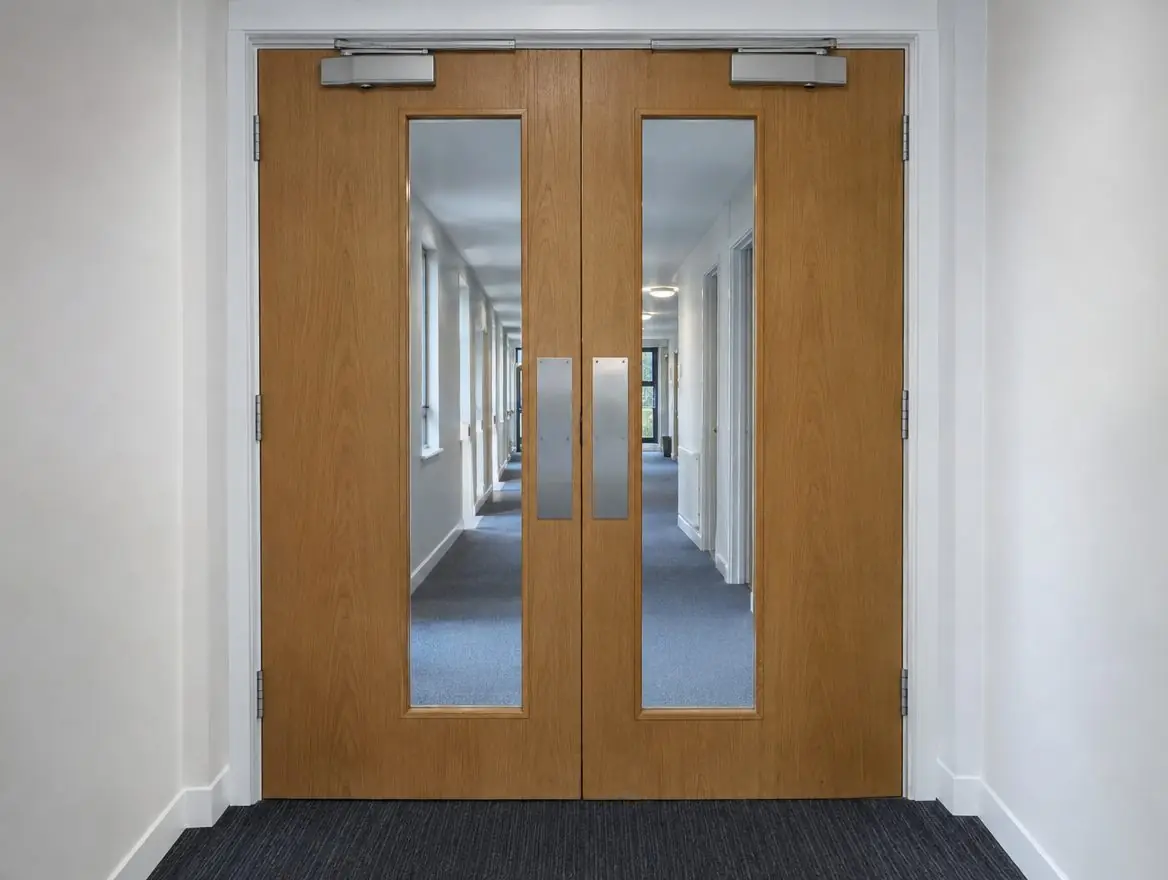
Getting communal fire doors right in Stowmarket
Our communal fire doors service in Stowmarket is simple: a survey, a fixed quote, certified products and an installation finished to the manufacturer's evidence.
Around Stowmarket, small blocks of flats, small offices and care homes all depend on fire doors that close, latch and seal. We survey each opening and tell you plainly which doors need work and which don't.
Communal corridors and stairs in Stowmarket buildings take the heaviest use, so we choose finishes and hardware that keep working between checks. We phase communal door replacements in Stowmarket so every escape route stays protected throughout the programme.
How do you work in an occupied building?
Escape routes have to stay usable. We phase communal door work so that no stair or corridor is left without protection overnight, keep a doorset ready to fit before removing the old one, and agree working hours with the building manager. Where a hold-open device is needed, we coordinate with your fire alarm contractor for the release interface.
As standard, the work covers:
- Evidence pack suitable for regulation 10 records
- Closers, coordinators and hold-opens as required
- Certified single, double or leaf-and-a-half doorsets
- Tested vision panels and durable finishes
The regulations behind fire doors in Stowmarket
In Stowmarket, as elsewhere in England, the starting point is the Fire Safety Order 2005: whoever controls a workplace or the shared parts of a residential block must make sure its fire doors work. When doors are replaced, the Building Regulations and Approved Document B set the standard the new work has to meet.
Blocks above 11 metres have a specific routine under regulation 10 of the Fire Safety (England) Regulations 2022: quarterly checks of communal fire doors and annual best-endeavours checks of flat front doors. If your Stowmarket building is a higher-risk building under the Building Safety Act 2022, we confirm the approval route with the Principal Accountable Person before any work is ordered.
Which buildings in Stowmarket need communal fire doors?
The need for communal fire doors usually arises in student accommodation or blocks of flats, and sometimes hotels. Each has its own pressures, such as residents at home or a building that must stay open, so we plan the sequence of work in Stowmarket to keep escape routes protected throughout.
Our process in Stowmarket
- Survey communal doors and plan a phased sequence
- Agree working hours and resident notices with the client
- Order doorsets to size with matching hardware
- Replace doors one route section at a time
- Commission closers and hold-opens with the alarm contractor
- Hand over evidence for your fire safety records
Budgeting for communal fire doors in Stowmarket
As a guide, budget from around £800 for a single communal doorset to £3,200 for a glazed pair, ex VAT for communal fire doors. The figure for your Stowmarket building depends on the number of doors, the rating, the condition of the frames, finishes, hardware and access. We confirm a fixed price after the free survey.
Covering Stowmarket and nearby
Neighbouring towns such as Ipswich, Bury St Edmunds, Sudbury and Thetford are covered too, so clients with several buildings can use one installer and one evidence format.
Questions from Stowmarket
Is Stowmarket within your coverage area?
It is. We cover Stowmarket in Suffolk and neighbouring towns such as Ipswich. There is no charge for the survey.
Do I need to be there for the survey?
Someone needs to give us access to the doors. For blocks and commercial buildings, a caretaker or site contact is fine; for HMOs and homes, we agree a time with you or your tenants.
How often should communal fire doors be checked?
In England, every three months for residential buildings above 11 metres under regulation 10. Your fire risk assessment may set other frequencies for other buildings and nations.
Can communal fire doors be held open?
Only with a proper hold-open device that releases the door when the fire alarm operates. Wedges and hooks are not acceptable. Electromagnetic holders or free-swing closers are the usual solutions.