
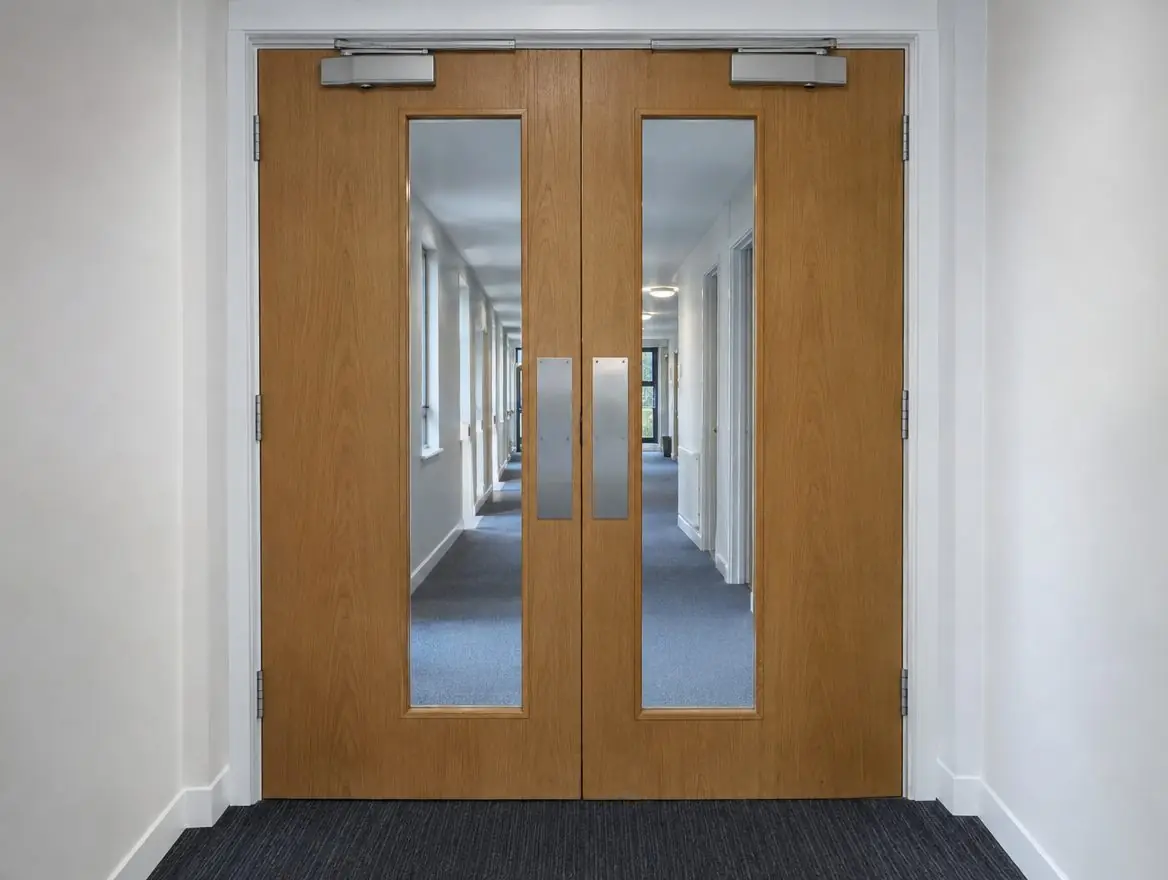
Communal fire doors in Newark-on-Trent, done to the evidence
If you need communal fire doors in Newark-on-Trent, we can survey, supply and install, then leave you the evidence your fire risk assessor will ask for.
Fire doors in Newark-on-Trent protect escape routes in houses with integral garages, schools and small offices alike. We adapt the programme to the building and its occupants, never the standard of the installation.
We phase communal door replacements in Newark-on-Trent so every escape route stays protected throughout the programme. The evidence pack for each communal door in Newark-on-Trent is set out to support whatever checking regime your fire risk assessment sets.
Pairs, vision panels and robust finishes
We fit single, double and leaf-and-a-half communal doors, with vision panels in tested glazing systems and finishes chosen to stand up to use, such as laminates and kick plates covered by the certification. For pairs, the meeting edges, rebates and any door coordinator must match the evidence; see our double fire doors page.
What you get:
- Tested vision panels and durable finishes
- Closers, coordinators and hold-opens as required
- Survey of every communal opening and its use
- Evidence pack suitable for regulation 10 records
Rules and responsibilities in Newark-on-Trent
England's framework applies in Newark-on-Trent. Approved Document B guides the fire performance of new and replacement doors under the Building Regulations 2010. Day-to-day duties sit with the responsible person under the Fire Safety Order 2005, and for multi-occupied residential buildings, the Fire Safety (England) Regulations 2022 add duties such as giving residents information about fire doors.
For blocks over 11 metres in Newark-on-Trent, those regulations require communal fire door checks at least every three months and best-endeavours flat entrance door checks each year. In higher-risk buildings, building work is overseen by the Building Safety Regulator, so we check whether approval is needed before starting.
Buildings and duty holders in Newark-on-Trent
Typical settings for communal fire doors include student accommodation, hotels and blocks of flats. In Newark-on-Trent, as anywhere, the duty holder varies: a responsible person for a workplace, a landlord or managing agent for a block or HMO, or a homeowner after building work. We adjust access, timing and paperwork to suit whoever commissions the work.
What happens after you enquire
- Survey communal doors and plan a phased sequence
- Agree working hours and resident notices with the client
- Order doorsets to size with matching hardware
- Replace doors one route section at a time
- Commission closers and hold-opens with the alarm contractor
- Hand over evidence for your fire safety records
Budgeting for communal fire doors in Newark-on-Trent
As a guide, budget from around £800 for a single communal doorset to £3,200 for a glazed pair, ex VAT for communal fire doors. The figure for your Newark-on-Trent building depends on the number of doors, the rating, the condition of the frames, finishes, hardware and access. We confirm a fixed price after the free survey.
Covering Newark-on-Trent and nearby
Neighbouring towns such as Grantham, Arnold, Nottingham and West Bridgford are covered too, so clients with several buildings can use one installer and one evidence format.
Common questions
Do you work in Newark-on-Trent?
Yes, we take on communal fire doors in Newark-on-Trent and the surrounding area, including Grantham and Arnold. Send your postcode and a few details and we'll come back with survey dates.
What happens on a survey in Newark-on-Trent?
We look at every door in scope: the leaf, frame, gaps, seals, hinges, closer, glazing and how the frame is fixed. You then get a written quote that prices each door separately.
Can communal fire doors be held open?
Only with a proper hold-open device that releases the door when the fire alarm operates. Wedges and hooks are not acceptable. Electromagnetic holders or free-swing closers are the usual solutions.
Will the stairs be out of use while you work?
No. We phase the work so that each route stays protected and usable, replacing doors one section at a time and never leaving an opening without a door at the end of the day.