
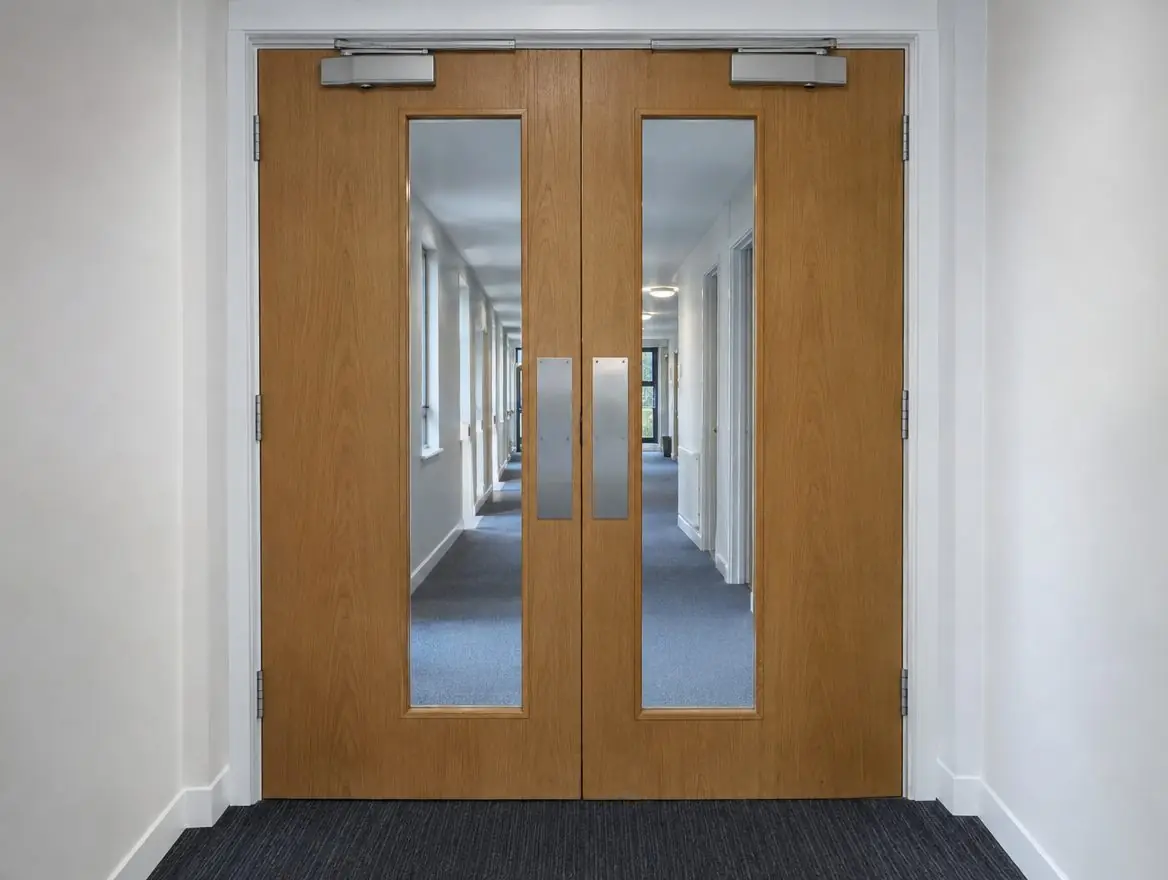
Communal fire doors in Scarborough: what's involved
For property owners, landlords and managing agents in Scarborough, we offer communal fire doors with one team for the survey, the product and the installation.
Scarborough has a broad mix of buildings, including high-street shops, industrial estates and HMOs, and the same fire door principles apply to all of them.
Communal corridors and stairs in Scarborough buildings take the heaviest use, so we choose finishes and hardware that keep working between checks. The evidence pack for each communal door in Scarborough is set out to support whatever checking regime your fire risk assessment sets.
What makes communal doors different?
Communal doors take far more traffic than flat entrance doors. They are pushed with trolleys, propped open and slammed. Many are pairs, glazed, or fitted with hold-open devices. That combination is why communal doors so often fail inspections for gaps, worn seals, damaged closers and doors that no longer latch.
In England, communal fire doors in residential buildings above 11 metres must be checked at least every three months under regulation 10. A sound installation makes passing those checks routine.
As standard, the work covers:
- Phased programme keeping escape routes protected
- Certified single, double or leaf-and-a-half doorsets
- Survey of every communal opening and its use
- Closers, coordinators and hold-opens as required
Which fire door rules apply in Scarborough?
England's framework applies in Scarborough. Approved Document B guides the fire performance of new and replacement doors under the Building Regulations 2010. Day-to-day duties sit with the responsible person under the Fire Safety Order 2005, and for multi-occupied residential buildings, the Fire Safety (England) Regulations 2022 add duties such as giving residents information about fire doors.
For blocks over 11 metres in Scarborough, those regulations require communal fire door checks at least every three months and best-endeavours flat entrance door checks each year. In higher-risk buildings, building work is overseen by the Building Safety Regulator, so we check whether approval is needed before starting.
Buildings and duty holders in Scarborough
Landlords, managing agents, facilities teams and homeowners in Scarborough can all commission communal fire doors from us. The usual settings are sheltered and supported housing and student accommodation, though single doors for blocks of flats are just as welcome.
The steps on a Scarborough installation
- Survey communal doors and plan a phased sequence
- Agree working hours and resident notices with the client
- Order doorsets to size with matching hardware
- Replace doors one route section at a time
- Commission closers and hold-opens with the alarm contractor
- Hand over evidence for your fire safety records
Guide prices in Scarborough
As a guide, budget from around £800 for a single communal doorset to £3,200 for a glazed pair, ex VAT for communal fire doors. The figure for your Scarborough building depends on the number of doors, the rating, the condition of the frames, finishes, hardware and access. We confirm a fixed price after the free survey.
Nearby areas we cover from Scarborough
Scarborough is about 56.9 km from York, and we cover both, along with nearby Bridlington and Beverley. Send us your postcode and we'll confirm survey dates.
Questions from Scarborough
Is Scarborough within your coverage area?
It is. We cover Scarborough in North Yorkshire and neighbouring towns such as Bridlington. There is no charge for the survey.
What happens on a survey in Scarborough?
We look at every door in scope: the leaf, frame, gaps, seals, hinges, closer, glazing and how the frame is fixed. You then get a written quote that prices each door separately.
Will the stairs be out of use while you work?
No. We phase the work so that each route stays protected and usable, replacing doors one section at a time and never leaving an opening without a door at the end of the day.
Can communal fire doors be held open?
Only with a proper hold-open device that releases the door when the fire alarm operates. Wedges and hooks are not acceptable. Electromagnetic holders or free-swing closers are the usual solutions.