
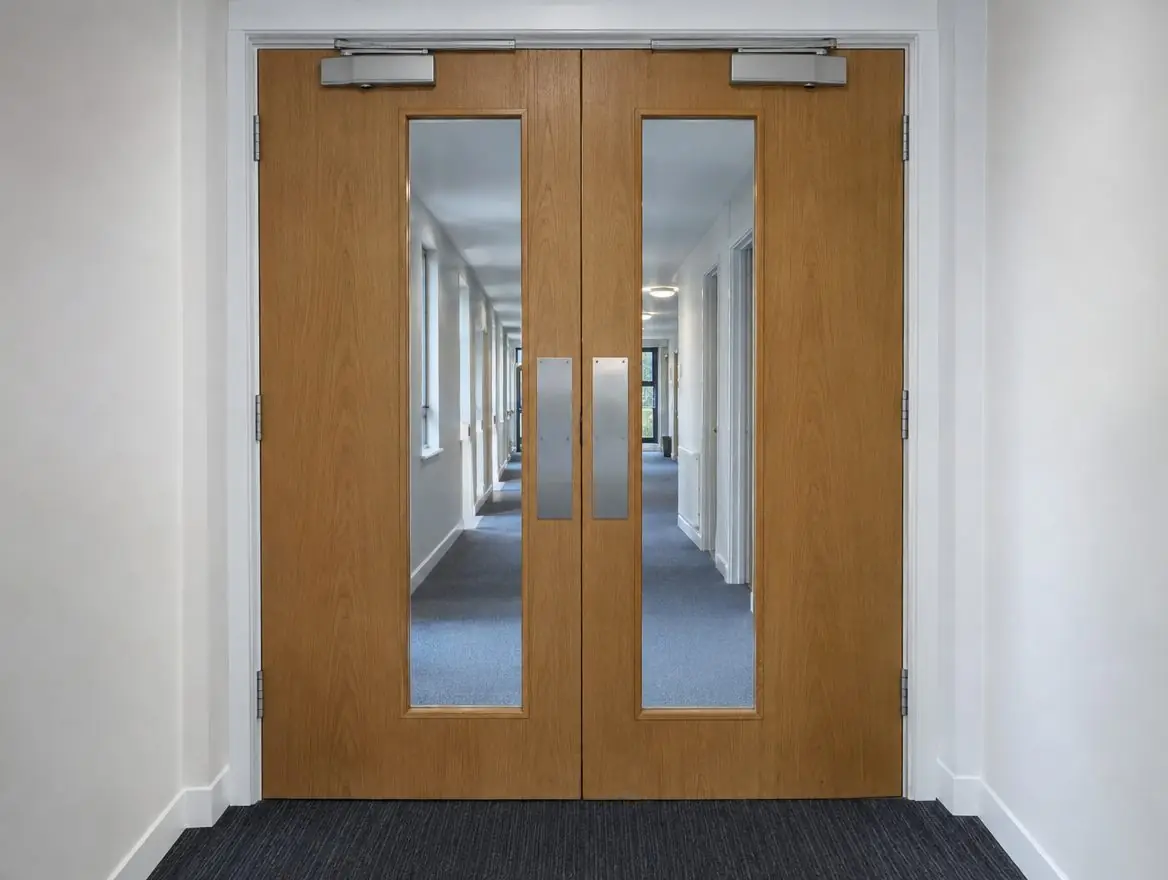
Getting communal fire doors right in King's Lynn
We provide communal fire doors in King's Lynn (PE30 and the surrounding postcodes), from the first survey through to a documented handover.
Buildings in and around King's Lynn range from light industrial buildings to care homes and houses with integral garages. Whatever the building, the standard is the same: certified products, correct gaps, seals and closers, and a frame sealed to the wall.
Communal corridors and stairs in King's Lynn buildings take the heaviest use, so we choose finishes and hardware that keep working between checks. The evidence pack for each communal door in King's Lynn is set out to support whatever checking regime your fire risk assessment sets.
How do you work in an occupied building?
Escape routes have to stay usable. We phase communal door work so that no stair or corridor is left without protection overnight, keep a doorset ready to fit before removing the old one, and agree working hours with the building manager. Where a hold-open device is needed, we coordinate with your fire alarm contractor for the release interface.
On a typical job that means:
- Phased programme keeping escape routes protected
- Tested vision panels and durable finishes
- Survey of every communal opening and its use
- Closers, coordinators and hold-opens as required
Rules and responsibilities in King's Lynn
Fire doors in King's Lynn fall under English rules. New and replacement doors are covered by the Building Regulations 2010 and Approved Document B. In workplaces and the common parts of blocks, the Regulatory Reform (Fire Safety) Order 2005, as clarified by the Fire Safety Act 2021, puts the duty on the responsible person to keep fire doors suitable and maintained.
For residential buildings in King's Lynn above 11 metres, regulation 10 of the Fire Safety (England) Regulations 2022 adds checks: communal fire doors at least every three months and best-endeavours checks of flat entrance doors at least every twelve months. Higher-risk buildings of at least 18 metres or seven storeys also come under the Building Safety Act 2022, where works may need approval from the Building Safety Regulator.
Buildings and duty holders in King's Lynn
The need for communal fire doors usually arises in hotels or sheltered and supported housing, and sometimes blocks of flats. Each has its own pressures, such as residents at home or a building that must stay open, so we plan the sequence of work in King's Lynn to keep escape routes protected throughout.
What happens after you enquire
- Survey communal doors and plan a phased sequence
- Agree working hours and resident notices with the client
- Order doorsets to size with matching hardware
- Replace doors one route section at a time
- Commission closers and hold-opens with the alarm contractor
- Hand over evidence for your fire safety records
Guide prices in King's Lynn
Budget around from around £800 for a single communal doorset to £3,200 for a glazed pair, ex VAT for communal fire doors. Our guide prices are the same in King's Lynn as elsewhere; what changes the cost is the doors themselves. Use our guide-price tool for a quick estimate.
King's Lynn and neighbouring towns
King's Lynn is about 62.4 km from Norwich, and we cover both, along with nearby Wisbech and March. Send us your postcode and we'll confirm survey dates.
Questions
Is King's Lynn within your coverage area?
It is. We cover King's Lynn in Norfolk and neighbouring towns such as Wisbech. There is no charge for the survey.
Do I need to be there for the survey?
Someone needs to give us access to the doors. For blocks and commercial buildings, a caretaker or site contact is fine; for HMOs and homes, we agree a time with you or your tenants.
How often should communal fire doors be checked?
In England, every three months for residential buildings above 11 metres under regulation 10. Your fire risk assessment may set other frequencies for other buildings and nations.
Can communal fire doors be held open?
Only with a proper hold-open device that releases the door when the fire alarm operates. Wedges and hooks are not acceptable. Electromagnetic holders or free-swing closers are the usual solutions.