
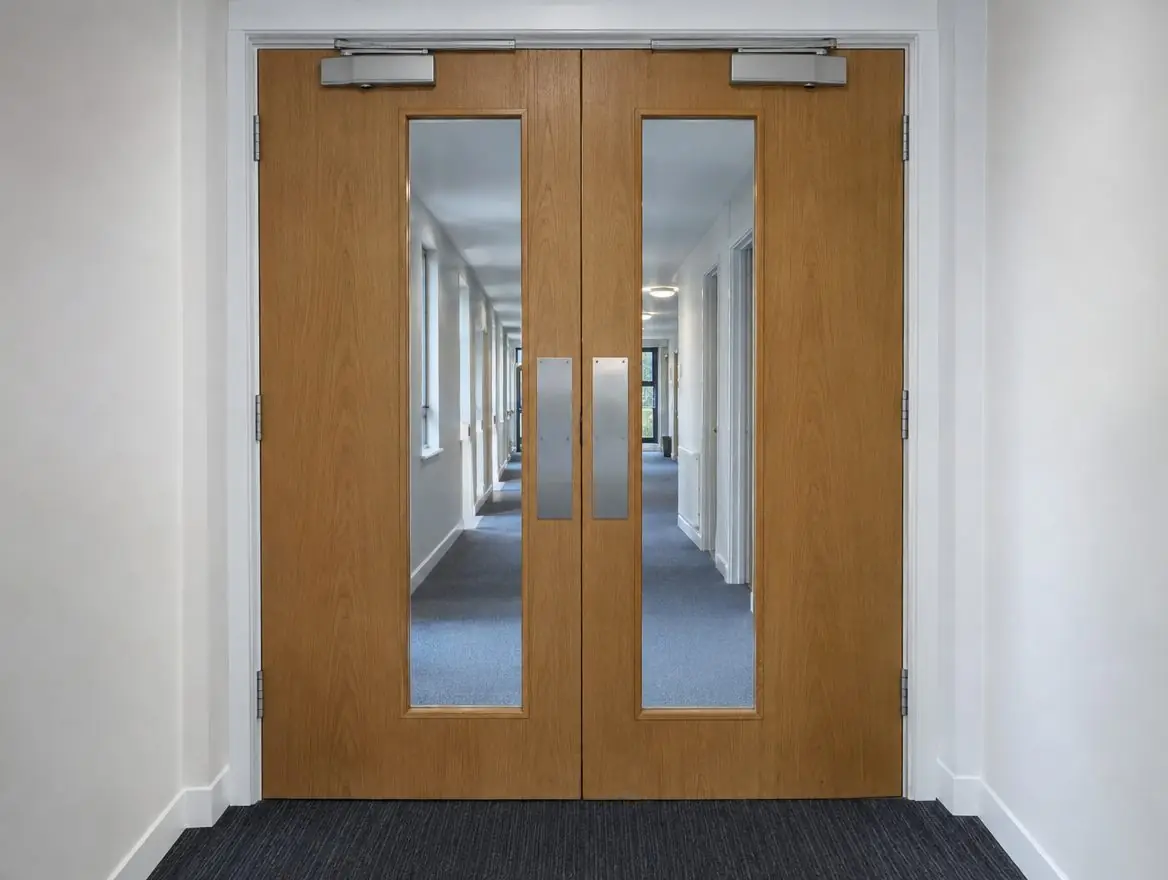
Communal fire doors: our service in Purley
We provide communal fire doors in Purley (CR8 and the surrounding postcodes), from the first survey through to a documented handover.
Purley has a broad mix of buildings, including hotels, clinics and restaurants, and the same fire door principles apply to all of them.
Communal corridors and stairs in Purley buildings take the heaviest use, so we choose finishes and hardware that keep working between checks. The evidence pack for each communal door in Purley is set out to support whatever checking regime your fire risk assessment sets.
What makes communal doors different?
Communal doors take far more traffic than flat entrance doors. They are pushed with trolleys, propped open and slammed. Many are pairs, glazed, or fitted with hold-open devices. That combination is why communal doors so often fail inspections for gaps, worn seals, damaged closers and doors that no longer latch.
In England, communal fire doors in residential buildings above 11 metres must be checked at least every three months under regulation 10. A sound installation makes passing those checks routine.
Each installation includes:
- Phased programme keeping escape routes protected
- Closers, coordinators and hold-opens as required
- Evidence pack suitable for regulation 10 records
- Survey of every communal opening and its use
What the rules say for Purley
The rules that apply to fire doors in Purley are England's. The responsible person under the Regulatory Reform (Fire Safety) Order 2005 must keep fire doors in non-domestic premises and the common parts of flats in working order; the Fire Safety Act 2021 confirmed that this includes flat entrance doors onto common parts. In London, the London Fire Brigade is the enforcing authority for fire safety law.
Where a Purley block is above 11 metres, regulation 10 of the 2022 regulations means communal doors are checked every three months and flat entrance doors annually on a best-endeavours basis. Replacement doors must also satisfy the Building Regulations, with Approved Document B as the guidance most building control bodies work from.
Buildings and duty holders in Purley
You are most likely to need communal fire doors if you look after sheltered and supported housing, blocks of flats or student accommodation. Whatever the building in Purley, we survey each opening and tell you which doors need work and which do not.
How a Purley job runs
- Survey communal doors and plan a phased sequence
- Agree working hours and resident notices with the client
- Order doorsets to size with matching hardware
- Replace doors one route section at a time
- Commission closers and hold-opens with the alarm contractor
- Hand over evidence for your fire safety records
What does communal fire doors cost in Purley?
Guide pricing for communal fire doors: from around £800 for a single communal doorset to £3,200 for a glazed pair, ex VAT. Volume work across several doors in one Purley building usually brings the per-door cost down. Your written quote is fixed once we have surveyed.
Nearby areas we cover from Purley
We also cover towns near Purley, including Coulsdon (2.7 km away), South Croydon and Wallington. If your building is in CR8 or a neighbouring district, the service and pricing are the same.
Questions from Purley
Do you cover CR8 and nearby postcodes?
Yes. We cover Purley including CR8, and nearby towns such as Coulsdon and South Croydon. The survey and written quote are free.
How quickly can you survey in Purley?
It depends on the number of doors and access, but we offer survey dates as soon as we reply to your enquiry. If an inspection has found urgent safety issues, tell us and we'll prioritise.
Do communal doors need vision panels?
Not always, but they are common on cross-corridor and lobby doors so people can see who is coming the other way. Any glazing has to be fire-rated and fitted in a tested system.
Can communal fire doors be held open?
Only with a proper hold-open device that releases the door when the fire alarm operates. Wedges and hooks are not acceptable. Electromagnetic holders or free-swing closers are the usual solutions.