
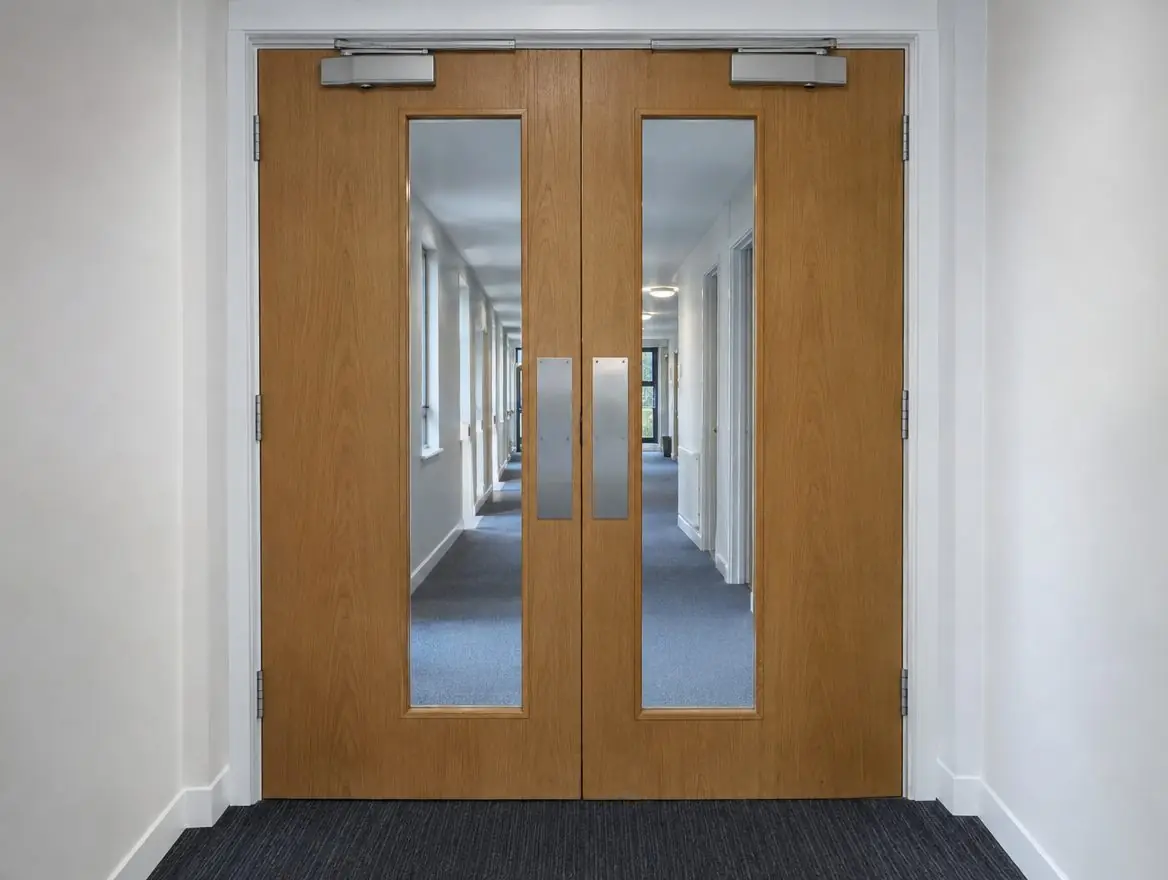
Getting communal fire doors right in Eastbourne
Our communal fire doors service in Eastbourne is simple: a survey, a fixed quote, certified products and an installation finished to the manufacturer's evidence.
Fire doors in Eastbourne protect escape routes in offices, converted period houses and schools alike. We adapt the programme to the building and its occupants, never the standard of the installation.
Communal corridors and stairs in Eastbourne buildings take the heaviest use, so we choose finishes and hardware that keep working between checks. We phase communal door replacements in Eastbourne so every escape route stays protected throughout the programme.
How do you work in an occupied building?
Escape routes have to stay usable. We phase communal door work so that no stair or corridor is left without protection overnight, keep a doorset ready to fit before removing the old one, and agree working hours with the building manager. Where a hold-open device is needed, we coordinate with your fire alarm contractor for the release interface.
On a typical job that means:
- Survey of every communal opening and its use
- Evidence pack suitable for regulation 10 records
- Certified single, double or leaf-and-a-half doorsets
- Closers, coordinators and hold-opens as required
Rules and responsibilities in Eastbourne
England's framework applies in Eastbourne. Approved Document B guides the fire performance of new and replacement doors under the Building Regulations 2010. Day-to-day duties sit with the responsible person under the Fire Safety Order 2005, and for multi-occupied residential buildings, the Fire Safety (England) Regulations 2022 add duties such as giving residents information about fire doors.
For blocks over 11 metres in Eastbourne, those regulations require communal fire door checks at least every three months and best-endeavours flat entrance door checks each year. In higher-risk buildings, building work is overseen by the Building Safety Regulator, so we check whether approval is needed before starting.
Buildings and duty holders in Eastbourne
Typical settings for communal fire doors include student accommodation, hotels and blocks of flats. In Eastbourne, as anywhere, the duty holder varies: a responsible person for a workplace, a landlord or managing agent for a block or HMO, or a homeowner after building work. We adjust access, timing and paperwork to suit whoever commissions the work.
From enquiry to handover in Eastbourne
- Survey communal doors and plan a phased sequence
- Agree working hours and resident notices with the client
- Order doorsets to size with matching hardware
- Replace doors one route section at a time
- Commission closers and hold-opens with the alarm contractor
- Hand over evidence for your fire safety records
What does communal fire doors cost in Eastbourne?
Guide pricing for communal fire doors: from around £800 for a single communal doorset to £3,200 for a glazed pair, ex VAT. Volume work across several doors in one Eastbourne building usually brings the per-door cost down. Your written quote is fixed once we have surveyed.
Eastbourne and neighbouring towns
Nearby towns we cover include Hailsham, Seaford and Bexhill-on-Sea. Distance from Eastbourne does not change our guide prices, and the survey and quote are free.
Common questions
Do you cover BN21 and nearby postcodes?
Yes. We cover Eastbourne including BN21, and nearby towns such as Hailsham and Seaford. The survey and written quote are free.
Can you work from an existing inspection report for my Eastbourne building?
Yes. Send it over and we can often price straight from it, then confirm on site. We report back against the same door references so you can close actions off.
Do communal doors need vision panels?
Not always, but they are common on cross-corridor and lobby doors so people can see who is coming the other way. Any glazing has to be fire-rated and fitted in a tested system.
Can communal fire doors be held open?
Only with a proper hold-open device that releases the door when the fire alarm operates. Wedges and hooks are not acceptable. Electromagnetic holders or free-swing closers are the usual solutions.